

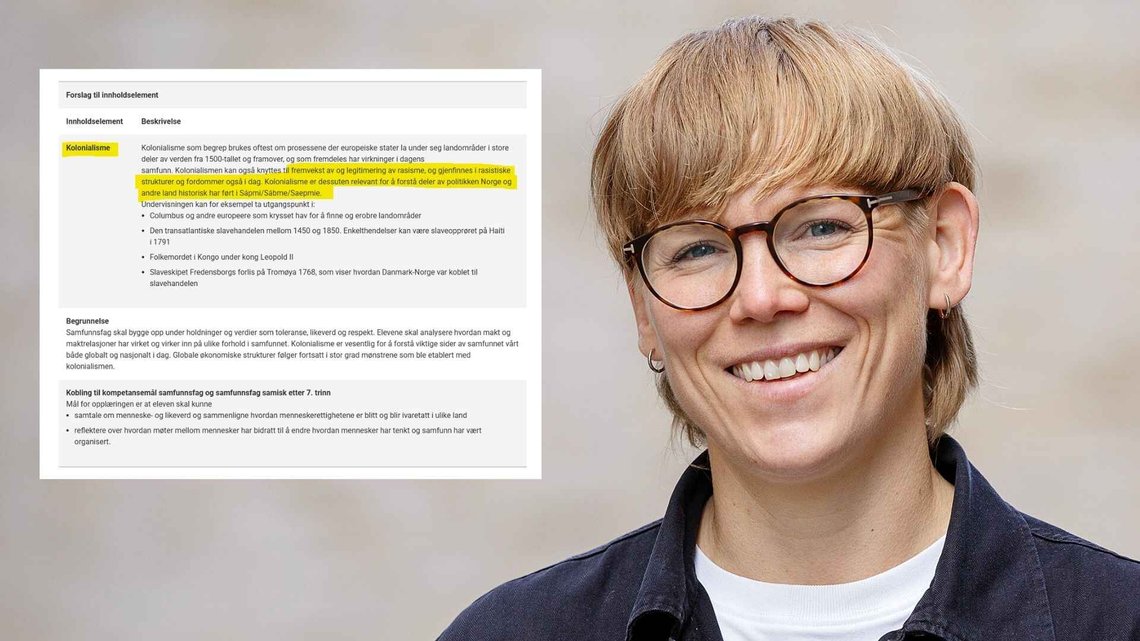
The Directorate for Education and Training’s (Utdanningsdirektoratet) new content list for social studies is alarmingly activist, and is intended to programme young children not to feel pride in their country, while racism and the oppression of the Sami are presented as central to our culture.
Strange outcomes arise when ideology is placed before subject matter. This is demonstrated by the new content list from the Directorate for Education and Training (Utdanningsdirektoratet). With postdoctoral fellow Elise Farstad Djupedal at the head of the subject group, they have revealed their own ideology in an alarming manner. Oil and Christianity are mentioned only in subordinate clauses for understanding our society. At the same time, enormous attention is devoted to a homosexual uprising in New York.
In social studies, the group is led by Elise Farstad Djupedal, postdoctoral fellow at NTNU. While Minister Kari Nessa Nordtun has repeated that “it is not politicians who determine the content”, I am not certain that it is much better to assign the matter to a postdoctoral fellow in pedagogy.
For this list is, to put it mildly, not a value-neutral enumeration of Norwegian history and Norwegian social conditions. It is an ideological document that views Norway from below and from the outside, through an academic framework in which colonialism, Norwegianisation (fornorsking), racism and power structures are the overarching lenses. And in which that which built the country—Christianity, oil, defence alliances and the development of prosperity—has been pushed out of the picture.
Let me demonstrate what I mean.
No Islamist terror
22 July 2011 has been given its own content element at lower secondary level. That is correct and natural. But observe how it is framed: pupils are to learn about “exclusion, echo chambers, racism and conspiracy thinking as possible explanations for the terrorist act”. The song “Påfugl” by Karpe is listed as a concrete teaching example.
Islamist terror? It is not mentioned. Not a single word. Not 11 September. Not Paris 2015. Not Nice, Manchester, Brussels, Stockholm. Not the ongoing Norwegian terror case involving the brothers who planned to bomb the American embassy in Oslo. Nor Matapour and Bhatti’s terror during Pride in 2022, which killed two people at a neighbouring pub.
The competence objective to which the list is linked states that pupils are to “account for causes and consequences of terrorist acts”. Terrorist acts—in the plural. Yet the subject group has chosen to specify only one type. Pupils are presented with a Norway in which the only terror that merits understanding is right-wing extremism.
This is not merely skewed. It is irresponsible in a time when the Police Security Service (PST) continually assesses the threat from extreme Islamism as high, and the entire West experiences the anger of radical Islam every single day.
The Christianity that disappeared
Norway came into being as a nation at the intersection of Christianity, law and geography. The Reformation altered power structures. Hans Nielsen Hauge’s lay movement democratised society from below. The Christian cultural heritage is inseparably linked to the development of Norwegian law, the Norwegian conception of humanity and the Norwegian welfare idea.
None of this is found in the content list for social studies. Christianity is mentioned once—in the section on the Viking Age, as something the Vikings “converted to”. The Reformation is not included. Hauge is not included. Christian cultural heritage as a formative force in society is not included.
Urnes stave church is mentioned as a cultural monument, not as an expression of Christian culture. Sami sacrificial sites, by contrast, receive detailed descriptions.
On top of this come the most peculiar descriptions, when the academics evidently have no grounding in our shared value norms. The Hagia Sophia church is one of the most significant in the world. It was consecrated as a church as early as 537.
Yet it is now referred to as a mosque. In the content list it states:
“The Viking expeditions. Sources may include the runic inscription ‘Halvdan was here’ in the mosque Hagia Sophia in Miklagard.”
But it was a church when Halvdan carved his runes.
On a list intended to provide “common frames of reference”, this is a remarkable choice. Common for whom?
Never mind, oil is merely wasted time
The Ekofisk discovery in 1969 transformed Norway. The petroleum industry is the reason the welfare state was expanded, that the Government Pension Fund Global exists, that Norway today is one of the world’s richest countries. It is the single most important factor in modern Norwegian history.
At the time of writing, news emerged that Equinor alone pays 204 billion kroner in tax. That amount funds the entire state budget for education and research. Twice over.
The history of oil is not included in the content list. The Oil Fund is mentioned in a subordinate clause under “welfare state”, but the petroleum adventure itself, the discoveries, the policies, the dilemmas and not least those who sacrificed life and health to build it, are not mentioned.
Instead, the subject group has prioritised a separate content element on the textile industry, with rubbish heaps in Atacama and Accra as examples. And a separate content element on the Fosen case, concerning wind power versus reindeer husbandry. The oil that actually built the country pupils live in? No, it is not deemed worth mentioning.
The Cold War no longer fits
No Cold War. No NATO. No Berlin Wall. No fall of the Soviet Union. No communism. No liberation of Eastern Europe. It is difficult for pupils to understand the context of how Norway has built alliances and secured itself against communist influence from the Soviet Union if this is omitted.
The list jumps from the Second World War directly to “decolonisation”. As if it were decolonisation movements in Asia and Africa, and not the Western defence alliance, that shaped the post-war period for Norway.
And otherwise, dear pedagogical experts: Norway has not had colonies!
Immigration is “mobility”
Perhaps the most striking omission is this: immigration as a societal issue is not included. Not for lower secondary. Not for middle primary. Not at all.
Migration is mentioned once, under “Where do I belong?” for Years 1–2—as “mobility and relocation”. The scope of immigration, its consequences, integration challenges, parallel societies and costs?
It does not fit. The focus is instead on Norway’s guilt for colonialism, and that immigration in practice is mobility and relocation. You see, it is the same when I move from one municipality to another as when Afghans travel 5,000 kilometres as the crow flies to seek asylum in Norway.
But “racism and anti-racism” have been given their own content element, with five concrete teaching proposals, including “right-wing extremism and neo-Nazism” and “the King’s speech in Slottsparken”. Pupils are thus to learn that racism is a structural problem in Norway—but they are not to learn about the phenomenon that has made integration policy one of the country’s greatest societal challenges.
“Racist structures” for 12-year-olds
Under colonialism (Years 5–7) we find this formulation: “Colonialism can also be linked to the emergence of and legitimisation of racism, and can be found in racist structures and prejudices also today.”
“Racist structures” is not a neutral academic concept. It is a concept from critical race theory—a wholly new and radical framework that understands the entire social order as permeated by structural racism.
That this is presented as an obvious fact for children aged 10–12 says much about the ideological starting point of the subject group.
One of the foremost proponents of “critical race theory”, which sounds like a parody of the skull measurements of Jon Alfred Mjøen more than a hundred years ago, is Sandra Fylkesnes. She has written a text that demonstrates how this type of academic thinks. “Whiteness” is a form of racism that permeates everything we do.
When we expect good behaviour from others, it is in reality a form of racism, because we regard “whiteness” as the norm.
Under “decolonisation” for lower secondary, this becomes even clearer: “In a broad sense, decolonisation entails challenging power structures that persist after colonialism and a Eurocentric worldview and knowledge perspective.” And further: “Social movements working for decolonisation today.”
This is political activism formulated as learning objectives.
If in Norway we are not permitted to have a Norway-focused worldview, or to be proud of Western civilisation and the structures built through generations of hard-working, outstanding people, then most things are turned upside down.
It is, after all, legitimate to ask why Western, European countries are by far the best in the world. And if one attempts to explain this by colonies, one fundamentally lacks the capacity for reasoning.
Homosexual uprising for 12-year-olds
Under the content element “Women’s liberation” for Years 5–7—that is, for children down to 10 years old—we find among the concrete teaching examples: “Parallels to other social movements such as the gay movement (the Stonewall uprising)”.
The so-called Stonewall uprising is one of the modern myths that has begun to gain strong traction, particularly among those who consider homosexual liberation a central part of our history. The reality is that the gay bar Stonewall Inn in Greenwich Village in New York was not the first uprising of homosexuals against the police and discrimination. It was, however, a mafia-owned bar where there was considerable violence, drugs and extortion.
A wide range of myths have been constructed around this uprising in the aftermath, as woke academics have searched with a magnifying glass for something to glorify in their historical narrative. One of them is that Judy Garland’s death triggered the uprising. But this has been thoroughly refuted.
The competence objective to which it is linked concerns “variations in identities, sexual orientation and gender expression”. For 10-year-olds.
Already for Years 1–2 (ages 6–7), “children’s rights” are linked to the competence objective “to talk about feelings, body, gender and sexuality”. The list also uses the term “functional variation” (funksjonsvariasjon)—a norm-critical neologism replacing disability.
1814—a lesson in guilt
The Constitution of 1814 is fortunately included. But observe how it is framed: “Nation-building also had a downside. It laid the foundation for an intensified Norwegianisation policy towards the Sami and national minorities, and the constitution denied Jews access to the realm.”
Norwegianisation (fornorsking) has additionally been given its own content element (Years 8–10), with six detailed teaching examples, including “invisibilisation, devaluation, shame and minority stress”.
The pattern is consistent throughout the list: every time something Norwegian and nation-bearing is mentioned, it is immediately followed by a “but” with a shadow side. The Constitution, but the Jewish clause. Nation-building, but Norwegianisation. Democratisation, but exclusion of minorities.
This is not historical integrity. It is a perspective. A perspective in which the Norwegian community is always, first and foremost, something we are to feel ashamed of.
Who produced this?
The head of the social studies group, Elise Farstad Djupedal, is a postdoctoral fellow at NTNU. Her academic publication list reveals a researcher with clear interests: in 2018 she published, together with Stine H. Bang Svendsen and Elisabeth Stubberud, the article “Skeive ungdommers identitetsarbeid: SKAM etter homotoleransen” in Tidsskrift for kjønnsforskning, as well as the English version “Becoming Queer after Homotolerance”.
Svendsen is also at NTNU. Her publications include “Learning racism in the absence of ‘race’”, “Decolonial Options in Education”, “White Migrations: Gender, Whiteness and Privilege” and “Undoing Colorblindness in Nordic Gender Studies”. Stubberud, also affiliated with NTNU, is co-credited on several of these works.
This is the academic environment from which the subject group leader for social studies originates. An environment in which “decolonisation of education”, “whiteness” and “the limits of homotolerance” are central research questions.
Should politicians intervene?
The Minister of Education has repeated that she had not seen the content of the lists before they were presented. “It should not be politicians who determine the content,” she said. It sounds democratic. In practice, it means that a small academic environment—characterised by postcolonial theory, norm-critical pedagogy and identity politics—has been given free rein to define what constitutes “common references” for Norwegian children.
The result is a list that resembles a reading list for a university seminar in gender studies and postcolonial theory—not a proposal for what Norwegian children should know about the country in which they live.
The list is to be “guiding”. But as the leader of the Education Association (Utdanningsforbundet), Geir Røsvoll, himself says: “Soft governance tools can influence what is perceived as important in the subjects.” Precisely.
When the state defines the Stonewall uprising, racism and the Sami as common references—while omitting oil, NATO, Christianity and Islamist terror—then it is no longer guidance. It is ideological instruction.
The consultation is open until 17 April. It is time for ordinary people, not only academics from NTNU, to express their views on what Norwegian children should actually learn.


