

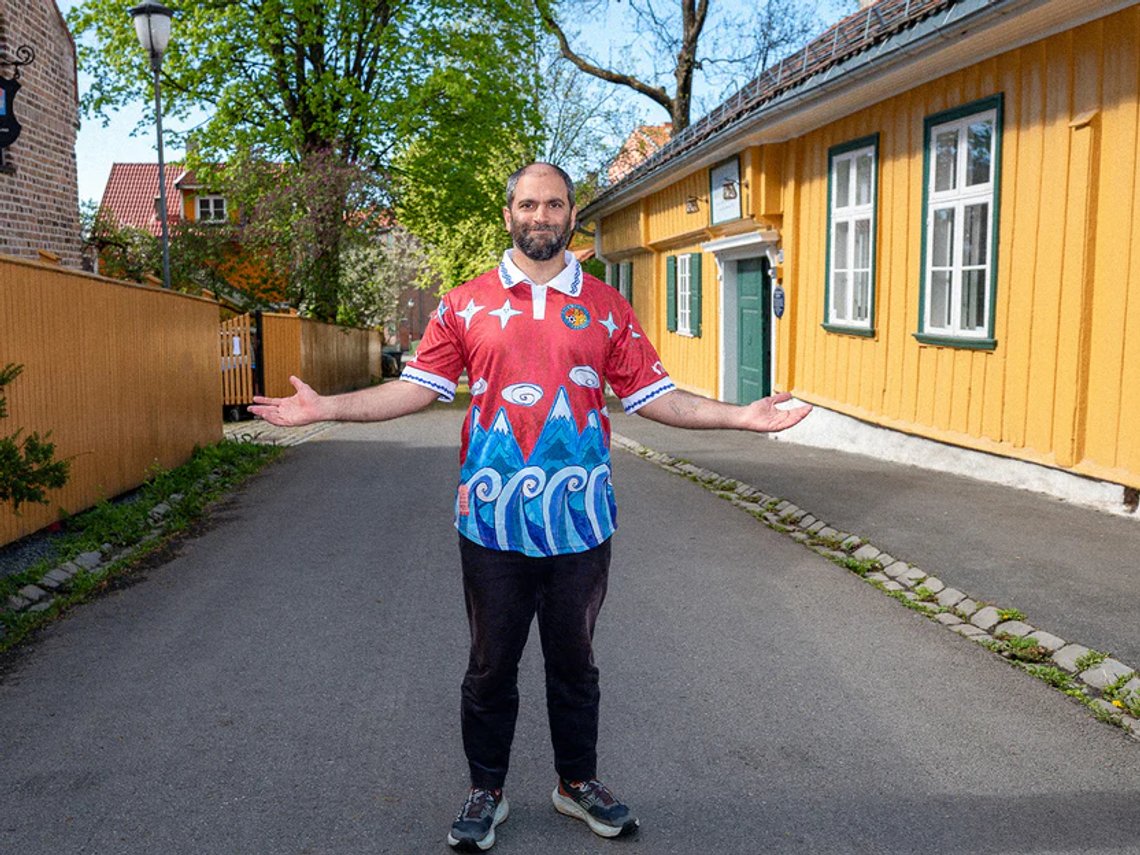


Amir Asgharnejad thinks the shirts worn by Norway’s football heroes are “ugly, frightening and nasty”. The lions in particular scare him out of his wits. He has therefore created his own version, which is enjoying a certain degree of success.
– They have two lions embroidered above the flag here, and they simply look absolutely terrifying, Asgharnejad tells an enthusiastic NRK, pointing to his chest.
It took NRK only about a week to copy the story, which had previously been covered by E24. There we learned that the shirt was created in collaboration with Eirik Bilet and Bjørn Asgeirssjon. Fine work by a public broadcaster with an annual budget of nearly NOK 8 billion, financed by us taxpayers through coercion.
The lions in Norway’s coat of arms symbolise royal authority, courage and strength. King Håkon Håkonsson introduced the lion emblem on his seal around 1220, and it became a symbol of Norway as a united and powerful kingdom in Europe. These evil figures have been replaced by friendly lions.
 Amir Asgharnejad’s Norway shirt has friendly lions. Photo: Amir for Norge website
England’s national team is even more lion-friendly, which is why the English team is known as the Three Lions.
The “Three Lions” primarily symbolise the English coat of arms and are historically associated with the royal authority, courage and majesty of the English monarchy.
The three golden lions on a red background were introduced in the twelfth century by the war hero and crusader King Richard the Lionheart (Coeur de Lion), and originally represented the combined territories of the Angevin Empire: England, Normandy and Aquitaine.
Over the centuries, the emblem became a global symbol of English identity and is now widely recognised as the coat of arms of England’s national football team and the British royal family. Even in a super-woke England, no one protests against the ugly, nasty and frightening shirt worn by Kane & co before a match.
Even globalists and socialists such as Prime Ministers Jonas Gahr Støre and Keir Starmer wear the national team shirt in an attempt to win votes.
 Video still/Instagram
King Håkon Håkonsson led the Birkebeiners and brought an end to the civil wars in Norway, which had lasted for more than a hundred years, from 1130 to 1240. During his reign (1217–1263), Iceland and Greenland were brought under the Norwegian Crown. Håkon was even proposed by the Pope as Holy Roman Emperor around 1250.
Norway’s national team shirt looks nasty, according to the Iranian, who also suffers from a certain fear of Batman.
– It looks a little as though they have been taken from a Batman film. And Batman is a little nasty. Even though I like Batman, he looks nasty, says the artist.
Batman fights criminals, and that is not an activity everyone likes. Defund the Police and open borders feel more just to the radical and self-hating left throughout the West.
We know this well from the United States in particular. But Norway’s national team has enjoyed great success in the World Cup so far, and the Norwegian supporters have been extremely well received and praised both by the public and by a number of media outlets in the country that the entire Norwegian media establishment loves to despise.
Asgharnejad has found his solution: He has created a “friendly” national team shirt, and is proud of the star-shaped smiley faces drawn by his daughter. Naturally, the Iranian’s shirt does not feature the frightening Norwegian flag as its main motif!
NRK’s Iranian hero wanted to create a shirt “that could unite us and perhaps not divide us. Or divide me.”
– And this shirt has united a great many people. It is rather cosy.
 Amir Asgharnejad in the national team shirt of his own design. Photo: Amir for Norge website
How on earth is the population united when people of different ethnic backgrounds cannot even rally around something as simple as a national team shirt worn by our football heroes in their first World Cup for 28 years? Is this an example of the incomprehensible concept of integration?
Many have chosen the “friendly” version, according to Amir and NRK. More than 6,000 have embraced the shirt. So far, Asgharnejad and the group behind the project have generated sales of well over NOK 4 million. This is merely a drop in the ocean compared with the sales figures for the original shirt, but it is nevertheless a success that deserves some praise.
But Asgharnejad, who is evidently goodness personified, does not wish to talk about money. He claims that his version of the shirt was inspired by our Constitution Day and never imagined that it would become a bestseller.
– I thought of 17 May. Every time we gather in the square and sing the national anthem. That feeling is very good, he says.
Apparently one has to go all the way to Iran to find a worthy pride in Norway. There one finds people such as Asgharnejad, who finds it uncomfortable to talk about money.
– I find all that money business so uncomfortable. Making things is like clear water. You simply dive into it and it feels wonderful. But once you put money into it, it becomes murky.
Why does he not give the shirts away for free if money is so unpleasantly murky? After all, his sole aim is to spread joy by removing the Norwegian flag and changing the frightening lions on the shirt worn by Haaland & co. Perhaps Asgharnejad also wants Norwegian supporters to stop rowing? Should they not sail instead? It is less noisy and not as brutal and frightening as rowing.
Or should those who love Norway’s national team travel around in a luxury yacht powered by Iranian fuel? Preferably without Viking attire, of course.
“The Dream Shirt”
His version has been given the name “The Dream Shirt” by some people (presumably Amir himself).
– I have been stopped so many times in the street. It is very strange and fun. I have never connected with people in this way before, he says.
Yes, no doubt quite a few people dream of a Norwegian national team shirt without the cross, the flag and references to ancient history. Today, the multicultural paradise is to be celebrated and promoted at any cost.
NRK journalist Haakon Nesse Moreau appears enthusiastic and has dug up a Norwegian D-list celebrity who likes the shirt without the flag and cross, decorated with friendly lions.
– I am most disappointed with the home shirt because that is the one I expect the most from, Tobias Mannes says of the official national team shirts.
The entirely unknown Mannes appears to be a music therapist and a member of the band Environ, which has two songs on Spotify that almost no one has heard of. Mannes also thinks Amir’s shirt is “friendly”.
– I think Amir is very funny, and he had a very good message with friendly lions and friendly motifs. And it was accessible. Even the waves are friendly. They are not the kind of waves that want to kill you. They are waves that want to embrace you.
Iranian waves are what Norway needs, in other words.
The Norwegian Football Federation naturally bows to the alternative, flagless shirt. The marketing director of the Norwegian Football Federation (NFF), Jan Ove Nystuen, says in all seriousness that it is not inconceivable that we might see the national team in “The Dream Shirt”, although it would have to be outside official matches.
I shall not be dreaming of Amir Asgharnejad’s anti-Norwegian shirt when Norway face England in the quarter-final on Saturday evening. Two teams, both wearing lions on their chests, will battle for a place in the World Cup semi-final!
Personally, I shall wear the same shirt I wore at the Stade Vélodrome on 23 June 1998, when Norway defeated Brazil.


