

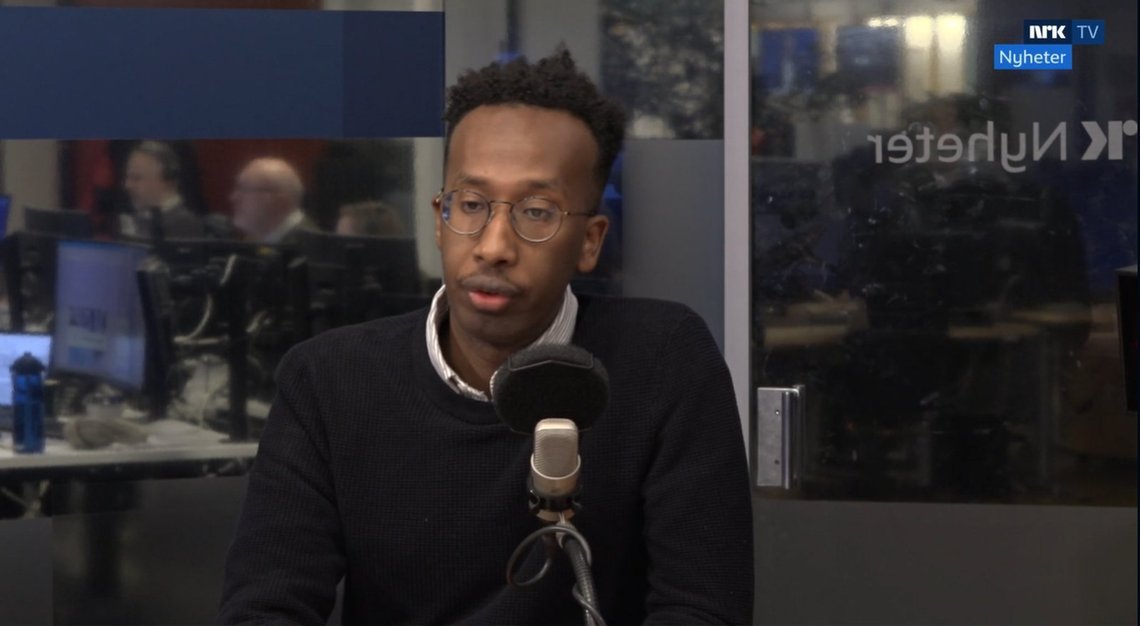


AUF leader Fawzi Warsame wants 10,000 refugees to come to Norway each year. He paints a rosy picture of immigration from different cultures, and wants to spend even more of the public purse. The real consequences are flatly dismissed.
«This weekend, you were presented with two very different stories about immigration to Norway»
This is how presenter Bjørn Myklebust opened Politisk kvarter on Tuesday 20 October at 07:45.
The Progress Party (FrP) had highlighted the challenges posed by non-Western immigration and the failure of integration.
The new AUF leader, Fawzi Warsame, strongly disagrees and had stated that “the FrP’s days as Norway’s largest party are over”.
To illustrate how well he believed integration was going in Norway, he used himself and his family as an example, explaining how his parents had fled from Somalia to Norway and become integrated, and argued that the FrP was painting a bleak picture of the situation.
When asked by Myklebust why he had told the story about his parents, Warsame explained as follows:
“I want to tell that story because I want to show that when Norway takes a chance on all the wonderful people who come to this country, things can turn out well. And when we also have so many people helping to keep the wheels of the welfare state turning – working in factories, driving taxis and buses – then we demonstrate that Norway’s broad diversity has the potential to succeed when we choose to invest in them, and we choose to spend significant resources on integrating as many people as possible into the wider Norwegian community – the wider community that has helped make my family’s and my dream of being part of this society possible.”
With this as a starting point, he and the AUF want to admit 10,000 quota refugees a year.
Ignoring the realities
Warsame was born in Norway, trained as a lawyer and works as an associate at EY, specialising in tax law. He is an articulate speaker and comes across as a prime example of successful integration into Norwegian society.
However, in his first debate with the new FpU leader, he refused to discuss the realities, focusing solely on the possibilities – and using himself and his family as a model. When the FpU leader justified his position with facts, Warsame elegantly swept them under the carpet.
His focus was on the positive side of the coin. He pointed out that 50 per cent of young people with immigrant parents went on to higher education and claimed that unemployment among immigrants in Norway is the lowest in the Nordic region.
Whilst the issue of integration primarily concerns non-Western immigrants in general and immigrants from Islamic countries in particular, Warsame chose to include all immigrants, including Westerners, whenever it suited his purpose, as if European engineers and illiterate Africans were one and the same.
Consequently, Warsame and FpU leader Sebastian Ytrevik were discussing two different things.
Will spend more money
“The Norwegian dream is still possible, but we need to have money on the table. We need to invest substantial funds in integration so that people can enter the labour market, so that people become part of Norwegian society and the wider community», Warsame continued.
He conceded that the Labour Party’s refugee policy is strict and fair, but points out that he and the AUF will place greater emphasis on fairness. And fairness, in Warsame’s view, means more immigration and more spending on integration, whilst “the cost will be borne by the average Norwegian via their tax bill, or in the form of reduced capacity or quality in various welfare services», to quote chief researcher Erling Holmøy at Statistics Norway (SSB), in *Finansavisen* in 2013.
Warsame repeatedly cites his own experience as a trainee solicitor as an example of successful integration in Norway.
Nor does he accept that immigration from poor countries creates inequalities, but instead points to the high cost of living.
If Warsame is not telling outright lies, he is presenting a distorted version of reality that comes very close to it.
The glossy image cracks
The realities that Warsame avoids, glosses over or dismisses as lies and doom-mongering can be seen in the official figures. There is not much to boast about there, and certainly not for the diaspora to which he himself belongs – residents with a Somali background.
The Somali diaspora in Norway is the fifth largest, after Poles, Ukrainians, Lithuanians and Syrians. At the start of the year, it numbered 44.,744 individuals, comprising 27,769 immigrants and 16,975 Norwegian-born descendants.
Figures from Statistics Norway puncture the rosy picture Warsame tried to paint. The immigrant group to which his parents and he himself belong is the least well-integrated in Norway, measured in terms of employment and crime.
Only 29 per cent of Somalis in the 20and 66 who have lived in Norway for seven years or more are in full-time employment. This means that more than seven out of ten Somalis of working age, who have lived in Norway long enough to be eligible to apply for Norwegian citizenship, are unable to support themselves. These people are over-represented among recipients of various forms of benefit.
Muslims at the bottom
When Warsame talks about all the wonderful people who keep the wheels of the welfare state turning – those working in factories, taxis and buses – he cannot possibly be referring to the majority of working-age people in the following diaspora communities.
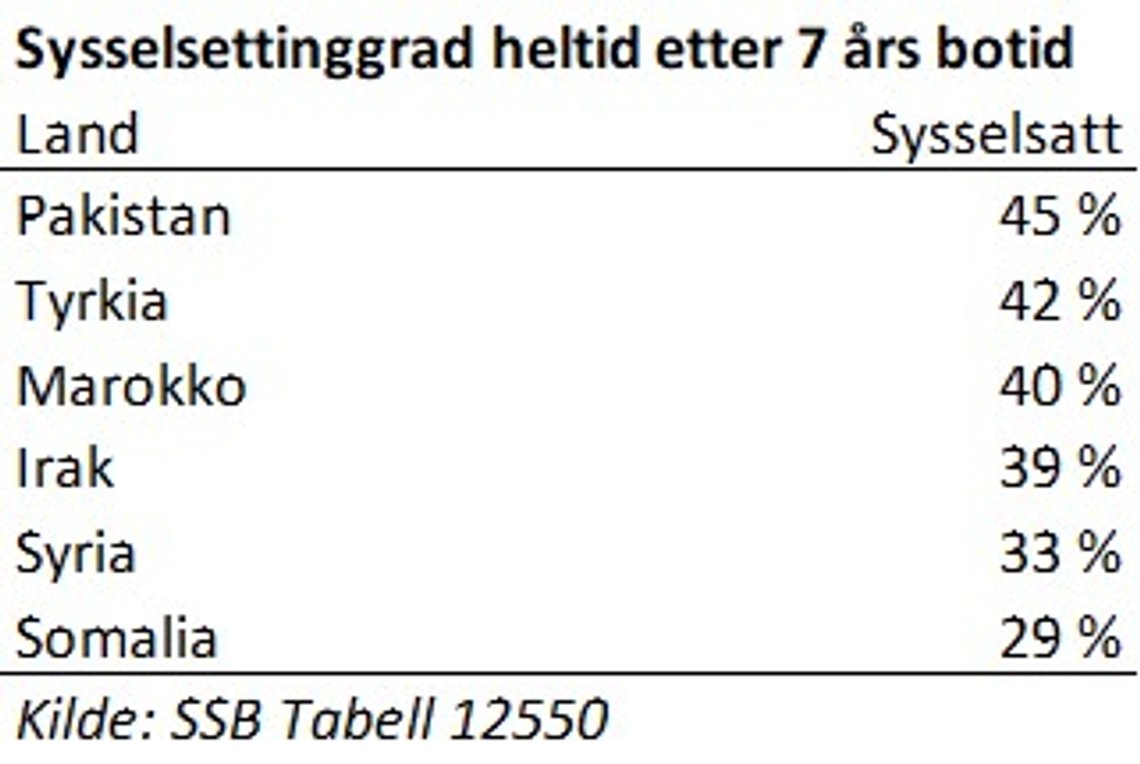
The table shows which diaspora groups in the 20–66 age group are at the bottom of the table for full-time employment. These are exclusively Muslim countries, and at the very bottom we find the Somalis.
A full-time job is normally what is required to support oneself and one’s family in this country. Normally, a family ideally needs both parents in work to make ends meet. But not amongst Somalis. As Warsame says, “we choose to spend the big money on integration”, even after seven years’ residence, which qualifies them for citizenship.
The contrast
When Warsame paints a rosy picture of integration and thereby glosses over how poorly the integration of migrants from Islamic countries is going, even after seven years’ residence or more, he deliberately uses the term ‘immigrants’.
Many immigrant groups in Norway are doing well. Whilst we showed the bottom of the employment table above, the top looks like this for the same age group.
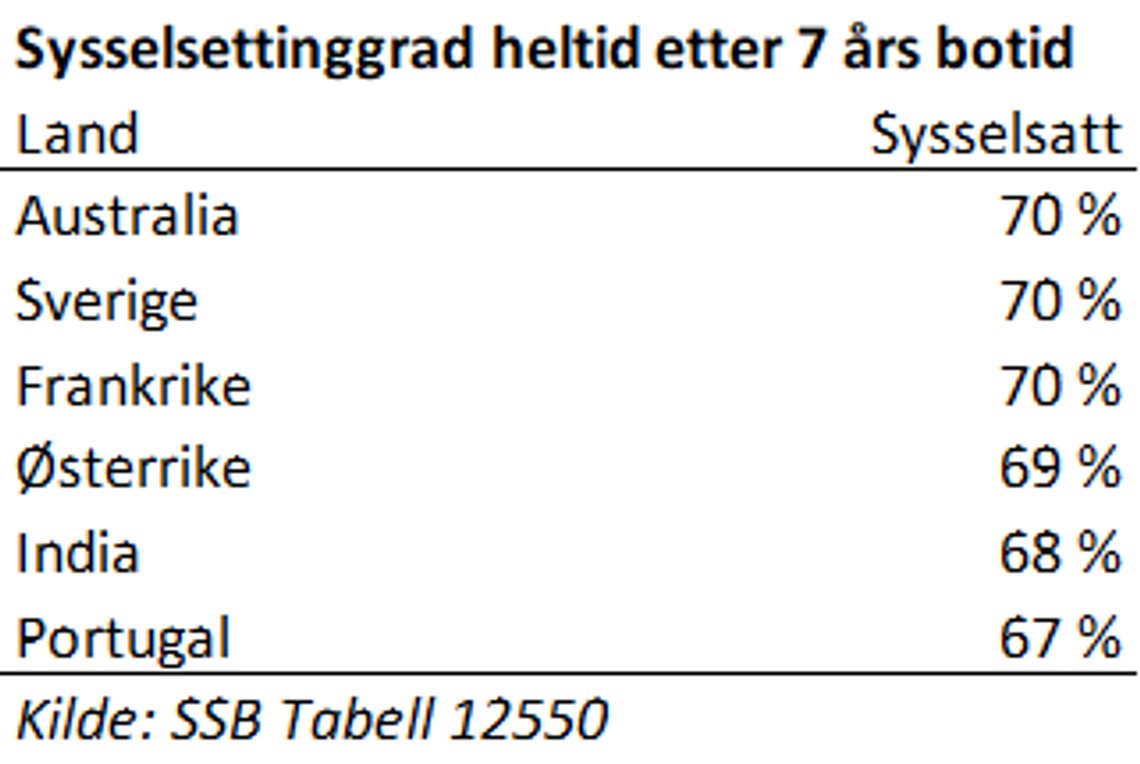
The table shows that an immigrant from India is more than twice as likely (68% / 29%) to be in full-time employment in Norway after seven years’ residence than an immigrant from Somalia.
This contrast is what the costs of immigration and a lack of integration are all about. But Warsame refuses to face up to reality. He is a smooth talker and managed to sidestep Bjørn Myklebust’s questions even when they were repeated.
The most violent group
Another indicator of integration – or the lack thereof – is crime.
Fawzi Warsame belongs to the most criminal diaspora in Norway – Norwegian-born descendants of immigrants from Somalia. They top the table for charges relating to violence and assault.
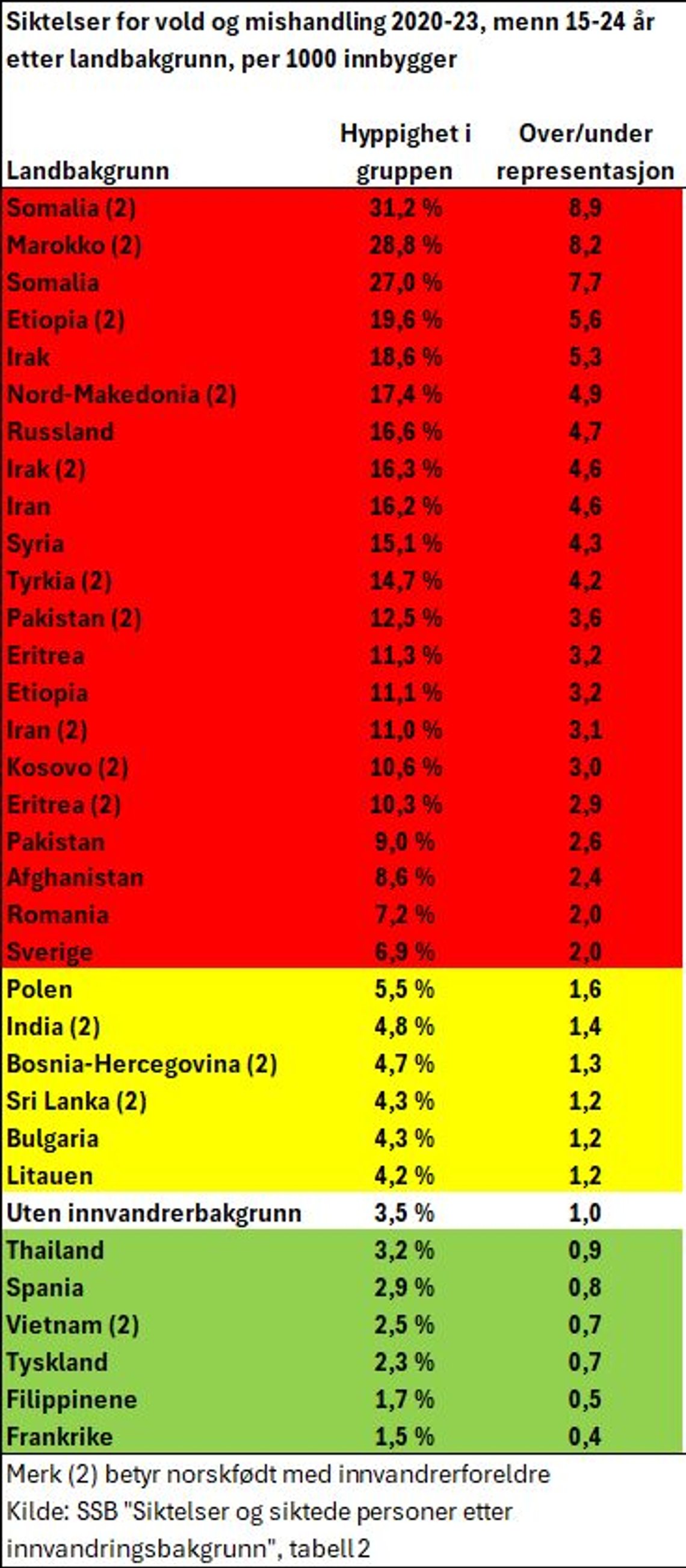
In the period 2020–23, there were 312 charges of violence and abuse per 1,000 residents in this group. This represents an over-representation in violent crime of almost nine times (8.9) compared with citizens without an immigrant background.
After Norwegian-born individuals with Moroccan parents, the diaspora to which Warsame’s parents belong – immigrants from Somalia, with a charge rate of 27 per cent and an over-representation of 7.7 times.
The group comprising Somalis and Norwegian-born individuals with Somali parents includes many hyper-offenders facing numerous charges of violent crime. Consequently, the table should not be interpreted to mean that 3 in 10 people of Somali origin are violent offenders. However, there is no getting away from the stark over-representation of Somalis in the violence statistics.
These are facts that Fawzi Warsame must be aware of if he is to maintain his credibility in the debate on immigration and integration.
Clan societies
In Sweden and Germany, it has been revealed how criminal clan networks have infiltrated public institutions. In Norway, evidence has recently been presented showing how criminal networks have infiltrated the child welfare services.
During her recent speech to the national executive committee, FrP leader Sylvi Listhaug addressed clan culture in Norway and called for Norway must map the extent of criminal organisations and clans.
This provoked reactions from, amongst others, Minister of Justice Astri Aas-Hansen, who believes Listhaug is painting a bleak picture of the situation and helping to create fear.
However, Aas-Hansen herself stated that criminal networks must be uncovered in all police districts, when the South-East Police District revealed how criminal networks had infiltrated the child welfare services there.
On that occasion, however, the message was put forward by Pål Lønseth, head of the Economic Crime Unit, who had previously served as State Secretary in Jens Stoltenberg’s second government. Consequently, it may appear as though the Minister of Justice’s view on the issue depends on who is delivering the message.
Document asked KI to rank the ten countries in the world with the most pronounced clan culture, and received the following ranking:
- Somalia
- Yemen
- Libya
- Afghanistan
- Iraq
- Sudan
- Pakistan
- Chad
- Mauritania
- South Sudan
The top nine places are occupied by Islamic countries. The three characteristics that define the most pronounced clan societies are as follows:
-
Collective protection: The family or clan is expected to assist members in conflicts and in the event of threats.
-
Informal legal system: Elders and traditional councils may mediate in disputes alongside or instead of the state courts.
-
Distribution of political power: Clan or tribal ties influence who gains representation, positions and access to resources.
The study highlights Somalia as the most typical clan-based society, where direct clan structures are woven into both community life and national politics.
There is a clear correlation between the degree of clan culture and the inability or unwillingness to integrate in Norway. This is a lesson that Fawzi Warsame should bear in mind before the next debate on immigration and integration. And if one wishes to achieve the greatest possible integration per krone spent from the substantial funds he says he intends to allocate from public resources to this end.


