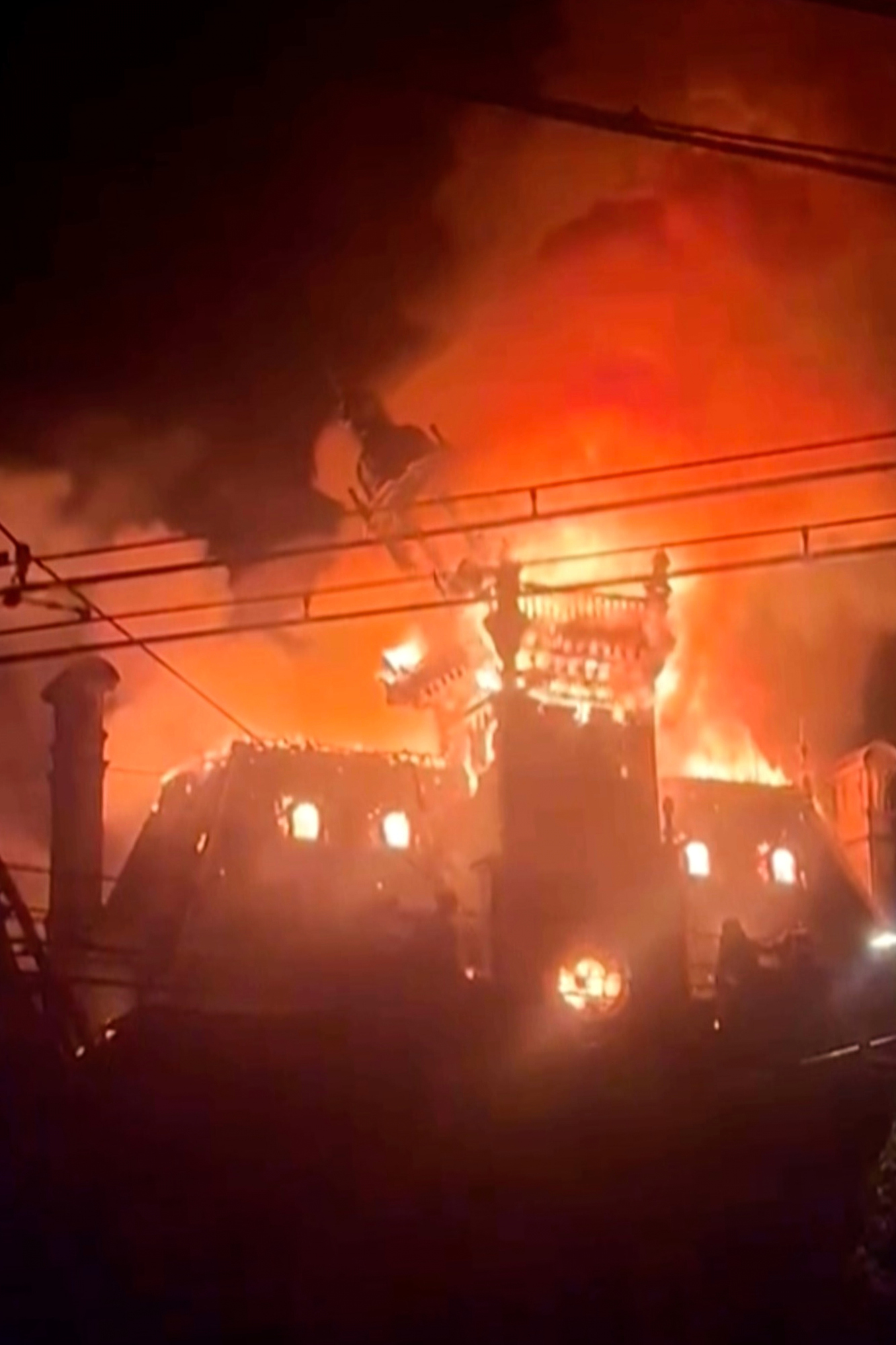
Limoges Town Hall in France is on fire on 17 October 2026. Still image from video: Lucas Destrem via AP/NTB.
Beautiful historic buildings such as Limoges Town Hall are being burnt down; desperate shopkeepers try in vain to prevent masked protesters from looting their shops; innocent bystanders who appeal for an end to the destruction are attacked; and the police are driven out of the scenes of chaos.
It is no longer a secret that immigrants and far-left extremists are the driving force behind the violence. The images do not lie: the vast majority of demonstrators have dark skin, the Palestinian flag is flying everywhere, and the French government and police accuse Mélenchon’s left-wing party, LFI, of mobilising the masses.
You can see for yourself the thousands of videos circulating on X. Thank goodness for Elon Musk and his fight for freedom of expression against the censorship of the reality experienced by ordinary people, because we get little help from large, state-funded media organisations such as DR. Ordinary people see things with their own eyes on platforms such as X, whilst DR viewers only see them through a filter of concealment, distortion and denial.
The unrest has also spread to Belgium and Italy, amongst other places. This follows the logic of the spiral of violence and radicalisation – indeed, civil war – characterised by unpredictable and rapid spread to other countries.
This can happen spontaneously through inspiration, but also through networks sharing contacts, experiences and forms of mobilisation across national borders. The wildfire of violence knows no border barriers.
The relevance of Enzensberger
A fresh look at Hans Magnus Enzensberger’s idea of ‘molecular civil war’ from the book *Aussichten auf den Bürgerkrieg* (1993, published in Norwegian the following year under the title *Borgerkrig*) is illuminating in this context.
Enzensberger’s idea is that a society can begin to disintegrate into violent conflicts before there are any organised fronts, armies or a declared civil war. Violence is scattered throughout society amongst gangs, hooligans, arsonists and individuals who attack others and destroy public buildings and infrastructure.
The term ‘molecular’ therefore refers to the scattered and, for the time being, limited form of violence.
The majority still desire peace and lead reasonably normal lives, but a minority can undermine the conditions for peaceful coexistence. Enzensberger writes that it is probably enough for just one in a hundred to want to make civilised coexistence impossible.
But the violence cannot be curbed. A sense of insecurity is rapidly taking hold in everyday life. Reuters describes how shops closed, tourists fled and the metro station by Milan Cathedral was shut during the spate of violence. Videos have shown how innocent people are trapped in the French metro whilst fireworks are fired at them.
All this illustrates – for the time being only on a small scale – the breakdown of peaceful everyday life.
The loss of achievable goals
Moreover, the civil war begins without mobilisation or a declaration of war. The signs are, first and foremost, everyday in nature: vandalism, damaged public facilities, threats and a growing anger towards that which remains intact and functioning.
This ‘molecular violence’ may remain scattered, but it can also coalesce and escalate into widespread riots, as Enzensberger observed in Los Angeles, and as we are seeing today in many French cities, and which has now also been reported in cities such as Brussels and Milan, just as Berlin appears to be heading in that direction.
One of the most radical aspects of Enzensberger’s thesis is not only that violence spreads like a frenzy of destruction, but that it loses its connection to an attainable goal.
The classic revolutionary seeks to seize power and reshape society. Among Enzensberger’s perpetrators of violence, however, destruction itself has become central; ideological justifications recede into the background or are stripped of their meaning.
Consequently, one can observe a blurring of the distinction between destruction and self-destruction.
The perpetrators also destroy their own living conditions and future prospects when, for example, they burn down their own schools, douse teachers in petrol and beat up their female teachers, or when they smash up libraries and town halls, from which many presumably receive their support. They fan the flames of self-hatred and burn down their own future.
The self-reinforcing spiral of violence
For the same reason, this implies that the spiral of violence is self-reinforcing. When people no longer trust the state to protect them, they arm and organise themselves. It becomes harder to distinguish between defence and attack, and more people are drawn into the conflict. In the ‘economy of fear’, fences, locks and security forces become the new currency.
The state loses control over its territory and thereby dissolves the social contract, whereby citizens hand in their weapons in exchange for protection from the state.
In his essay, Enzensberger writes about the ‘autistic’ nature of violence. This is his metaphor for blind violence. His provocative conclusion is that these wars are fought ‘over nothing’.
When I reread the essay, I thought of the old sayings about the devil’s deeds; he desires not anything, but precisely nothing – to destroy for the sake of destruction itself. Pure nihilism.
There are many causes behind the current uprisings, but here one might well set aside the desire for better schools and more teachers; that was merely the pretext; it is far more accurate to speak of the Islamo-left’s well-known hatred of their homelands (France, Italy, Belgium, Germany), of the established system, and of Israel; yet this destruction serves no coherent project for the future.
Since no reform will solve the problem, punishment and deportation are also the best responses. Until then, the violent elements of the conflict will flare up again and again.