

The riots in France, which could well be described as the start of the European civil war, could have been an argument for keeping well clear of the Brussels-led Union. But in Westminster and in the Storting, this is simply ignored.
That is surely why the media in Norway, led by NRK, constantly talk about ‘school protests’ or reactions to the ‘high cost of living’. No one seems willing to say what everyone can see with their own eyes: the mob consists largely of immigrants.
Nor is anyone willing to point out simple facts, such as that the high cost of living is largely due to the enormous costs that immigration imposes on the mismanaged countries of Western Europe. The rest of our tax money goes on aid, climate hysteria and Ukraine.
The collapse of Europe is not something that affects France alone. In Downing Street and the Storting, one should be watching with great concern the collapse of Europe’s political centre in France, Spain and Germany. There have also been riots in Belgium, Italy and Albania, and Sweden is a disaster story in its own right.
Trevor Phillips, founder of the Equality and Human Rights Commission, emphasises this simple and obvious fact in a commentary in The Times.
Phillips believes that the British Prime Minister Andy Burnham, who is flirting with the EU, must understand that EU membership is not just about food labelling and youth mobility. Burnham should know that the crucial issue in any negotiations will be immigration, where the realities are increasingly non-negotiable.
He begins by referring to the famous phrase from the French Revolution: liberty, equality and fraternity. Phillips deserves credit for being the first person I can recall off the top of my head to write that these three concepts cannot can co-exist, something I wrote in a university exam paper as early as the 1990s.
Sometimes, the preservation of liberté et égalité requires one to sacrifice fraternité, writes Phillips. The order of the words can be changed with the same result. My personal criticism of this idiotic and harmful expression is that it is impossible to combine freedom with equality.
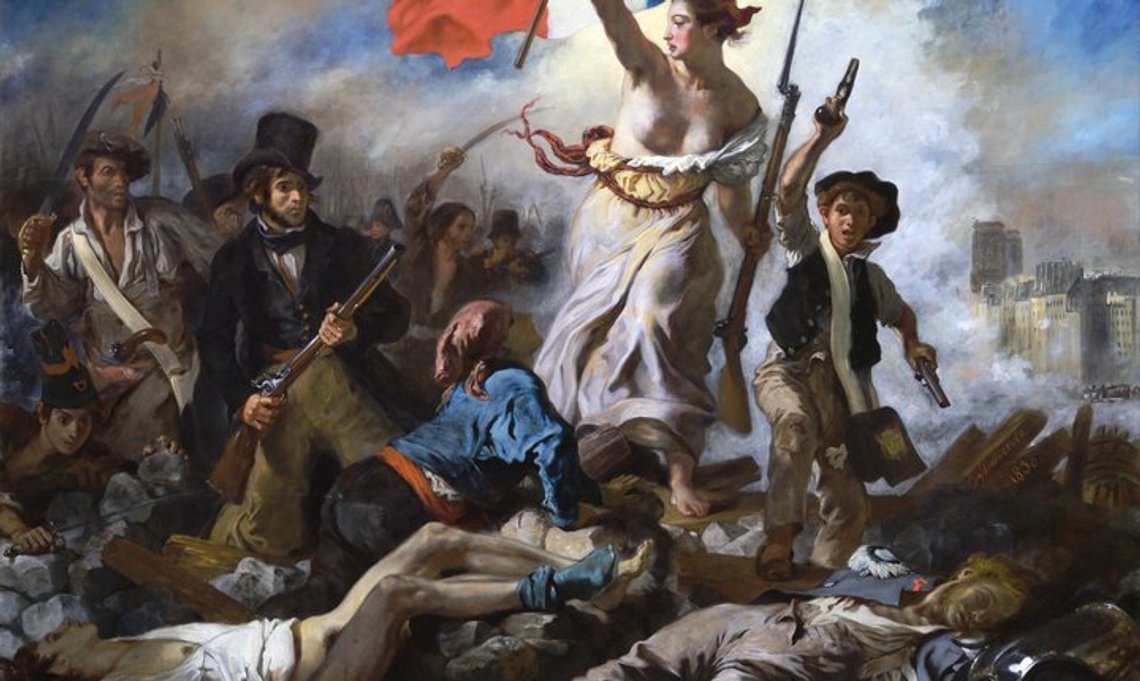
During the riots, statues and other works of art depicting the symbol of the Revolution, Marianne, have been destroyed by sheer vandalism. The mob consists of hundreds of thousands of young men who have never heard of Napoleon or Robespierre, but who hate everything France once stood for.
France’s President Emmanuel Macron has appeared to be a ‘lame duck’ for several weeks. When he finally delivered a address to the nation regarding the unfolding disaster, we were treated to empty words and pathetic platitudes. The violent collapse of the bell tower of the historic town hall in Limoges is the perfect symbol of the implosion of Macron’s centrist political project.
As Giulio Meotti wrote yesterday: It is no longer five to twelve; France has passed midnight – in flames.
Europe is in the midst of a deep demographic crisis as a result of a lack of willingness to have children. In 21 of the 27 EU countries, the number of deaths is consistently higher than the number of births. It is therefore possible to argue that Europe needs immigration.
The question is simply this: what kind of immigration would benefit Europe and its native population?
As US Vice-President J.D. Vance has pointed out on several occasions: the danger of a ‘civilisational collapse’ in Europe is not due to the number of migrants. It is not a question of quantity, but of ‘who are they?’ and ‘what values do they hold?’ Europe has opted for immigration from the very lowest echelons and is committing civilisational suicide at breakneck speed.
Europeans are beginning to react, as symbolised by the rise of the right, writes Phillips.
By 2029, when the next Labour election manifesto is to be drawn up, Paris and Berlin may well be in the hands of leaders who oppose immigration and multiculturalism – Marine Le Pen and Alice Weidel of Alternative für Deutschland. Nor is it inconceivable that the continent’s dominant politician, Giorgia Meloni, might decide to take her talents to Brussels.
He could, of course, have mentioned the British parties themselves, Reform UK and Restore Britain. In any case, a more right-wing Union will create problems for the British.
It is unlikely to be a pleasant experience sitting opposite these women at the negotiating table. Will the UK agree to the deployment of naval forces in the Mediterranean? What proportion of Europe’s asylum seekers are we willing to accept?
The British are led by Europe’s most helpless politicians. Since Britain is an island, one could easily halt all immigration across the Channel in an instant. All it would take is a single armed boat and the will to use force. Furthermore, one could easily cut off absolutely all forms of financial support to those who manage to sneak in anyway.
But the British prefer instead to send rescue boats all the way to the French coast to pick up the illegal boat migrants who are causing massive problems, particularly in England. For years, Norwegian ‘charitable’ organisations sent boats all the way to the coast of Libya to pick up migrants!
So, whilst it is understandable that attention is currently focused on France, perhaps we should take a quick look at what is happening in our own countries? After all, we can actually look into the future. The future is the clock tower in Limoges, and both British and Norwegian politicians seem to be looking forward to the clock striking twelve.
I do not wish to exaggerate France’s difficult situation. On many occasions, the country has seemed to be on the brink of anarchy. For a journalist in Paris, tear gas is an occupational hazard.
Phillips himself inhaled la lacrymo in 2019, during the ‘gilets jaunes’ demonstrations. He was present during the 21 days of rioting in 2005, when 9,000 vehicles were destroyed, over 3,000 people were arrested and property worth 200 million euros was damaged.
The ongoing clashes were literally triggered by the electrocution of two Muslim boys of North African origin whilst they were hiding from the police in an electrical substation.
At the time, I was chair of the UK’s Commission for Racial Equality and was invited by the Minister for the Interior, Nicolas Sarkozy, to advise on the government’s handling of the matter. I suggested that he could start by stopping referring to young French men and women as racaille (scum).
Marine Le Pen is likely to become France’s next president following the election in April. She is polling at around 38 per cent, 20 points ahead of her nearest challenger, the ultra-radical Jean-Luc Mélenchon, who appears, unforgivably, to have encouraged the violence currently afflicting France. Le Pen faces almost insurmountable challenges, and the riots are likely to erupt the very day she moves into the Élysée Palace.
France cannot be saved without a massive wave of repatriation. Several million immigrants must be deported, and this will not happen without violent reactions that must be countered if France is to survive. The question is whether there is still sufficient will to survive in France in particular and in Europe in general. There is much to suggest that the Western European zest for life already belongs in the history books.
Le Pen, like Meloni, has weathered a wave of personal criticism and contempt from traditional opponents. A similar attack is now being directed at Nigel Farage. This is a mistake. It is unlikely that their supporters will be swayed by revelations that they have weaknesses, or that dubious individuals are to be found amongst their supporters.
In fact, it seems quite clear that the attacks on the Rassemblement National, the AfD and Reform UK are only making these parties stronger. The reason may be that the attacks come from a political establishment that is despised by a large proportion of Europeans who have to live with the consequences of decades of reckless policies.
Small villages in the British countryside face being overwhelmed by camps three times the size of the village itself, full of young men with nothing better to do. A privileged minority welcomes immigration because they reap all the benefits, whilst the forgotten majority must bear all the costs.
The British Prime Minister’s proposed solution is classic: he does not want to solve the problems; he wants to spread the costs. We have heard this before, from Burnham’s favourite city, Brussels. When Budapest, as one of the few capital cities, said no, the response from the Brussels mafia was massive economic sanctions. Unfortunately, Phillips seems to share Burnham’s views.
Burnham recently, in what was probably a misunderstood moment of radical honesty, lent weight to this view when he argued that the middle class should bear a greater share of the burden of housing asylum seekers. But this is precisely where he should be focusing his efforts, and he should therefore support the Home Secretary’s determination to share the burden.
Phillips does, however, understand that the British middle class is hardly keen to see their neighbourhoods populated by Afghans, Somalis, Syrians or other migrants who are disproportionately represented in the statistics on serious crime.
We should not be surprised that, in light of migrants’ apparent freedom to come and go as they please, and some locals’ sense that they are being treated unfairly, there is less and less ‘brotherhood’ to share.
There has never been any ‘brotherhood’, Mr Phillips. Many of the most enthusiastic supporters of mass immigration have been feminists who at least resemble women, without caring in the slightest that tens of thousands of British little girls were sexually abused in the most appalling manner for decades by these wonderful new Britons whom they so warmly welcomed with their Refugees Welcome signs.
If you have an overflowing bin, you don’t solve the problem by scattering the rubbish all over the flat, and a bit onto the balcony. You solve the problem by taking a quick trip to the bin.