

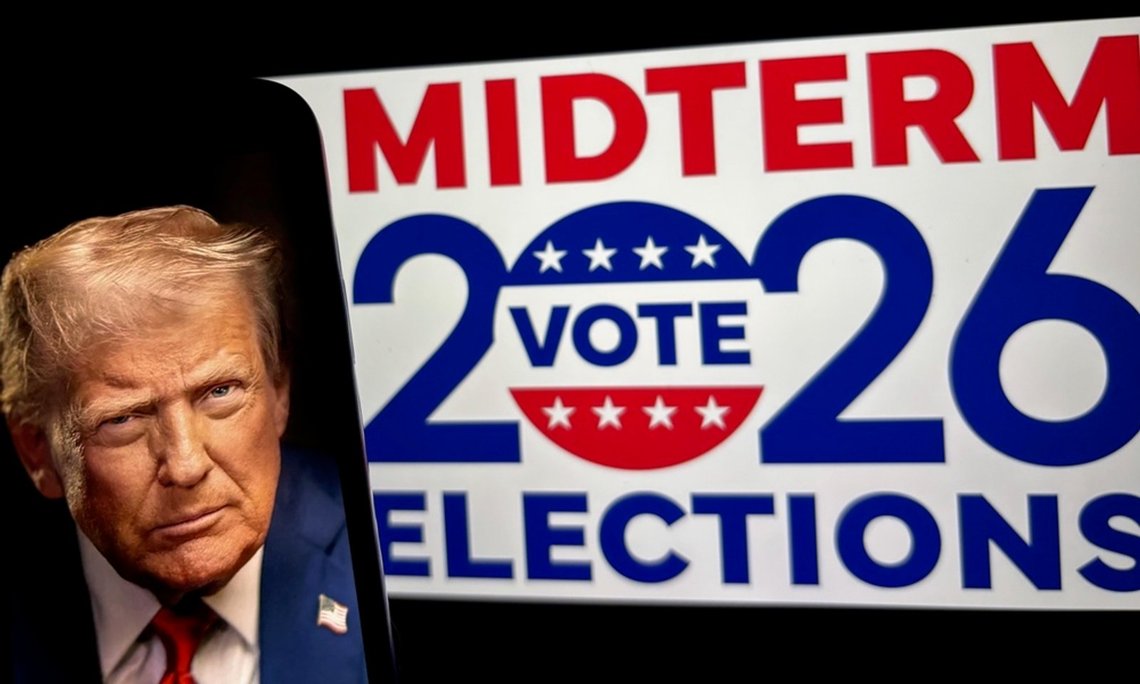


The Democrats could make significant gains in the US mid-term elections in November without managing to win a number of states that traditionally vote Republican. That is the view of Patrick Ruffini, a Republican election strategist and pollster, in an interview with the left-leaning Politico.
“The polls are, I think, intentionally inflating the size of the battleground,” Ruffini told POLITICO.
Ruffini is one of the founders of the polling and analysis firm Echelon Insights. He does not dispute that the polls show a shift in the Democrats’ favour, both nationally and in several individual races. However, he believes there is a big difference between the Democrats making gains and them managing to win states that Donald Trump won by a double-digit margin in 2024.
The Democrats hope to win Senate seats in states including Iowa, Texas, Ohio and Alaska. Trump won all these states by at least eleven percentage points in 2024. The Democrats are also looking at Kansas, South Carolina and Mississippi as potential targets.
I think we can read the environment right, but the map wrong.
Ruffini believes, however, that the polls may paint an exaggerated picture of how many states are actually up for grabs.
Democrats respond more frequently to opinion polls
According to Ruffini, likely Democratic voters respond to opinion polls twice as often as their Republican counterparts. At the same time, he believes that voter turnout among the two groups will be roughly equal.
When you see high-propensity Democrats [responding to polls] at twice the rate of high-propensity Republicans, whilst we know that turnout on both sides will be roughly equal, that is a warning sign for polling in this election cycle.
This results in the Democrats appearing stronger in the polls than they are amongst the voters who actually cast their ballots. He describes this as a warning sign for this year’s election.
He also believes that polls commissioned by Democratic candidates may help create the impression that several states are closer than is actually the case.
Particularly sceptical about Iowa and Ohio
Ruffini points out that opinion polls in the Midwest have previously overestimated support for the Democrats, particularly in Iowa and Ohio.
He believes that voters’ fundamental party allegiances often have a stronger influence towards the end of the election campaign. In states where Trump had a solid lead, he therefore believes the Republicans may perform better than the polls suggest.
He is also sceptical of the Democrats’ optimism regarding Kansas.
At the same time, he does not rule out Democratic victories in certain Republican states. Alaska, where Mary Peltola is standing for the Democrats, is a real possibility.
A Democratic victory in Texas would not surprise Ruffini either, where James Talarico is standing against the Republican Ken Paxton.
The House of Representatives
As for the House of Representatives, Ruffini believes the most likely outcome is that the Democrats will take the majority.
He emphasises, however, that a three-percentage-point discrepancy between the opinion polls and the actual result could make the outcome far closer. Anything can happen.
… if there’s a three-point polling error or something, then I think it gets very, very tight and anything can happen.
He considers the race for the Senate to be completely wide open. He estimates that the Republicans have a 50 per cent chance of retaining their majority, and believes that, if they do, they will likely end up with 50 senators.
Texas could prove decisive in determining who secures a majority in the Senate. Ruffini believes the Republicans are right to spend money defending vulnerable seats, but that does not mean the Democrats will win all the close races.
He also believes the Republicans may be underestimated in Ohio. In Maine and Michigan, however, he assesses the Republicans’ chances as being less than 50 per cent, although he believes Senator Susan Collins in Maine still has a realistic chance.
A historic shift
If the Democrats end up with a genuine blue wave in the Senate, Ruffini believes it will reflect a depolarisation amongst voters that the US has not seen since around 2012.
To find a comparable example of a state like Kansas switching parties, one has to go far back in history. For the Democrats to win there and, at the same time, unseat an incumbent senator would be highly unusual.
In the past, it was far more common for Senate elections to result in candidates from the other party winning, even in states where one party traditionally dominated. But from the Trump era onwards, American politics became increasingly polarised.
According to Ruffini, a Democratic wave that also sweeps through traditionally Republican states could mean that the US is heading into a new political era. He believes such an outcome would represent a historic shift.
For the Republicans, in that case, there would be ‘hope in the hanging snore’. Or, to put it plainly: hope in a hanging noose.


