

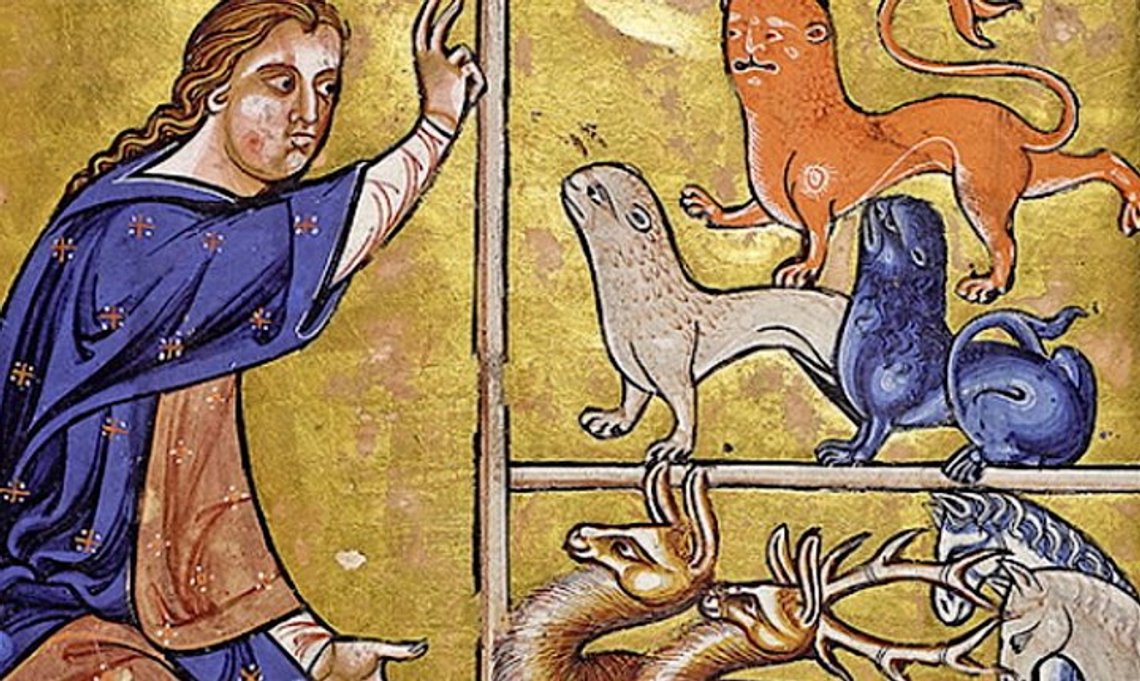


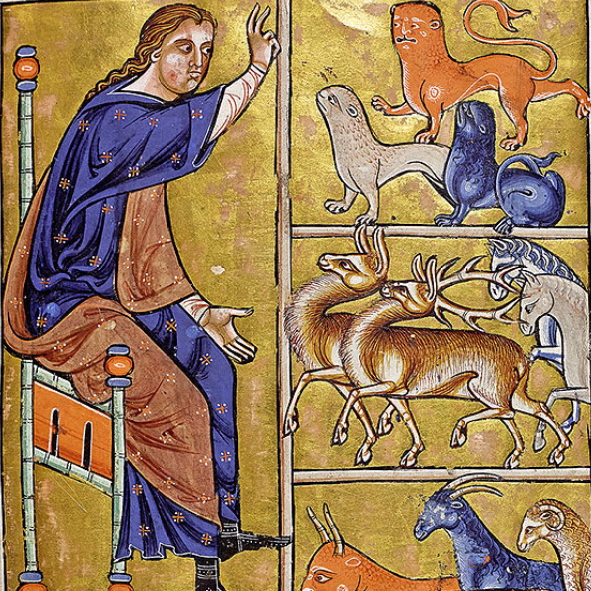
‘Adam names the animals’, illustration from the Aberdeen Bestiary, University of Aberdeen Library.
4 Thus says the Lord of Hosts, the God of Israel, to all whom I have led into exile from Jerusalem to Babylon: 5 Build houses and live in them; plant gardens and eat their fruit! 6 Take wives and have sons and daughters! Take wives for your sons and give your daughters in marriage, so that they may have sons and daughters. There you shall increase in number and not decrease. 7 Seek the peace and prosperity of the city to which I have sent you into exile, and pray to the Lord on its behalf; for if it prospers, you too will prosper.
Jeremiah 29:4–7
Today’s Bible passages provide us with a basis for discussing an interesting question: Has God given humankind the freedom to explore nature and develop the institutions of society through reason and experience, without every choice being dictated by religious authority? And if so, where does the boundary lie between this freedom and the moral obligations God has given us?
A natural biblical starting point is the Book of Genesis. In chapter 1, verses 26–28, humankind is given the task of subduing the earth and having dominion over the animals. In chapter 2, verse 15, humankind is set to cultivate and tend the garden.
This can be understood as a mandate for human activity, not merely for obedience. Mankind is to investigate, develop, organise and improve the world in which it has been placed to live. If we are to be able to steward creation, we must have been given the ability to investigate how it works. Natural science is based on the premise that the world has an order that we can investigate, even though our understanding is always limited.
We do not need to consult the Bible to find out how gravity works, how a cell functions or how a chemical reaction takes place. God has created a world that can be investigated, and he has given us the abilities to explore it.
The same can be said of how we should organise society. Jeremiah urged God’s people to build, plant and work for the society in which they lived, even when that society was not organised according to their own faith. They were not to wait until society became ideal, but to actively contribute to the society of which they were in fact a part.
The same can be said of the economy. God has not given us a biblical formula for tax rates, the banking system, competition policy or the organisation of a modern healthcare system. Such questions require an understanding of economic mechanisms and interrelationships, which God clearly asks us to try to understand.
To put it another way: in the Christian faith, we encounter a God who creates human beings who are not merely recipients of commandments; they are also creative and responsible agents in the world.
Since God has given us reason, freedom and responsibility, this must mean that he also leaves many specific decisions to us. There is not necessarily a single Christian solution to all questions concerning the organisation of society. We must examine the consequences, weigh up the alternatives and take responsibility for our choices.
This does not mean that all solutions are equally good, but that God has not necessarily revealed which one we should choose.
This brings us back to my text from last Sunday. In the American Declaration of Independence, we find a thought that is important in this context: human rights are endowed by the Creator and therefore precede the state. The authorities cannot themselves be the ultimate arbiter of what is right and wrong.
John Adams was concerned that freedom could not be maintained through political institutions alone. It also required morality and civic virtue. If a society loses sight of the idea that there is a moral order that stands above the will of the majority, democracy risks becoming a tool for the power of the majority rather than a safeguard of human rights.
The fact that we can develop economic systems does not mean that we have the moral freedom to exploit people. Our ability to develop medical technology does not mean that every use of it is right. The fact that we can organise society as we wish does not mean that the majority automatically has a moral right.
None of this means that God is absent from public life. However, He has not given us revealed commandments that regulate in detail how all of society’s institutions should be organised. In many areas, we must use our own reason and experience, examine the consequences and take responsibility for our choices.
This is a form of human autonomy, but not necessarily autonomy in the sense of independence from God. It is a freedom granted to humankind, and as such it also entails responsibility.
Taken together, today’s texts paint a picture of people who are not merely to receive commandments, but also to act, to assess and to take responsibility. God entrusts real tasks to humankind. We are to use our reason and our freedom to build society, whilst at the same time being accountable for how we treat one another.
I believe this also says something fundamental about God’s nature. He does not regard human beings merely as subjects who must obey, but as creatures to whom he grants freedom, responsibility and tasks. In the Christian faith, this freedom can be understood as a result of God’s love: He takes human beings seriously and calls them to be responsible co-workers in creation.


