




The claim that Israel has committed genocide in Gaza has become accepted as fact. This year’s Nobel Peace Prize laureate has been at the forefront of promoting this claim. *Document* has analysed the figures. 70 per cent of those killed are men.
This year’s Peace Prize was awarded to South African Navanethem Pillay (85), “for her efforts for peace and international legal principles”, to quote the Nobel Committee’s citation.
“Today she is a judge at the International Court of Justice, in the case in which Myanmar stands accused of genocide”, as stated in the statement from the Nobel Committee.
What was not mentioned in the statement is that Pillay headed the UN’s independent commission of inquiry into the ‘occupied’ Palestinian territories from 2021 to 2024. In this role, she concluded that Israel had committed genocide in Gaza.
Dominated by Islamic countries
Thirteen of these countries are members of the Organisation of Islamic Cooperation (OIC). Most of these 24 countries themselves face significant challenges relating to human rights violations.
Nine countries voted against the establishment.
The nine countries that voted against it were: Austria, Bulgaria, Cameroon, the Czech Republic, Germany, Malawi, the Marshall Islands, the United Kingdom and Uruguay.
14 countries abstained from voting.
Apart from the 13 Islamic countries, the group was dominated by Russia, China, Cuba and Venezuela, and countries belonging to the Moscow–Beijing axis of power and dependency. It is worth noting that Argentina’s vote came two years before Javier Milei was elected president of the country.
74,370 killed
Gaza’s Ministry of Health reports 74,370 killed as a result of the hostilities in Gaza as of 10 October 2026. Many will dispute this figure, as Gaza’s Ministry of Health is under Hamas’s control. Sceptics will argue that Hamas has an incentive to exaggerate the figures for propaganda purposes, in order to garner sympathy, particularly in Western countries. Let us therefore assume that this is a maximum figure.
The PCBS (Palestinian Central Bureau of Statistics) reported 72,601 fatalities as at the end of April this year. The UN agency OCHA, for the ‘occupied Palestinian Territory’, reported 71,266 deaths by the end of 2025. OCHA cites figures from the Ministry of Health, but has not necessarily verified every single death.
It is therefore not entirely accurate to refer to all these figures from the PCBS and OCHA as independent estimates, as both are largely based on reports from the Gaza Ministry of Health, even though the publication dates and basis for updates vary.
70 per cent men
Of the 74,370 killed, 72,835 have been identified, according to UK Factcheck, ‘Gaza casualties and identified deaths’, i.e. 98 per cent.
70 per cent of those identified are men.
The following table shows the gender breakdown of the dead across different age groups.
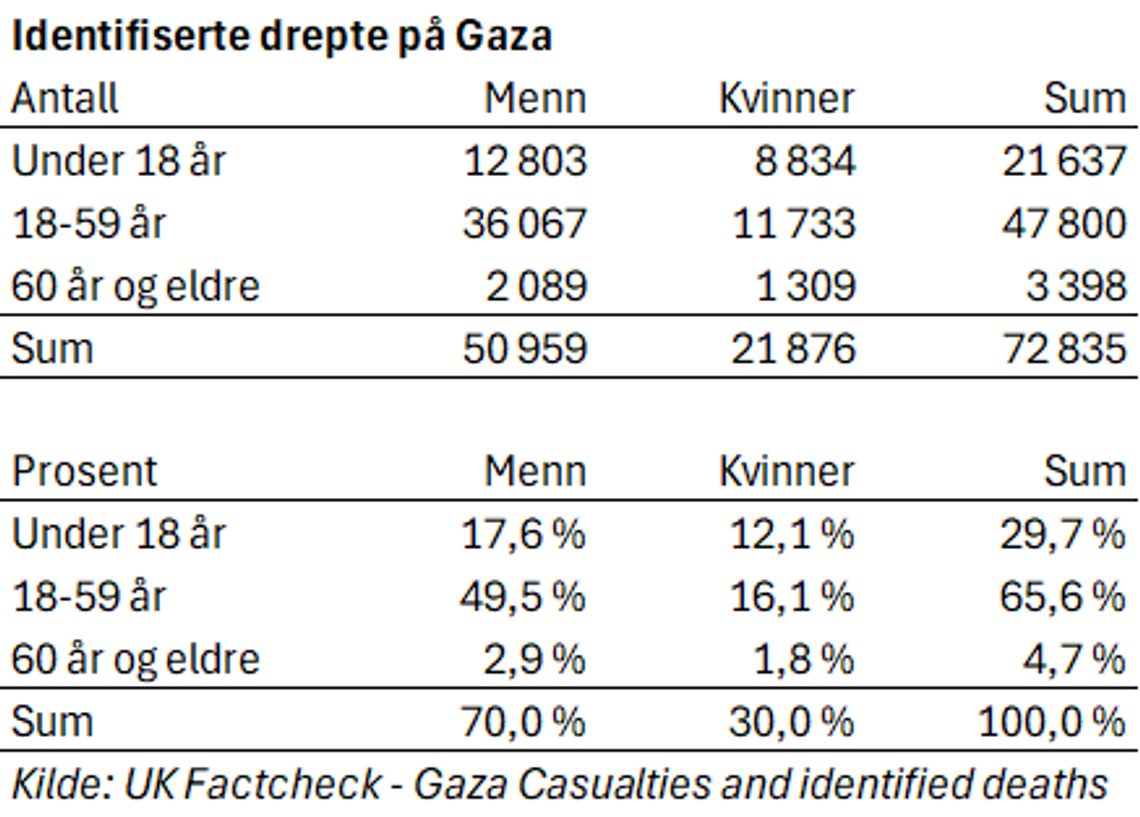
The figures show a significant over-representation of male fatalities. This is particularly evident in the 18–59 age group. Here, the mortality rate among men is more than three times higher than among women.
Among those aged 60 and over, men are 60 per cent over-represented compared with women. Even among victims under the age of 18, boys are significantly over-represented, at 45 per cent.
The Ministry of Health’s list of names does not distinguish between civilians and combatants, so gender alone cannot be used to determine who was a combatant. Hamas and other armed groups mainly recruit men.
40 per cent militants
Assuming that civilian men, women, boys and girls are equally at risk, the over-representation of men in the table above could be representative of the number of male militants. The table totals 50,959 male and 21,876 female victims. The difference is 29,083, accounting for 40 per cent of the total number killed.
The figures therefore give reason to believe that 40 per cent of those killed are militants.
To assert that civilian men account for the same number as civilian women is an assumption with no solid basis. Particularly in a country at war and a country in the Middle East. Therefore, the estimate of 40 per cent militants amongst those killed is probably a conservative estimate.
Child soldiers
Some would argue that it is incorrect to include people under the age of 18 in the estimate of militants. However, it is a fact that boys under the age of 18 are significantly over-represented compared with girls. And it is a well-known fact that teenage boys are recruited into armed groups.
The following table is based on data from August 2025, presented by Palestine Datasets and reproduced in The Guardian.
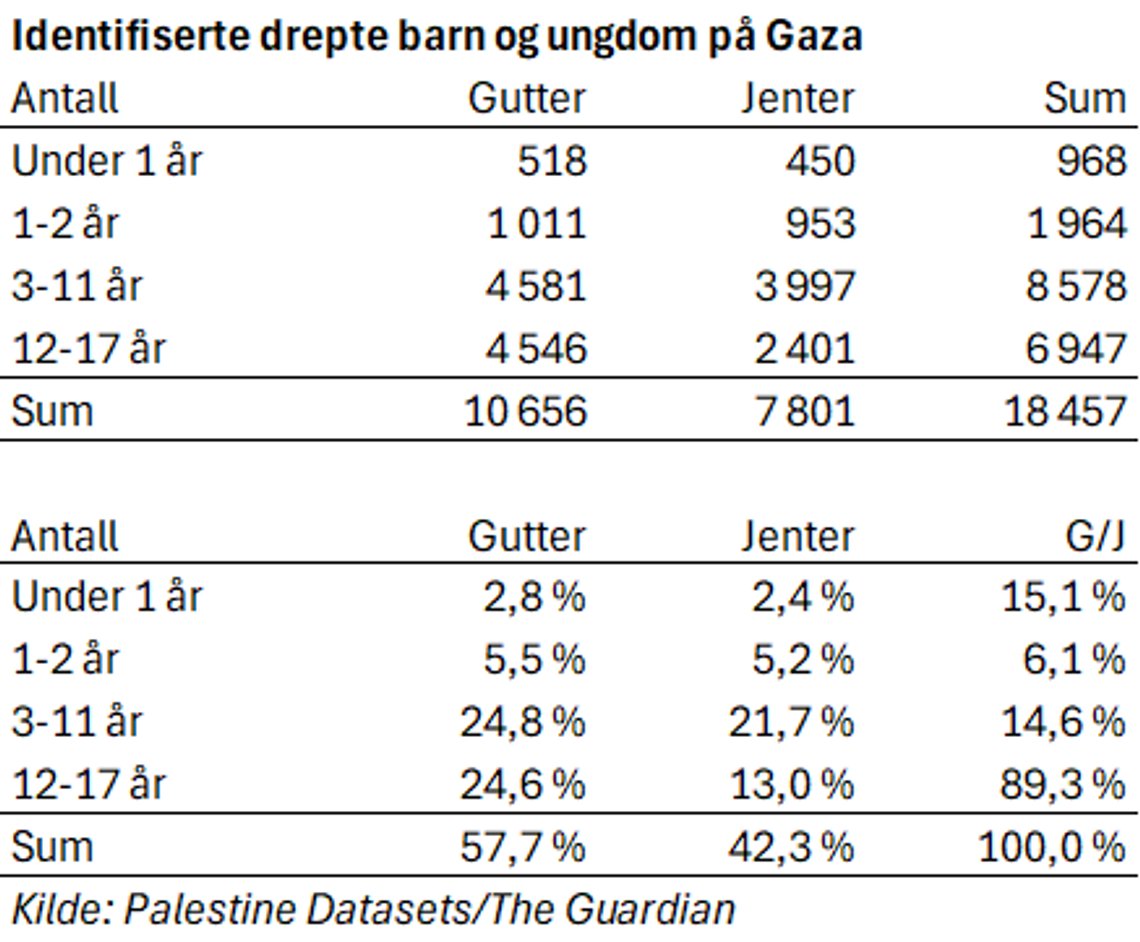
This table is not from the same date as the one above, but shows roughly the same figures as for the under-18 age group in the table above. It appears that boys are over-represented in all age groups. However, the over-representation is particularly evident in the 12–17 age group, where it stands at as much as 89 per cent compared with teenage girls.
This difference can be interpreted as a significant proportion of child soldiers amongst boys in the 12–17 age group.
Genocide?
On 7 October 2023, the population of the Gaza Strip stood at 2.2 million people, spread across a land area of 365 square kilometres. Gaza is therefore one of the world’s most densely populated areas, with 6,027 people per square kilometre.
Oslo’s population stands at 729,000 inhabitants spread across 454 square kilometres, which equates to 1,605 people per square kilometre. If Oslo had the same population density as Gaza, this would mean a population of more than 2.7 million people.
Based on the figures above, and assuming that somewhere between 8,000 and 10,000 missing persons are distributed in the same way, we can estimate that the number of civilian fatalities is around 50,000.
50,000 represents just under 2.3 per cent of Gaza’s population prior to the outbreak of war. This is presumably the maximum number of civilians killed in this urban war. Given that Hamas has used schools, hospitals and mosques as fortifications, this figure is low.
History’s most sparing urban war
In contrast to the controversial commission led by Pillay, several military experts have concluded that the war in Gaza is the most sparing urban war in history.
John Spencer – an expert on urban warfare and head of urban warfare studies at West Point – has argued that Israel has done more than other modern military powers to protect civilians.
Richard Kemp – a former British colonel – has defended Israel’s military operations and described them as unusually sparing of civilians.
Roy Altman stated in an interview in June 2026 that the war was ‘the most humane, the most precise urban warfare fight the world has ever known’.
Not Stalingrad
The doctor and Palestine activist Mads Gilbert compared Gaza to Stalingrad in terms of destruction. When the Germans attacked Stalingrad on 23 August 1942, the city had a population of 710,000. According to the historian Tatyana Pavlova, 185,232 civilians had been killed by the time the battle ended on 2 February 1943.
This represented 26.1 per cent of the population. It can therefore be concluded that Mads Gilbert, in his comparison, has got his estimate for Gaza wrong, as it is more than ten times higher than the corresponding figures for Stalingrad.


