

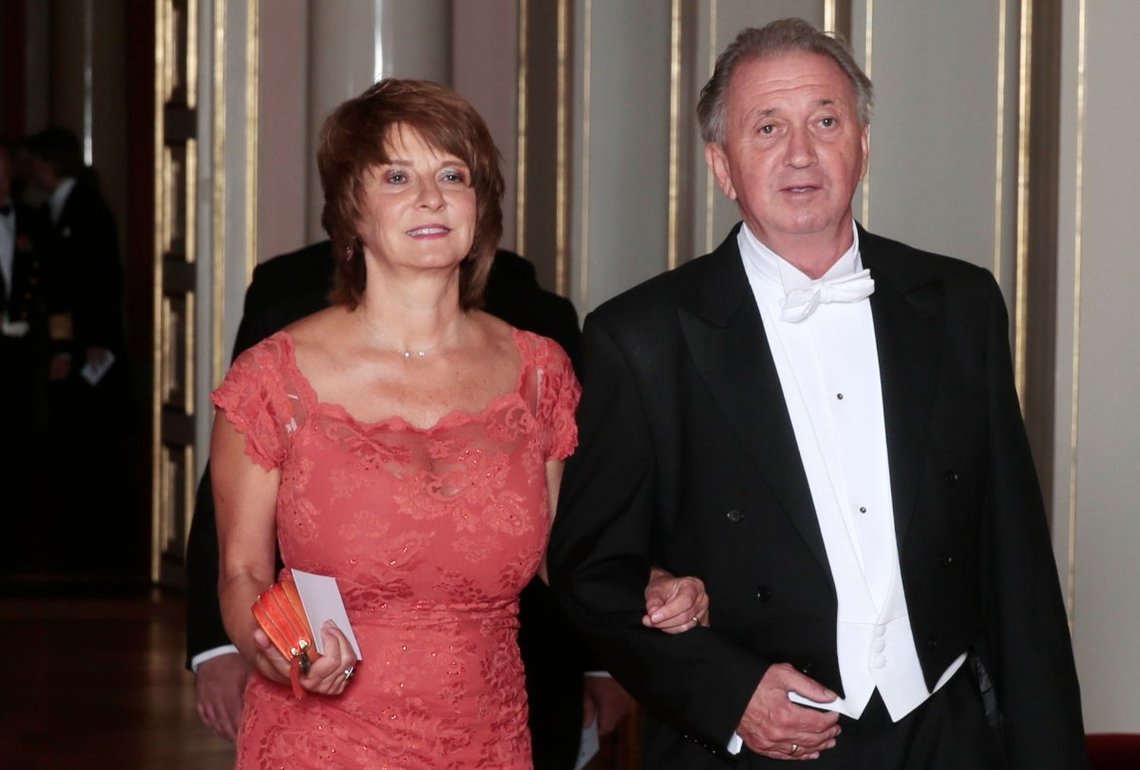


During the hearings in the Foreign Affairs and Constitutional Affairs Committee we have now learnt that Mona Juul had her security clearance downgraded from ‘Strictly Confidential’ to ‘Confidential’ in 2021. It was Foreign Affairs Councillor Torgeir Larsen (Labour Party) who revealed this information.
According to him, the downgrade occurred because new information had come to light in the public domain. He would not specify what information this concerned, and following the hearing he replied to follow-up questions that he could not comment on the matter.
As no one else commented on it, it was presumably in response to an article I wrote in *Klassekampen* on 12 February 2021 and in *Document* on 17 February 2021, entitled ‘A Norwegian security problem’ and ‘Has Mona Juul been compromised through her husband Terje Rød-Larsen?’.
If so, it is rather embarrassing, not to say reprehensible. The Ministry of Foreign Affairs and the PST should have realised this themselves, and at a much earlier stage. In the two articles from 2021, it was pointed out that:
“The fact that Rød-Larsen has been involved in criminal circles (Epstein, child prostitution and human trafficking) implies that there are reasonable grounds for suspecting that he has been compromised and thus poses a potential security risk. In that case, it also implies that there are reasonable grounds to suspect that those close to Rød-Larsen – first and foremost his spouse and Norway’s UN Ambassador, Mona Juul – have been compromised”.
The Security Act is quite clear both with regard to close associates and the circumstances that lead to the loss of security clearance. Section 8.4(c) of the Security Act refers, amongst other things, to ‘circumstances which may result in the person themselves, or the person’s close associates, are exposed to threats to their life, health, liberty or honour, such that the person may be pressured into acting contrary to national security interests.” Section 8.4(k) refers specifically to «financial circumstances which may tempt him or her to act contrary to national security interests».
Revelations by *Dagens Næringsliv* in 2019 and 2020 documented Terje Rød-Larsen’s close ties to Epstein and his loan of 130,000 dollars from him. Mona Juul was mentioned, though no indication was given that she might pose a security risk. This first came to public attention through the articles mentioned above, published on 12 and 17 February 2021 respectively.
It was, of course, good that this finally prompted a reaction from the PST. But at the same time, it raises questions as to why neither the Ministry of Foreign Affairs nor the PST addressed the matter much earlier. They have clearly not done their job. The links between the convicted Epstein and Rød-Larsen were, after all, apparent from the outset, and it later became clear that Mona Juul not only had an indirect connection to Epstein via her husband, but also a direct one.
Epstein’s criminal past was already public knowledge as early as 2008. Epstein’s links to the IPI and Terje Rød-Larsen were known from 2011. The alert from IPI to the Ministry of Foreign Affairs came in 2019. DN’s revelations about the close ties between Epstein and Rød-Larsen also came in 2019. Yet the PST only took action in 2021, after it was publicly reported that Mona Juul must also have been compromised? Surely the Ministry of Foreign Affairs and the PST should have realised this themselves much earlier, had they been paying attention.
And this raises questions as to how the Ministry of Foreign Affairs and the PST could have allowed Mona Juul to continue in the trusted and important position of UN Ambassador with reduced security clearance for a further five whole years, until she finally resigned in May this year.
Firstly, she could not function effectively as UN Ambassador without access to all relevant classified documents. That should be a cause for concern for the Ministry of Foreign Affairs, particularly in such a key and sensitive position.
Secondly: How could she have continued in the post at all if, under the Security Act, she was to be regarded as a security risk? The UN environment in New York is one of the worst hotbeds of espionage in the Western world. This should be a cause for concern for both the Ministry of Foreign Affairs and the Norwegian Police Security Service (PST).
The question that arises is what Epstein received in return for all the favours he did for Terje Rød-Larsen; the personal loan of 130,000 dollars, the funding for the Broadway play, the donations to the IPI, the connections to Epstein’s extensive network, the stay on the island, the inheritance for the children, the dinners and everything else that went with it?
Was Terje Rød-Larsen’s spouse, Norway’s UNambassador, with whom Rød-Larsen shared a home and a bed, a source of classified information about Norwegian positions and other matters that Epstein could use and trade on, or pass on to other countries’ intelligence services?
Mona Juul also had a close, direct relationship with Epstein herself and, amongst other things, visited his island together with Rød-Larsen and the couple’s two children.
What on earth were they thinking at the Ministry of Foreign Affairs and the PST?
Was the PST’s inaction due to the fact that the political leadership in the Ministry of Foreign Affairs and the Ministry of Justice – to which the PST reports – did not wish to bear the political burden of sacking her immediately, in the faint hope that the whole affair would blow over? Was it the close-knit political networks operating behind the scenes? Were she and Terje Rød-Larsen so deeply embedded in high society that they were ‘untouchable’?
There is good reason to ask these questions. The Ministry of Foreign Affairs and the PST have a lot to answer for here.
Even more worrying than the fact that our UN ambassador had been compromised without the PST and the Ministry of Foreign Affairs taking any action is a matter I raised on the Documents website on 4 February this year, where I asked: ‘Who were they really, Jeffrey Epstein and Terje Rød-Larsen?’ It remains unclear whether this has been followed up.
I referred to something that was, admittedly, merely a rumour circulating in parts of the US intelligence community in the early 2000s. This was after Norway became a partner in the F-35 development programme in 2002, whilst Knut Vollebæk (KrF) was ambassador in Washington.
It was rumoured that Epstein’s house right next to Central Park in Manhattan was frequented by several Norwegians at a high civil service level, something US intelligence found highly peculiar. They were evidently already keeping an eye on Epstein at that time. Vollebæk is said to have been briefed on this, though he apparently took no action.
Could this have influenced the negotiations regarding the procurement of F-35 fighter jets from the US, or the Norwegian Oil Fund’s substantial investments in the US, or other sensitive matters? I would have confronted those responsible for equipment procurement at the Ministry of Defence and those responsible for US investments at Norges Bank about this.
Could Mona Juul, through her husband, who was clearly in a relationship of dependence on Epstein, have leaked information relating to Norwegian Middle East policy, Norwegian negotiating positions in the Osloprocess and the allocation of Norwegian aid funds to Palestine and countries in the Middle East? If so, this constitutes extremely serious security breaches.
What did Epstein receive in return for his generous services? What was the quid pro quo? What did they give in return? The question must be put, not only to Terje Rød-Larsen and Mona Juul, but also to Thorbjørn Jagland and Børge Brende – and possibly also to parts of the civil service.
I don’t know. I’m just asking. The Ministry of Foreign Affairs and the PST should have done this a long time ago.


