

The fact that Crown Princess Mette-Marit has remained largely on the sidelines – and is now, as ever more Epstein documents are released into the public domain, being accused of not telling the full truth – fits a broader pattern within what many see as a dysfunctional royal family. This is, of course, the fodder that the press thrives on.
Far more serious, however, is the reality that several key Norwegian politicians and civil servants maintained extensive dealings with Epstein, deriving personal benefits while exposing themselves to compromise (from the Russian term kompromat – material that leaves one vulnerable to blackmail or pressure, editor’s note). This represents a clear security risk.
We are not talking about minor figures. In addition to our future queen, the names include two former prime ministers, at least two former foreign ministers, and a former UN ambassador – all of whom remain active in public or influential roles. Like Mette-Marit, they are now said to be dodging difficult questions and offering evasive explanations.
Whatever the details of their actions, the conduct of Thorbjørn Jagland, Kjell Magne Bondevik, Børge Brende, Terje Rød-Larsen, Mona Juul, and others demonstrates extraordinarily poor judgement – on a par with that of the Crown Princess. They may well have contributed to jeopardising Norway’s national security.
To varying degrees, they appear to have abused positions of public trust in order to secure personal advantages: free flights, stays on Epstein’s private island or in his various properties worldwide, assistance with financing property purchases, personal loans, or even substantial bequests in Epstein’s will.
Morally, this is utterly reprehensible. They have grossly betrayed the confidence of Norwegian voters and taxpayers. The full nature and extent of these relationships with Epstein will likely emerge gradually as further documents are made public. By allowing themselves to become so entangled, they have placed themselves – and potentially the country – in a position where they could be subjected to undue pressure or influence.
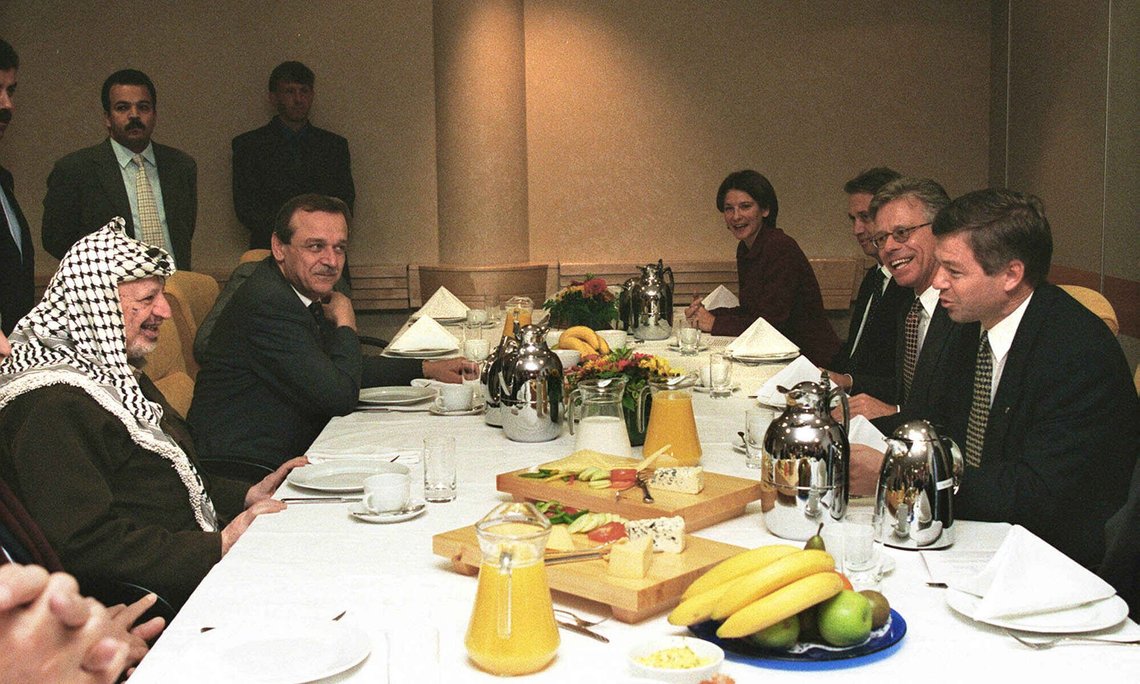
Much of this appears to trace back to the Oslo Process in the 1990s, which was driven to a significant extent by private initiatives from the Norwegian Labour Party, the Fafo institute, and the Foreign Ministry duo of Terje Rød-Larsen (Labour) and Mona Juul (Labour). In hindsight, a great deal of what has since come to light should have raised serious red flags long ago – at PST (the Norwegian Police Security Service), the National Security Authority, and the Office of the Public Prosecutor.
The Norwegian political elite’s dealings with Epstein extend well beyond mere moral questions. As early as 2021, an article in Klassekampen titled ‘A Norwegian security problem’ warned of the security risks posed by their connections to Epstein and his circle – yet no apparent consequences followed. The married couple Terje Rød-Larsen and Mona Juul clearly sit at the heart of this Norwegian network, with Rød-Larsen in particular having a decidedly chequered past.
In 1996, he was recalled from the UN to serve as Minister of Planning in Thorbjørn Jagland’s government, only to be sacked just days later after supplying false information to the tax authorities in the infamous Bird/Fideco scandal. He escaped with a fine of NOK 50,000 from Økokrim (Norway’s economic crime unit) but was able to return unimpeded to his role as Deputy Secretary-General of the UN.
A similar episode occurred three years later, in 1999, when the couple each received a peace prize worth USD 50,000 from the Shimon Peres Centre. Both reacted with fury at the time – but they failed to report the award to the Ministry of Foreign Affairs, constituting a serious breach of the Civil Service Act. Nonetheless, there were no lasting repercussions.
Mona Juul was required to repay the money, yet the following year she was appointed state secretary in Jens Stoltenberg’s government. In 2001, Kjell Magne Bondevik dispatched her as ambassador to Tel Aviv. Rød-Larsen kept the funds and resumed his position as Deputy Secretary-General at the UN.
For a long period thereafter, the couple faded from the spotlight – until Rød-Larsen was forced to resign once more in 2020, this time as president of the International Peace Institute (IPI), after his ties to the convicted sex offender Jeffrey Epstein came to light. Among other things, Epstein had provided Rød-Larsen with a personal loan of USD 130,000 (frequently reported as approximately USD 133,000 in some sources).
Mona Juul maintained that she had no knowledge of either the loan or her husband’s relationship with Epstein. By then, she had herself been appointed by Børge Brende to the prestigious role of ambassador in London in 2014 – despite the earlier reprimand for failing to declare the USD 50,000 from the Israelis.
In 2019, Ine Eriksen Søreide named her Norway’s ambassador to the UN and representative on the Security Council. In 2024, she was appointed ambassador to Jordan – widely viewed as a softer, retreat posting.
Throughout this period, vast sums of aid money have been channelled through the Ministry of Foreign Affairs’ budget. Substantial portions have been directed towards the Oslo Process and the Middle East, as well as international NGOs such as the Gates Foundation and the Clinton Foundation. This has occurred without sufficient oversight mechanisms or auditing procedures – a failing repeatedly criticised in annual reports by the Office of the Auditor General, which has described it as “highly reprehensible” and involving “very serious” breaches.
Norway’s generous aid budget has afforded its administrators privileged access to red carpets and associations with figures like Bill Gates, Bill Clinton, Jeffrey Epstein, and others. Epstein himself appears to have been primarily motivated by gaining access to the Norwegian aid funds that these individuals managed on behalf of Norwegian taxpayers. In due course, it emerged that many of them – both donors and recipients – were close associates of Epstein.
What has now come to light reveals that those overseeing the aid purse – the Norwegian political elite and elements of the civil service within the Ministry of Foreign Affairs – have evidently allowed themselves to be indulged with gifts and favours from a criminal milieu, far exceeding what could reasonably be termed “normal diplomatic activity”, to borrow Jagland’s own phrase. This undoubtedly applies to Jagland, likely to Bondevik as well, and possibly to Brende.
A further illustration of this collusion and disregard for basic principles of impartiality in the civil service is Geir O. Pedersen, Rød-Larsen’s former colleague and close friend at Fafo. As Head of Mission at the Ministry of Foreign Affairs, Pedersen allocated funds to the International Peace Institute (IPI) during Rød-Larsen’s tenure as its head.
The ministry’s funding to IPI surged from virtually nothing before Rød-Larsen’s appointment in 2005 to NOK 116 million by the time he was dismissed in 2020 – at which point the flow was finally curtailed.
That Rød-Larsen employed Pedersen’s spouse at IPI in New York only compounds the issue. Nor does it help that Ine Eriksen Søreide, who was Foreign Minister when this surfaced in 2019, had to recuse herself from the matter due to her close friendship with Mona Juul.
All of this speaks volumes. It highlights the tight-knit networks spanning leading politicians across party lines, as well as between politicians and the civil service – and it underscores a pattern of consistently poor judgement and lax stewardship of both fundamental rules of impartiality and public funds.
Now, they are scrambling for cover, forced to concede that their dealings with Jeffrey Epstein were far more extensive than they initially cared to admit.
The ancient notion that Nemesis tends to follow closely on the heels of Hubris is a form of karma we can quietly relish alongside the more colourful elements of the press. Crown Princess Mette-Marit is now reaping what many believe she has sown. Yet she is far from alone in this predicament.
What should truly disturb us is not merely the spectacle of a royal house in disarray or a political class evidently lacking a robust moral compass. Far more alarming is the revelation of an entrenched elite circulation that treats serious principles of governance and administration with cavalier disregard: a foreign service devoid of adequate oversight and security protocols, and a situation in which senior politicians and officials have willingly placed themselves in positions where they can be subjected to external pressure or influence.
It is frankly baffling to most observers that Terje Rød-Larsen has been permitted to go on representing Norway and its interests in one high-profile international role after another, despite a well-documented history of repeated financial irregularities.
Equally incomprehensible is how the political leadership at the Ministry of Foreign Affairs has continued to bestow one prestigious appointment after another upon Mona Juul – even after she demonstrated gross negligence in her duties, and in the face of her husband’s far more serious lapses, misconduct, and apparent compromise within a manifestly corrupt milieu.
If PST (the Norwegian Police Security Service), the National Security Authority, and the Office of the Public Prosecutor have still not raised serious concerns – particularly after it emerged that the couple’s two children each stand to inherit USD 5 million (a combined USD 10 million) under Jeffrey Epstein’s will – then something is profoundly wrong with Norway’s prosecuting and security apparatus. A sum of that magnitude is hardly trivial; it strongly resembles a kickback or favour extended to close associates – a classic method of evading scrutiny from tax and law-enforcement authorities.
The couple are compromised, and quite likely have been for a considerable time. Terje Rød-Larsen declines to comment, yet astonishingly he has not been summoned by the prosecuting authorities. Mona Juul insists she had no knowledge whatsoever of Epstein or of her husband’s ties to him – a claim that strains credulity. In any event, the Security Act is unequivocal: the mere existence of such circumstances involving close associates is sufficient grounds for the revocation of security clearance.
The Security Act Section 8.4 c) refers, among other things, to «circumstances that may lead to the person themselves, or their close relatives, being exposed to threats against life, health, freedom or honour, such that the person may be pressured to act contrary to national security interests».
Section 8.4 k) refers specifically to «financial circumstances that may tempt him or her to act contrary to national security interests».
This description fits Mona Juul’s situation to a tee: her husband’s close ties to the convicted paedophile Jeffrey Epstein, the loan of USD 133,000, and the fact that the couple’s two children now stand to inherit USD 5 million each under Epstein’s will. Together, these elements indicate a relationship of such a nature that it “could lead to the person themselves, or their close associates, being pressured to act contrary to national security interests”.
Under normal circumstances, facts like these – or even a reasonable suspicion of them – would trigger an immediate security investigation and very often result in the individual losing their security clearance, and with it their position in the foreign service. There are plenty of precedents for this. Yet, remarkably, none of this appears to apply to Terje Rød-Larsen and Mona Juul – nor, it seems, to any of the other Norwegians implicated.
This is extraordinary. It is also striking that, across the Nordic region, only Norwegian politicians and officials feature in the Epstein case. No leading figures from Sweden, Denmark, or Finland are involved. It is all too easy to connect this pattern to Norway’s prominent role in the Oslo Process, its active Middle East policy, and the Foreign Ministry’s notoriously lax oversight of aid funds.
While the Epstein affair may “merely” involve a paedophile ring, it could equally represent an intelligence and influence operation – a classic “kompromat” case or honey-trap. Conspiracy theories are rife online. Many argue that the scale and sophistication of the operation far exceed what Jeffrey Epstein and Ghislaine Maxwell could have managed on their own.
Some point the finger at the CIA. Others look to the Middle East, Israel, and Mossad – a theory that would neatly explain why only Norwegians, and no other senior Scandinavian politicians or officials, appear to be entangled.
Whatever the truth, the mere suspicion of “kompromat” is enough under the Norwegian Security Act to warrant a full and thorough investigation. It is high time that PST (the Norwegian Police Security Service), the National Security Authority, and the Office of the Public Prosecutor finally took this matter seriously and acted accordingly.


