


Legal immigration to the US from Muslim-majority countries has fallen dramatically since Donald Trump took office.
In December 2024, Joe Biden’s last full month as president, 21,096 people from 45 Muslim-majority countries were either granted immigrant visas to the US or admitted through the US refugee programme.
By February 2026, that figure had fallen to 808.
This represents a 96 per cent drop.
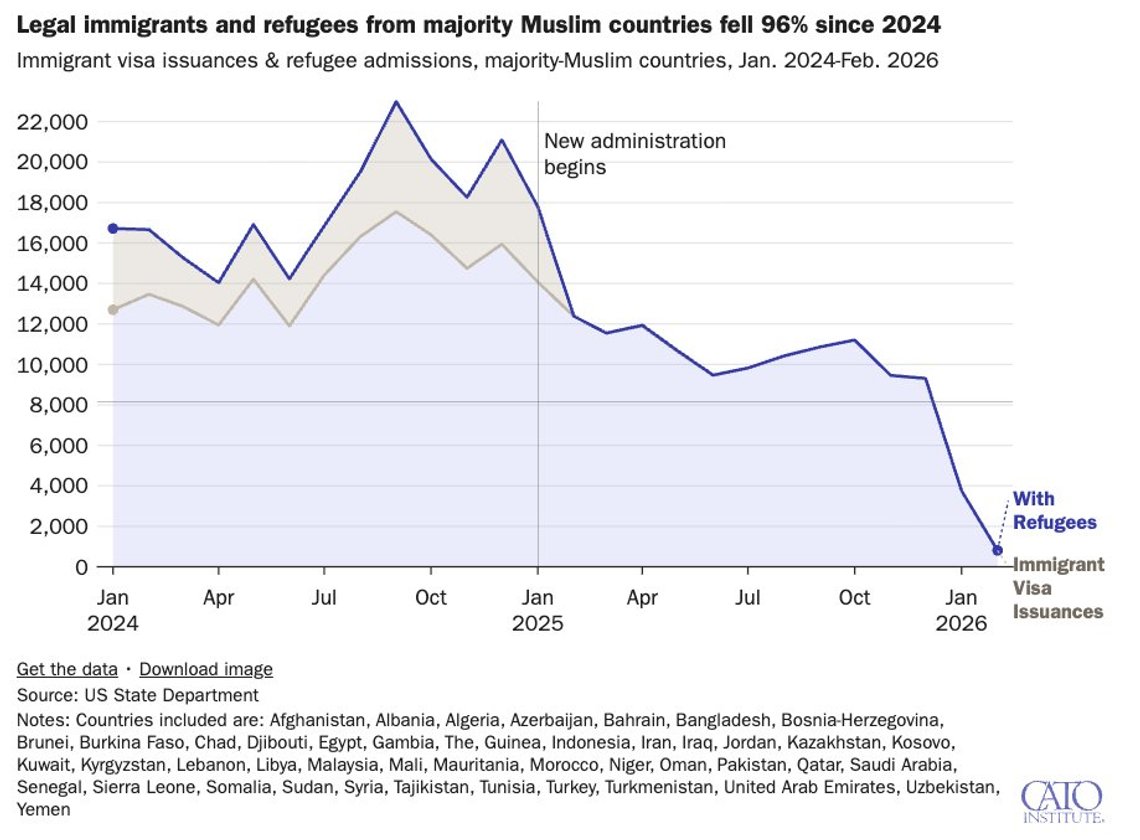
Figures sourced from the White House.
The figures come from the libertarian American think tank, the Cato Institute, which has analysed statistics from the US Department of State.
According to the Cato Institute, the decline cannot be explained by normal seasonal variations. Even compared with February 2024, the fall was almost as sharp.
The number of immigrant visas issued to people from the 45 countries fell by 95 per cent.
At the same time, the intake of refugees from these countries came to a complete halt. In December 2024, the US admitted 5,157 refugees from Muslim-majority countries. By February 2026, the figure was zero.
Afghanistan accounts for a significant proportion of the decline.
In December 2024, 5,563 Afghans were granted immigrant visas or admission to the US as refugees. By February 2026, that figure had fallen to nine.
This represents a decline of 99.8 per cent.
For Pakistanis, the figure fell by 2,963 people, equivalent to 97.9 per cent. Only Qatar, Indonesia and the United Arab Emirates saw an increase between December 2024 and February 2026, according to Cato.
Since taking office, the Trump administration has introduced a number of measures restricting immigration to the US.
Trump suspended the US refugee programme shortly after taking office in January 2025. The administration has since introduced extensive entry restrictions and visa restrictions against a number of countries.
In June 2025, Trump introduced complete entry restrictions for nationals from twelve countries, including Afghanistan, Iran, Libya, Somalia, Sudan and Yemen. Seven other countries were subject to partial restrictions.
In December of the same year, the restrictions were further extended. Burkina Faso, Mali, Niger, South Sudan and Syria were among the countries subject to complete restrictions.
The White House justified the measures on the grounds of, amongst other things, inadequate identity checks, weak public registers, a lack of information sharing and difficulties in assessing security risks associated with certain countries.
According to the Cato Institute, 34 of the 45 Muslim-majority countries included in the analysis were subject to either specific entry bans or visa restrictions.
At the same time, the decline has been far more pronounced for these countries than for the rest of the world.
Whilst the number of immigrant visas and refugees from Muslim-majority countries fell by 96 per cent from December 2024 to February 2026, the decline from other countries was 36 per cent.
People from Muslim-majority countries accounted for 33 per cent of the legal immigration measured by the Cato Institute in December 2024, but accounted for 57 per cent of the total decline up to February 2026.
The Cato Institute itself is critical of Trump’s immigration policy and believes that several of the measures go too far. The think tank also points out that several of the administration’s measures have been challenged in US courts.
At the same time, the statistics must be interpreted with one important caveat: they record nationality, not religion.
It is therefore not possible to conclude that all 21,096 people admitted in December 2024 were Muslims. The figures relate to people from countries where Muslims make up the majority of the population.
However, the difference between the Biden and Trump periods is striking: from 21,096 immigrant visas and refugee admissions from Muslim-majority countries in December 2024, to 808 in February 2026.


