

This is a commentary and reflects the author’s own opinions.
The saga of the attempt to exclude Hans Rustad from the Norwegian Editors’ Association and discredit Document as a truth-seeking press outlet continues.
In NRK’s Debatten this week, we truly saw the witch-hunt unfold in real time, and the hypocrisy was palpable.
We take a closer look at comments made by VG’s editor-in-chief Gard Steiro to and about Hans Rustad during the debate, while also examining VG’s own journalism, which breaches several provisions of the Code of Ethics of the Norwegian Press (Vær Varsom-plakaten).
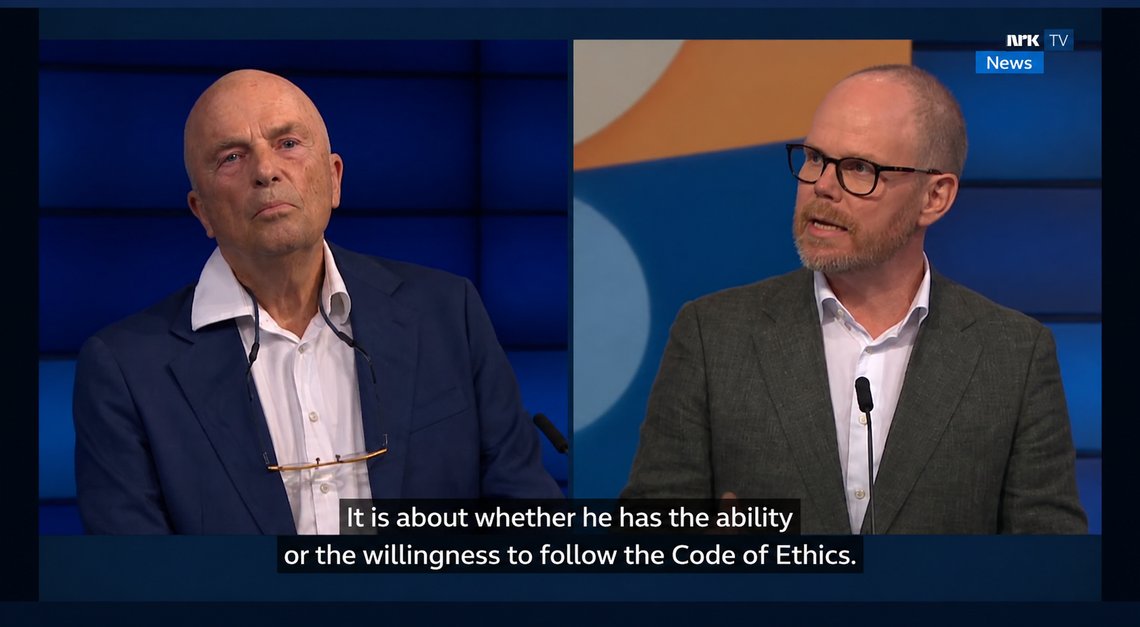
In this clip, Steiro lectures Hans Rustad on his lack of ability or willingness to follow the Code of Ethics. If he lacks that ability or willingness, Steiro does not understand why Rustad wants to be a member of the Norwegian Editors’ Association.
Thanks to Daniel Haugerud of Politics and Communication, who posted the debate on YouTube. He has been a great defender of Document, and we greatly appreciate that.
We reproduce Steiro’s own words: ‘What I mean is that what Hans Rustad is doing does not resemble journalism, because he does not follow the Code of Ethics of the Norwegian Press.’
VG and the Code of Ethics of the Norwegian Press
It is not difficult to find publications in VG that do not comply with the Code of Ethics. In the analysis that follows, we uncover some serious breaches. These are only a few examples, but they are symptomatic of a larger challenge at VG and in the Norwegian media industry.
Now that the Norwegian Editors’ Association is to decide whether Hans Rustad should be allowed to remain a member, we doubt that it will scrutinise the mainstream media, including VG, with the same critical eye.
It is therefore up to us to continue doing precisely that.
The examples we will examine include the allegation that Donald Trump praised Hitler, incorrect and misleading reporting about ICE, VG’s smear campaign against Charlie Kirk and the case of the starving child in Gaza.
Former chief of staff: Trump praised Hitler
Already in the headline and lead, VG breaches Section 4.4 of the Code of Ethics: Headlines and leads must not go beyond what is warranted by the content.
The headline says that Trump praised Hitler. The reader is left with this as fact. It is Kelly’s claim, which has not been proven.
The short version repeats that Kelly calls Trump a fascist, that he praised Hitler and wants Hitler’s generals. This is followed by a quotation from Kamala Harris, who describes the statements as deeply disturbing and dangerous.
VG quotes interviews by the NYT and The Atlantic with Kelly, who said that Trump admired dictators and preferred dictatorial approaches. He is said to have stated several times that Hitler also did some good things.
The Atlantic claims that Kelly remembers Trump saying that he needed German generals. When Kelly asked whether he meant Bismarck’s generals, Trump allegedly replied: ‘Yes, yes, Hitler’s generals.’
Two unnamed sources are also said to have heard Trump say that he needed generals of the same kind as Hitler had.
Section 3.2 requires critical choice of sources, verification of information and breadth of sources. Anonymous sources must be treated with particular caution.
There is no audio recording documenting what Trump said. Nor is Kelly a neutral source. Following his bitter break with Trump, he has become one of his most conspicuous and vocal critics.
Section 4.1 requires factuality and consideration in content and presentation. There is nothing factual or considerate about this article. The purpose is to prove that Trump praises Hitler and is a fascist.
Section 4.2 requires a distinction between factual information and commentary. ‘Praised Hitler’ is presented as fact. It is Kelly’s and anonymous sources’ version, not documented speech.
But let us say that there were evidence and recordings of Trump saying this. The angle of the headline, lead and article would still be erroneous.
Trump has a long history of offhand, strange and exaggerated statements, and he often uses humour and provocation.
That does not mean that every statement should be excused as a joke, but nor does it mean that every strange or tasteless statement is automatically the same as praising Hitler.
VG and Hitler’s moustache
But what can one really expect from a newspaper that put a Hitler moustache on Trump? That may be worth bearing in mind when we hear Gard Steiro’s tirade against Hans Rustad about the Code of Ethics.
Steiro told NRK that the reason for the Hitler moustache was the way Trump handled the riots in Charlottesville. Yet another story that was misreported by VG and the rest of the media in Norway.
As we have written previously: The left-wing fact-checker Snopes admits seven years later that Trump never called the neo-Nazis in Charlottesville ‘fine people’.
‘I’m white, so they don’t stop me’
This article is about Isidro Sanchez-Lopez, who came to the United States 26 years ago on a temporary work visa. Out of fear of ICE, a colleague drives him home. The colleague says that because he is white, he is not stopped.
That is not true. ICE targets people without lawful status. Most people without lawful status come from Latin America, which is why around nine out of ten people arrested by ICE come from there.
Here VG has already breached Section 4.4 of the Code of Ethics concerning headlines and leads. The headline says that white people are not stopped. The article documents one white driver and one frightened Latino. It goes beyond what is warranted by the content.
VG also breaches Section 3.2 on sources and verification. The newspaper uses the colleague’s claim about race and random Latinos without checking it against ICE’s mandate and demographics.
White people without papers are also arrested, but they make up a small proportion of the illegal population.
According to an analysis by the left-wing PBS, only 5 per cent of illegal immigrants come from Europe, Canada and Oceania.
VG omits the demographics and allows a single anecdote to stand as evidence that white people escape enforcement.
In the article, we find another erroneous claim:
ICE was accused of arresting random Latinos they picked up on the street, instead of arresting migrants with criminal records, as it was said they were supposed to.
That is not true either. They were supposed to prioritise the worst of the worst. They did not say that they would arrest only criminals. As Tom Homan has said several times: The Trump administration intends to deport everyone who is in the United States illegally.
The same principle applies in Norway, but we rarely see the Norwegian media cover it unless the person fits the victim narrative.
In addition, VG breaches Section 4.1 on factuality and consideration and Section 4.2 on factual information. The article is constructed as evidence that ICE is racist, not as enforcement of immigration law.
And VG itself proves that white people are arrested, when it covered the case of the Norwegian woman Hanne Bredal Engan, who was arrested by ICE agents in December.
That article, which was fact-checked by Document, was full of lies and misinformation intended to cast Trump and his immigration policy in a bad light.
It is far from the only ICE story VG has presented in this way.
Erroneous claims about lower medicine prices
Not long ago, Document wrote about VG’s and TV 2’s portrayal of the fall in prescription drug prices in the United States. Both media outlets portrayed Trump’s statements as a blunder and gave Biden the credit through the Inflation Reduction Act.
Flause av VG og TV 2: Latterliggjør Trump med feilaktige påstander om lavere medisinpriser
But a review by the left-wing Associated Press, which Norwegian media constantly use as a source, showed that the picture is far more complicated.
VG and TV 2 cherry-picked one explanation and used it to ridicule (and lie about) Trump, while an AP review involving several experts shows that the price decline has several causes.
Here, both newspapers breached several provisions of the Code of Ethics. They were not critical in their choice of sources. They were not factual and considerate in their content and presentation.
They did not ensure that the headline and lead did not go beyond what was warranted by the content. And they did not verify whether the information was correct.
US expert: ‘Bordered on the far right’
This article in VG is highly problematic, particularly because it was written on the same day that Charlie Kirk was murdered.
It is long, and it is a condemnatory and appalling text that breaches several provisions of the Code of Ethics.
Already in the headline and lead, the angle is established and breaches Section 4.4 of the Code. Kirk is not presented first and foremost as an activist who was killed in a political assassination, but through a series of the most damning characterisations that can be applied to an American conservative politician.
Section 4.3 of the Code is also relevant and is breached several times in the text. That provision states that respect must be shown for people’s individuality and identity, private life, ethnicity, nationality and beliefs. Exercise caution when using terms that may have a stigmatising effect.
Among the terms used here are ‘radical right’, ‘extremist’, ‘far right’ and ‘racist conspiracy theory’, in addition to those mentioned in the lead.
An even greater problem is who gets to define the story. Most of the accusations against Kirk came from his political opponents, and most of the statements were taken out of context.
VG allowed US expert Hilmar Mjelde to define the story of Charlie Kirk:
‘He was politically on the radical right. He was extremist in both ideology and style,’ says US expert Hilmar Mjelde.
‘He made intolerant statements about both transgender people and minorities, statements that bordered on the far right,’ says the US expert.
Klungtveit’s modus operandi
These are serious political characterisations to make, particularly when the accusations are based on a selection of disputed statements stripped of context.
It is reminiscent of Harald Klungtveit’s portrayal of Hans Rustad and Skogpod, in which individual statements are selected and assembled to substantiate a predetermined conclusion.
Section 3.2 of the Code requires critical choice of sources and verification of information. VG breaches this provision several times in the article.
VG had to correct one of the claims. It wrote that Kirk had claimed that black pilots lead to poorer aviation safety. We find the correction at the bottom of the page, where no one sees it.
VG initially wrote that Kirk had claimed that black pilots lead to poorer aviation safety, but the correct version is that he claimed that quotas for black pilots can lead to poorer aviation safety.
As we all know, the narrative about Charlie Kirk was already in place. Never before have we seen a more hateful crowd following the death of a man whom half of America loved. And that was precisely the point.
Words and images are powerful weapons. Do not misuse them! says the Code of Ethics. They misuse them every single day.
VG’s smear campaign against Charlie Kirk, following such a tragic American story, is a textbook example of an article that breaches countless provisions of the Code of Ethics. All the provisions I have mentioned in the other examples, and several more besides.
That is why one really has to ask what is wrong with this world when one hears Gard Steiro’s attack on Hans Rustad and Document live on NRK.
At one point, Steinar Suvatne told Steiro that he might be one of Norway’s most powerful editors. I believe that is precisely where the problem lies.
He and all the others know what power they have, and they can use it against us because, ultimately, they set the agenda and control the public conversation.
Because they can.
Shock first, diagnosis afterwards
Another textbook example of an article that breached several provisions of the Code of Ethics is VG’s story about the starving child in Gaza. Document has already written extensively about this case, so there is no reason to repeat it here.
Ingen norske medier har fulgt New York Times’ korrigering om Gaza-gutten
Section 4.13 of the Code states: Incorrect information must be corrected and, where appropriate, apologised for as soon as possible. It does not say how the correction is to be made.
VG chose the path of least resistance: The correction was placed at the bottom of the page, where as few people as possible would see it.
A perfect illustration of the principle that words and images are powerful weapons; do not misuse them.
The New York Times handled the same case differently and issued a separate press release that was also posted on social media. The newspaper apologised and did not suggest, unlike VG, that the child’s starvation was still Israel’s fault.
Of course, the New York Times is also biased in the extreme, and there is no need to excuse that. But at least it handled the correction properly.
Rarely, if ever, do we see the same in the Norwegian media. Even Russiagate, one of the greatest hoaxes of modern times, did not lead to much reflection on the fact that it was fake news.
Once the story has been sold to the public, it appears to be very difficult to come back and say: We were wrong.
An uneven debate
Hans Rustad was given the last word in a debate in which he was repeatedly interrupted and given far less time to speak than the other participants.
Steinar Suvatne did, admittedly, eventually give him the floor, but nevertheless made sure to interrupt him before he had finished speaking.
It is difficult to find a better illustration of how the media treat those they would rather not listen to.
I repeat: In NRK’s Debatten this week, we truly saw the witch-hunt unfold in real time, and the hypocrisy was palpable.
This commentary will be sent to Gard Steiro and the others who were involved in the debate, including Suvatne.
It is doubtful that they will respond, as my correspondence with the Norwegian media is generally one-way, but the hope is that some of them will read it.
Many thanks to all our readers and to those who have taken out subscriptions. That is something our critics probably never saw coming.


