

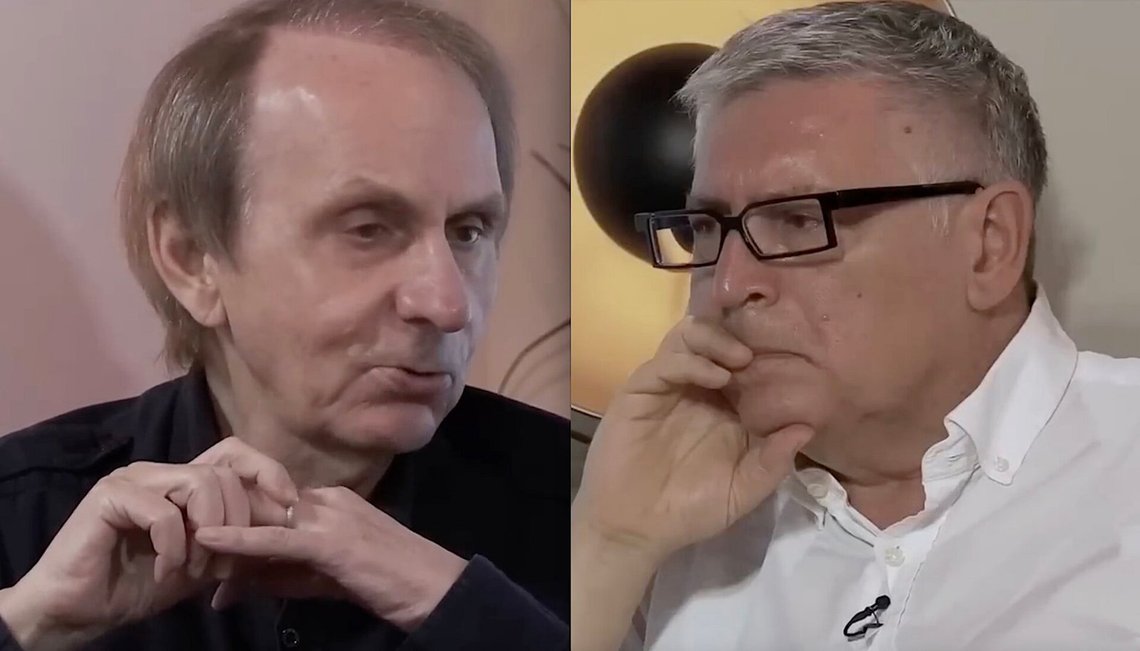


On Tuesday, an investigating judge at the court in Nanterre, France, charged the renowned French author Michel Houellebecq with hate speech following remarks about Muslims made during a conversation with the well-known French philosopher Michel Onfray in 2022, in which he predicted violent resistance to the Islamisation of France at some point in the future.
Le Figaro was the first to break the news, which has since been confirmed by franceinfo.
Michel Houellebecq has been charged with ‘complicity in incitement to discrimination, hatred or violence against a group of people on the grounds of their origin or their membership or non-membership of a particular ethnic group, nation, race or religion’, Le Figaro has learnt from a source close to the case.
This is not the first time Houellebecq has come under the scrutiny of the judicial authorities for the 2022 interview with Onfray organised by the magazine Front Populaire, of which he is the editor. Among those offended by the interview was the head of the Grand Mosque of Paris, Chems-Eddine Hafiz, who decided to let the matter rest following a conversation with Houellebecq. This time, however, the charges have been brought at the initiative of the public prosecutor’s office.
There were several statements by Houellebecq that caused a stir four years ago:
What are the controversial statements? “When entire areas come under Islamist control, I believe acts of resistance will arise. There will be attacks and shootings in mosques, in cafés frequented by Muslims – in short, reverse Bataclan attacks.” [… ] “And Muslims will not be content with simply placing candles and bouquets of flowers. So yes, things could escalate quite quickly.”
‘I believe that what the so-called ethnic French population wants is not for Muslims to assimilate, but for them to stop stealing from and attacking them – in short, for their violence to subside, and for them to respect the law and other people. Or, another good solution, that they should go their own way.”
The author also believed that “for many Muslims, the best solution at the moment is undoubtedly to return”. Michel Houellebecq quoted his Muslim neighbour and explained that ‘fundamentally, he was right to believe that it is impossible to remain a good Muslim in a Western country’. ‘One must read the Qur’an. In my opinion, the most correct interpretation is the Salafist one, but not the jihadist one (…) I have the impression that the course of action most in keeping with the Qur’an – the best one for a good Muslim – is to return to the lands of Islam, and that one should follow this path, if one’s financial means allow it. If not, one must stay away as far as possible.”
Houellebecq was also criticised for stating that demographic replacement is a reality.
‘I was extremely shocked that people call this a theory. It is not a theory, it is a fact (…) Renaud Camus is a good writer; there is no doubt about that. He has, in fact, observed a major demographic shift, or, to be more precise, a change in the ethnic and religious composition of the European population. It is a statistical fact.”
Europe’s best-known novelist takes a critical view of what he calls the increasing judicialisation of intellectual debates.
‘Michel Houellebecq denies the criminal offence of which he is accused. The controversial statements contain no inciting element, not even indirectly, and therefore fall within the scope of freedom of expression. A prophet of doom does not wish for misfortune; on the contrary. This case does not belong in a courtroom,” say lawyers Thibault de Montbrial and Louis Cailliez, who represent Michel Houellebecq, to *Le Figaro* after he was charged on Tuesday.
Michel Houellebecq faces one year in prison and a fine of 45,000 euros if the case results in him being convicted of hate speech.
The charges against the famous author have not attracted much attention in the media outside France.
A free intellectual climate is no longer so important to the European media industry, which has instead become a mouthpiece for the state. It is hardly to Houellebecq’s advantage that in 2018 he said he thought Trump – whom the European media almost unanimously despise – was a good president.


