



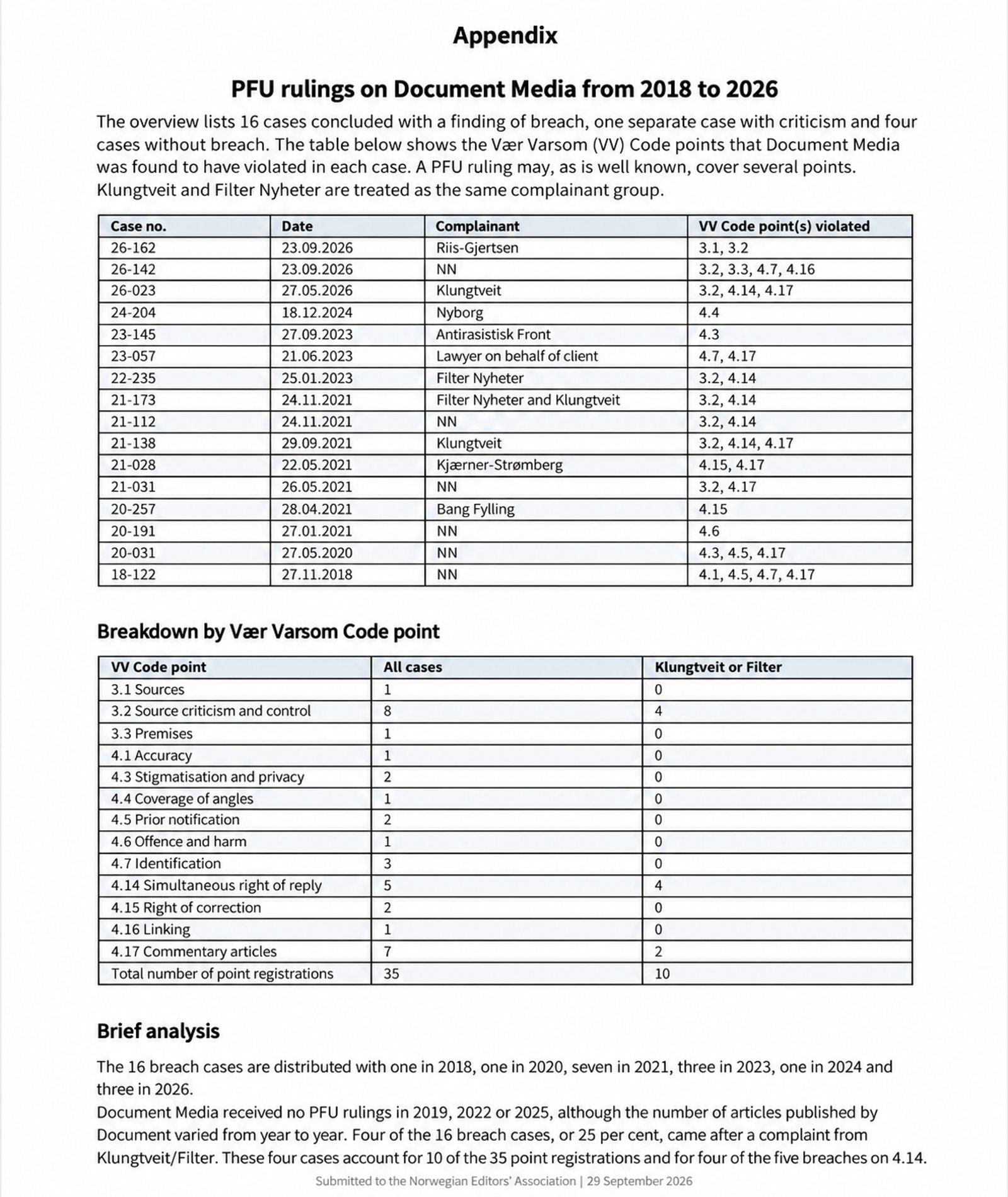
Hans Rustad is to meet the Norwegian Editors’ Association on Thursday 15 October. The board will then consider the issue of a formal warning at an extraordinary board meeting on Friday 16 October. Here we present the letter from the Norwegian Editors’ Association and Hans’s full response, so that readers can assess the basis of the case for themselves. Also attached is the Volda Report – a content analysis of Document.no commissioned by the Norwegian Media Authority in 2023, as well as an overview of the PFU cases.
The letter from the Norwegian Editors’ Association: 28 September 2026 Letter to Hans Rustad also published on 13 October 2026:
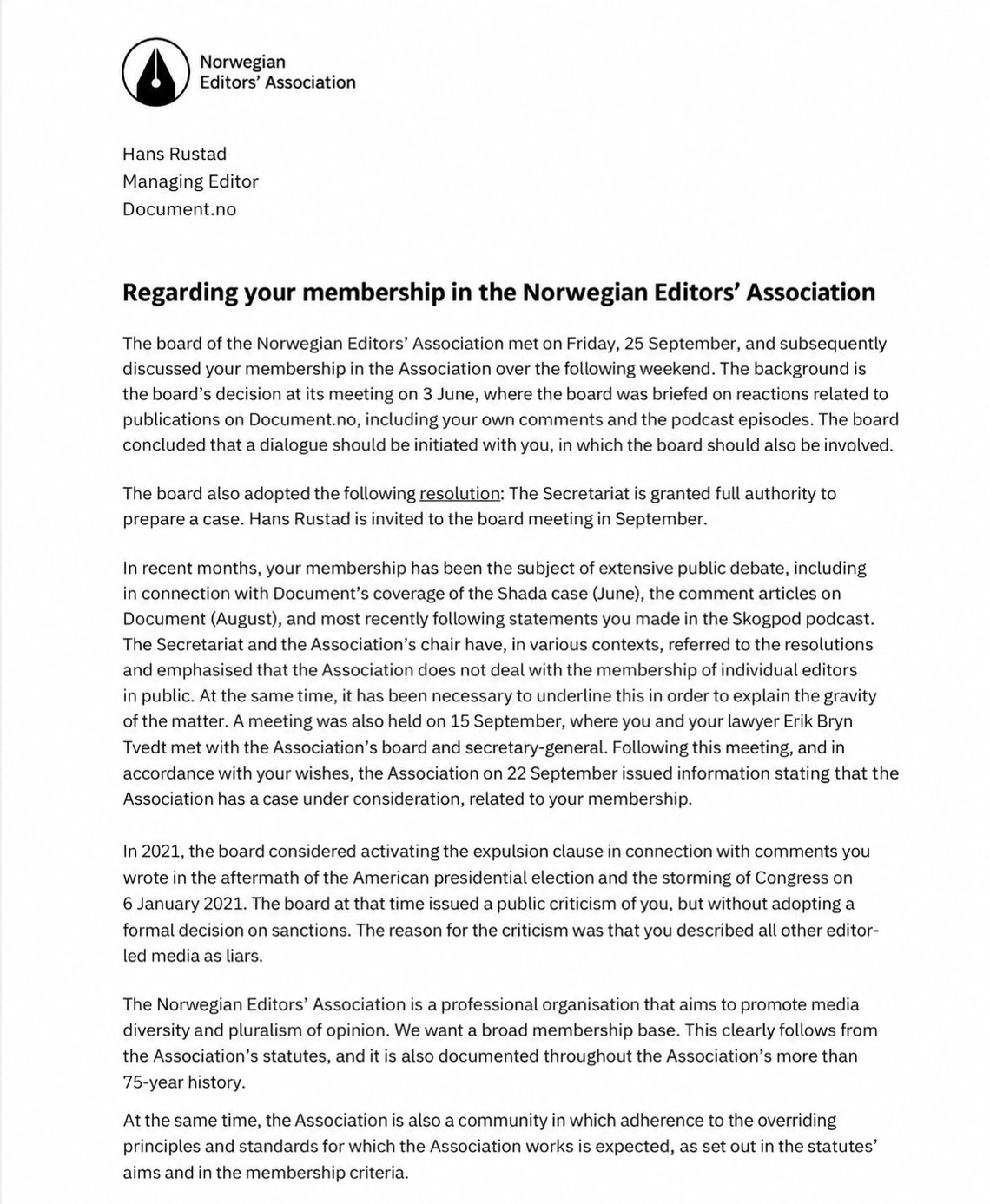
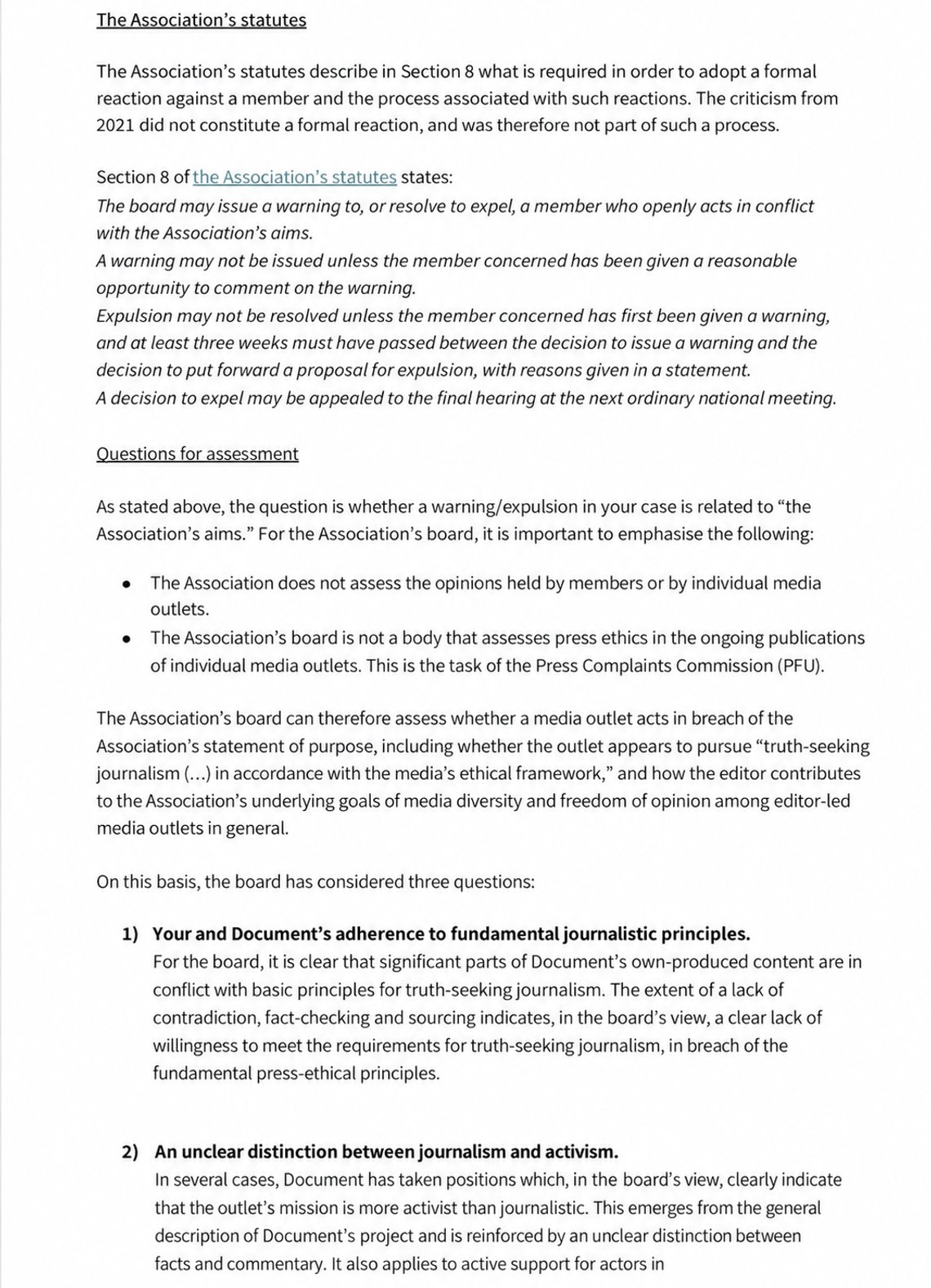
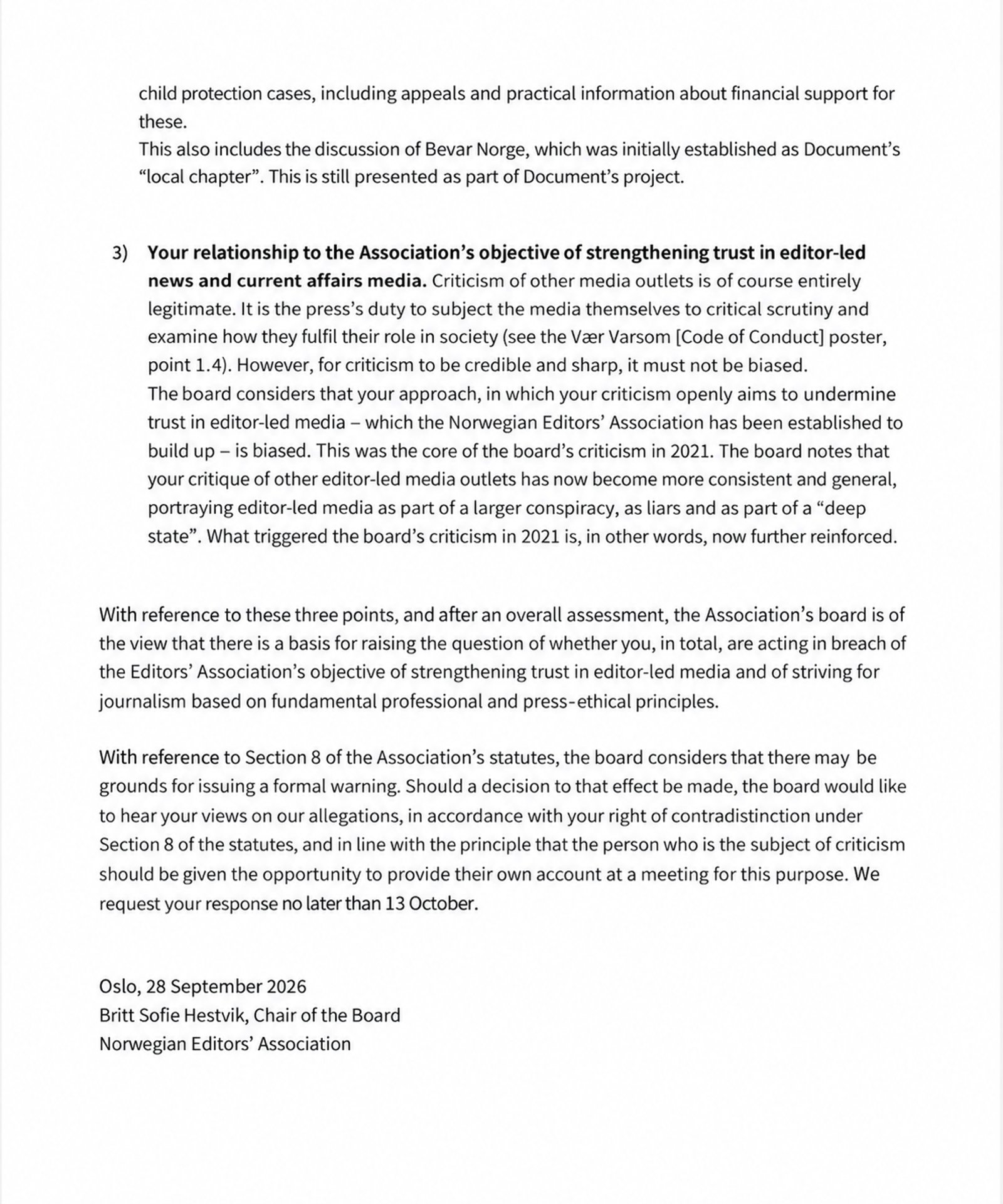
Hans’s reply to this letter: Response – NR – Hans Rustad
To the Board of the Norwegian Editors’ Association
I refer to the Board’s letter of 28 September 2026 and hereby submit my response before the Board decides on a warning pursuant to Section 8.
I dispute that the letter provides grounds for a formal warning. Below, I respond to the Board’s three points in the same order as in the letter. Document Media has a clear editorial stance, and I direct sharp criticism at other media outlets. I dispute that this, or the material the Board has presented so far, demonstrates that I am acting ‘manifestly contrary to the association’s objectives’.
1 Relationship to fundamental journalistic principles
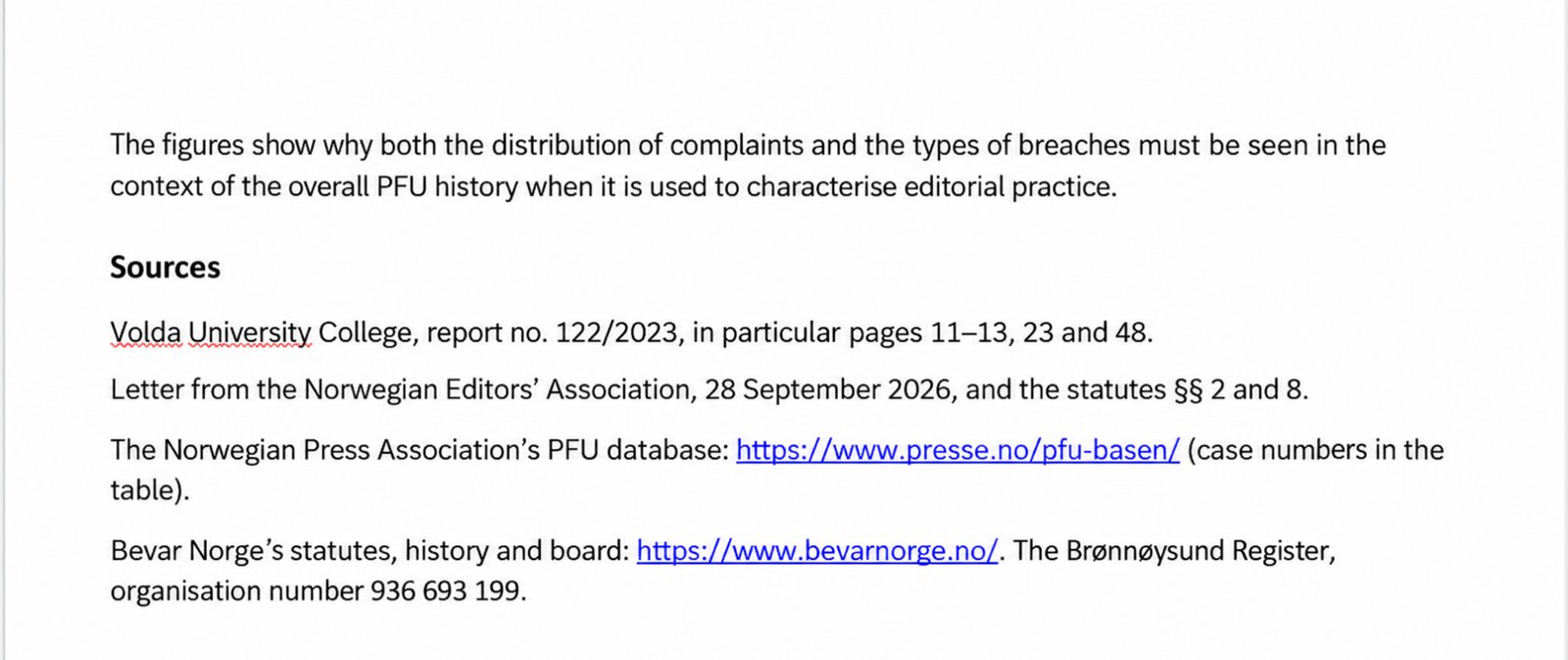
When Document first received a production grant, the Norwegian Media Authority commissioned a content analysis from Volda University College. Report No. 122/2023 examined, amongst other things, 385 articles, eight podcasts and 14 programmes on DOC-TV. Regarding the use of sources, the researchers write on page 12:
“As many as 94 per cent of the news articles cite explicit written sources.”
“If we look at the use of sources as a whole, we find that in only five per cent of the articles are no sources cited at all. In this respect, Document stands out positively, even within the general context of Norwegian journalism.”
“As far as we can see, sources are cited responsibly, and usually with a link to the original article if these are online sources.”
The researchers concluded that Document engages in journalistic activity, produces a sufficient amount of original content and, for the most part, covers topics relevant to democracy and current affairs. They found no obvious breaches of the Code of Ethics in the sample of editorial articles and broadcasts.
Document has not changed the format or type of its article production since the investigation. NR must therefore demonstrate which more recent material justifies the opposite, general conclusion regarding our source citations and our journalistic integrity.
Right of reply and verification of information
The Board refers to a ‘lack of right of reply’. I take it that this refers in particular to simultaneous rebuttal in accordance with VVP 4.14. The PFU overview in the appendix lists five cases of breach on this point during the period 2018–2026. Four of these arose following complaints from Harald Klungtveit or Filter Nyheter. Every breach must be taken seriously, but five cases over this period do not in themselves document that ‘significant parts’ of Document’s own content lack simultaneous rebuttal. If the Board is basing its assessment on other publications or using ‘contradiction’ in a broader sense, I would ask that this be clarified.
Of the eight cases of breaches relating to VVP 3.2, source criticism and verification of information, four originated from Harald Klungtveit or Filter Nyheter. The figures and the individual decisions are documented in the appendix below. They do not absolve us of responsibility for the specific publications, but do not in themselves provide a basis for the board’s claim of a consistent practice across significant parts of our output.
Comment sections and current measures
We also take responsibility for moderation. The comment sections on Document’s own website are pre-moderated. Facebook operates differently and requires follow-up after publication. As a general rule, we remove posts from Facebook after around ten days. We have seen comments from profiles that appear to be fake, but cannot determine who is behind them or their motive. The board should review current procedures if the comments sections are drawn into the membership issue.
Many other editorially managed media outlets have closed or restricted their comments sections, which is relevant when comparing the number of moderation cases across different media outlets.
The seven breach cases involving VVP 4.17 are spread over several years, with three cases in 2021. There were no breaches of this provision in 2019, 2022, 2024 or 2025.
2 The distinction between journalism and activism
I dispute that Document’s editorial stance in itself makes the organisation activist. The board must demonstrate which publications and actions justify this characterisation. The requirement for a clear distinction between facts and commentary also applies to media outlets with an explicit political or ideological perspective.
Document has a clear stance and publishes both news and commentary. Klassekampen, too, has a clear political profile and a recognisable angle. The Volda Report cites Klassekampen, Dagen and Norge IDAG as examples of media outlets with ideological or religious angles that receive production grants. An editorial perspective is compatible with journalism; the question is how information is verified and presented in each individual story.
Among other things, we cover child welfare services from the perspective of families who come into contact with them against their will. Other media outlets tell the stories of refugees and their journeys to Norway from the refugees’ perspective. Both are legitimate editorial choices. The board must identify which specific publicationsit believes blur the line between fact and commentary, and, in such cases, which factual information the reader has been misled about. The same applies to references to appeals and practical information regarding financial support in child welfare cases.
Bevar Norge
The ‘Meeting Places’ section began as an opportunity for *Document*’s readers to meet. As the activity grew, we spun it off. Bevar Norge was founded on 12 November 2025, has organisation number 936 693 199 and its own board. Section 3 of the Articles of Association describes the association as a self-governing and independent legal entity. Bevar Norge has its own objectives and organises its own activities. Document does not organise the meetings; we attend as guests. The historical connection is openly described on the association’s website.
At our first meeting, I drew a parallel with the left-wing media. They were accepted as legitimate participants in public discourse, with a clear political stance. Document must have the same right to participate. In my view, the left currently dominates the media, and we are treated as an enemy because we challenge their perspective. This is happening at the same time as voters across large parts of the West are shifting to the right. The media should try to understand this shift and the people behind it.
The board uses the term ‘truth-seeking’ and accuses Document of activism. In that case, the same standards must apply to other editorial teams. In my view, large sections of the Norwegian press have been waging a smear campaign against Trump for ten years, with a one-sidedness that is difficult to reconcile with the ideal of truth-seeking journalism. I believe this coverage may now also harm Norwegian security interests. Our relationship with our most important ally requires that the public be given an informed picture of American politics and leadership. Where does the board draw the line between journalism and activism when it comes to this coverage?
It is also worth mentioning that the political party Rødt owns around 20 per cent of *Klassekampen*. A direct ownership link to a political party is therefore compatible with journalistic activity. The board must therefore explain why Document’s historical connection to Bevar Norge – which is now an independent association with its own board – should justify an accusation of activism.
3 The relationship with trust in editorially controlled media
I dispute that the purpose of my media criticism is to undermine trust in editorially controlled media. The purpose is to hold the media accountable for how they exercise their power and fulfil their role in society. Trust must be based on the public being able to verify information and encounter different perspectives. Criticism of bias, errors and omissions is part of this work. The board itself acknowledges that even harsh and sharp media criticism is legitimate, and refers to point 1.4 of the Code of Conduct. I ask the Board to explain how it distinguishes such criticism from what the Board considers to be an attempt to undermine trust.
NR levelled public criticism at me in 2021, referring to my description of other editor-led media outlets as ‘liars’, but did not impose any formal sanctions. Now that the Board claims that such descriptions have become more consistent and general, and refers to terms such as ‘liars’, ‘conspiracy’ and ‘deep state’, I ask that the statements be identified with dates and their full context. Isolated terms such as those Filter Nyheter has extracted from various Skogpodder episodes make no sense without context. I must be given the opportunity to respond to the specific statements on which the board bases its assessment.
I am witnessing a closure of the Norwegian public sphere that is unprecedented in my time as an editor. When access to courtrooms, press conferences and police press channels is tied to status as an editorially controlled medium, the question of who is recognised as a journalist has very concrete consequences. If, at the same time, the established media turn the journalistic legitimacy of challengers into a question of political stance, a closed system: those who are already inside get to define who is allowed in. The Norwegian Editors’ Association should counteract such a development and also defend the challengers’ place in the public sphere.
Conclusion
Under Section 8, a formal warning requires that a member’s conduct be ‘manifestly contrary to the Association’s objectives’. The Board’s allegations regarding source citations stand in contrast to a concrete, independent analysis of the content. The other allegations have not yet been substantiated in such a way that I can refute the publications and statements on which they are based. I ask the board to take the report and the PFU overview as a basis, to forward the specific material underpinning its three main points, and to give me the opportunity to submit a supplementary response before a decision is taken. On the basis of the information currently available, I dispute that the conditions for issuing a warning have been met.
Yours faithfully
Hans Rustad
Appendix: Report No. 122 Volda
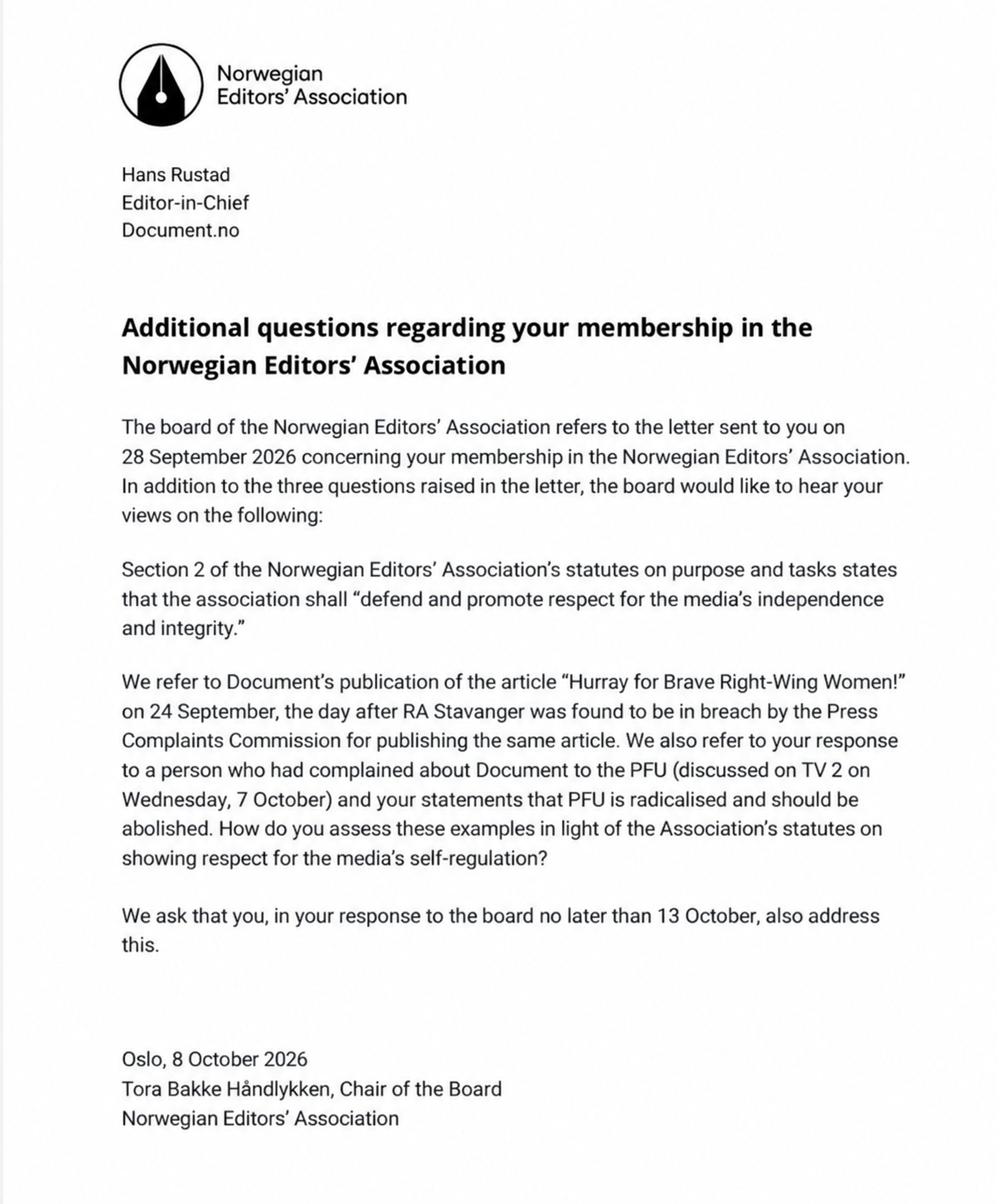
The Norwegian Editors’ Association sent a further email on 8 October with supplementary questions: Additional questions from NR
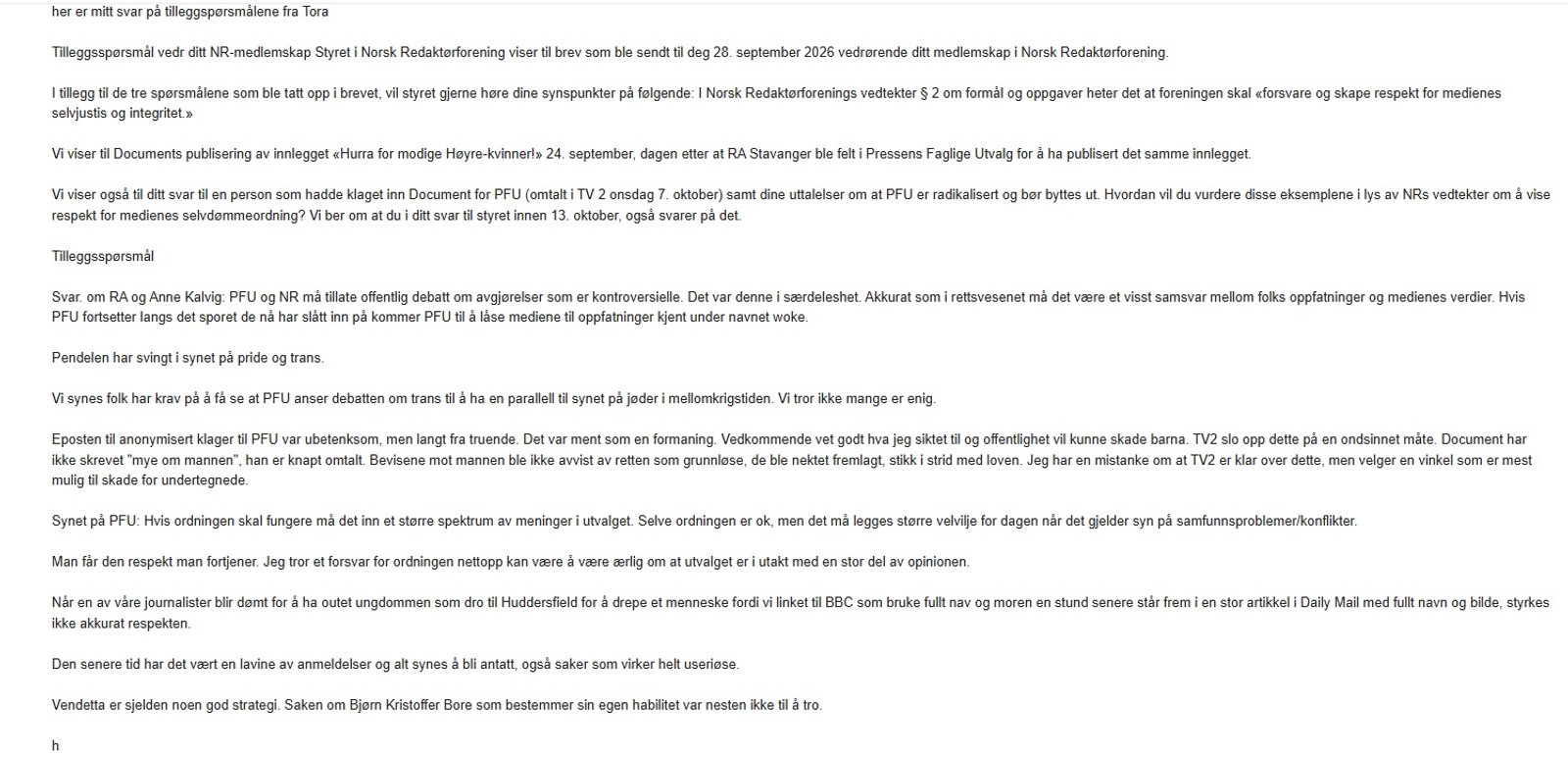
This was answered by Hans in an email dated 13 October 26:
Here is my response to the additional questions from Tora
Additional questions regarding your NRmembership. The Board of the Norwegian Editors’ Association refers to the letter sent to you on 28 September 2026 regarding your membership of the Norwegian Editors’ Association.In addition to the three questions raised in the letter, the Board would like to hear your views on the following: Section 2 of the Norwegian Editors’ Association’s Articles of Association, concerning its aims and tasks, states that the Association shall ‘defend and foster respect for the media’s self-regulation and integrity.’We refer to Document’s publication of the article ‘Hurrah for brave Conservative women!’ on 24 September, the day after RA Stavanger was censured by the Press Complaints Commission for publishing the same article.We also refer to your reply to a person who had lodged a complaint against Document with the PFU (reported on TV 2 on Wednesday 7 October), as well as your statements that the PFU has become radicalised and should be replaced. How would you assess these examples in light of NR’s statutes regarding respect for the media’s self-regulatory system? We ask that you also address this in your reply to the board by 13 October.Supplementary questionResponse regarding RA and Anne Kalvig: The PFU and NR must allow public debate on decisions that are controversial. This was particularly true in this case. Just as in the judicial system, there must be a certain alignment between people’s views and the media’s values. If the PFU continues along the path it has now embarked upon, it will lock the media into views known as ‘woke’.Opinions on Pride and trans issues have swung back and forth.We believe the public is entitled to see that the PFU regards the debate on trans issues as having parallels with attitudes towards Jews in the interwar period. We do not believe many people would agree.The email from the anonymised complainant to the PFU was thoughtless, but far from threatening. It was intended as a warning. The person in question knows full well what I was referring to, and publicising it could harm the children. TV2 reported on this in a malicious manner. Document has not written “much about the man”, he has barely been mentioned. The evidence against the man was not dismissed by the court as groundless; it was refused permission to be presented, in direct contravention of the law. I suspect that TV2 is aware of this, but is choosing an angle that is as damaging as possible to myself.Views on the PFU: If the system is to work, there needs to be a broader spectrum of opinions within the committee. The system itself is fine, but greater openness is needed when it comes to views on social issues and conflicts.You get the respect you deserve. I believe one way to defend the system is precisely to be honest about the fact that the committee is out of step with a large section of public opinion.When one of our journalists is convicted for having outed the young people who travelled to Huddersfield to kill someone – because we linked to a BBC article that used their full names – and their mother subsequently appears in a major article in the Daily Mail with her full name and photograph, this does not exactly strengthen respect.Recently, there has been an avalanche of complaints, and everything seems to be accepted, even cases that appear completely frivolous.A vendetta is rarely a good strategy. The case of Bjørn Kristoffer Bore, who decides on his own impartiality, was almost unbelievable.h
Hans Rustad also wrote a commentary in response, which was published on 13 October 2026:


