

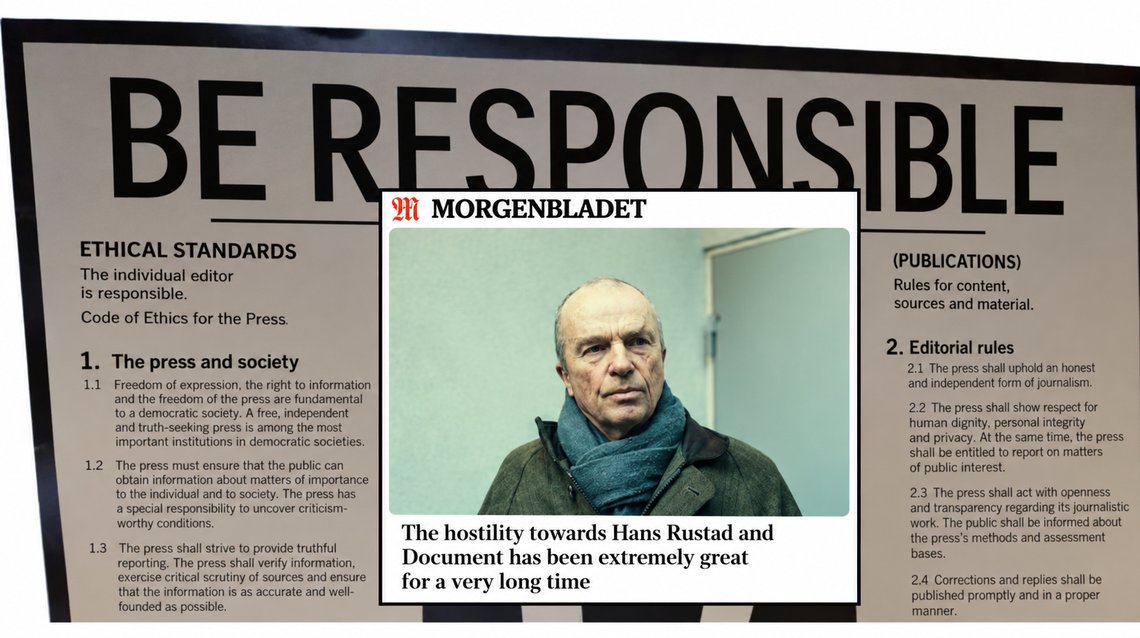
– There is nothing about Document’s activities to suggest that they have such an understanding of what ‘our job’ consists of. Before one has even reached the first point of the Code of Ethics of the Norwegian Press (Vær Varsom-plakaten), Document has already opted out.
Bernhard Ellefsen, culture editor at Morgenbladet, believes that patience with Hans Rustad and Document has been far too great for far too long.
In a lengthy commentary, he criticises the editors who have argued, for various reasons, against excluding Hans Rustad from the Norwegian Editors’ Association.
In the commentary, he makes serious accusations against us at Document. I have therefore sent him questions about these accusations, which you will find further down in the article.
It is no longer merely about what Ellefsen thinks of Hans Rustad or Document. It is about whether Document is engaged in journalism at all within what he considers to be the framework of an editor-controlled medium.
Ellefsen’s main argument is that the problem with Rustad primarily concerns editorial responsibility. He believes that Document can no longer be regarded as an editor-controlled medium, and that the fundamental principles governing editor-controlled media, such as verification of information, right of reply, balance and the pursuit of truth, are absent.
Among other things, he highlights Document’s coverage of the Shada case and believes that this case alone should have led to a review of Rustad’s membership of the Norwegian Editors’ Association.
He also writes that what Hans Rustad does at Document cannot be encompassed by the concept of editorial responsibility, and that a truth-seeking journalistic practice would make many of Rustad’s opinions ‘impossible to maintain’.
These are some of the most serious claims Ellefsen makes. When reading the commentary, it is difficult to avoid noticing the contempt for us at Document that shines through.
Below are my questions to Ellefsen. Should he respond, I will update the article.
Questions for Morgenbladet’s Bernhard Ellefsen
You write that Rustad’s opinions are secondary from a press perspective, and that the greater problem is his relationship with editorial responsibility. You refer to the Declaration of the Rights and Duties of the Editor (Redaktørplakaten), which is based on the premise that the press has a professionalism, a professional code of ethics and a distinctive character that distinguish it from other forms of communication in the public sphere.
You then make a serious claim against us at Document:
Rustad and his website have no visible interest in being such an actor, what we describe with the dry characterisation ‘editor-controlled medium’.
I interpret this as meaning that you believe that the entire editorial staff, and we journalists who work at Document, have no interest in professionalism and professional ethics, nor any genuine interest in practising journalism.
Is that what you mean? And if so, how have you arrived at this conclusion?
Conspiracy theories
You then continue with serious accusations against all of us at Document. You write:
At Document, attempts to find out what is going on in the world are often subordinate to the extreme conspiracy theories that underpin them.
Can you elaborate on which conspiracy theories you are referring to, and which specific articles or cases in Document you believe are based on them?
You go on to write:
The fundamental principles to which editor-controlled media are subject – concerning right of reply, verification of information, balance and the pursuit of truth – are absent.
This is not a claim about a single article or a single case. You write that these fundamental journalistic principles are ‘absent’ at Document.
Document has published hundreds of thousands of articles over the years. I myself have written close to 1,700 articles for Document during the four years I have been here, based on research and source references.
Many of them are analyses of media coverage of the United States, in which I have found countless lies, half-truths and distortions. I would be happy to send you some examples.
On this basis, how can you conclude that right of reply, verification of information, balance and the pursuit of truth are ‘absent’ at Document? What factual basis do you have for such a sweeping claim?
Truth-seeking journalism
You write:
The problem with Rustad’s continued membership of the Editors’ Association is that it hollows out what it means to be an editor-controlled medium. The idea of editorial responsibility cannot be stretched so far that it encompasses what Hans Rustad does at Document.no. Then it breaks and becomes nothing. To the extent that his ‘opinions’ are relevant, the point is that a truth-seeking journalistic practice would have made many of them impossible to maintain.
As mentioned above, I have written a number of analyses of Norwegian media coverage. After you and two other journalists at Morgenbladet resigned, I have also analysed your articles in Morgenbladet.
In one of your articles, about the so-called Gestapo coat, I found conspiracy theories, falsehoods and a journalistic presentation that was far removed from what you yourself describe as truth-seeking journalism.
I am now working on an article by Ingeborg Bergem about Trump supporters. Her portrayals give a false picture of millions of working-class people, and the article would have problems with several of the principles in the Code of Ethics of the Norwegian Press.
You also speak of smear campaigns in the open letter about Hans Rustad. I would characterise both your article about Bovino and ICE agents as a smear, in the same way as Bergem’s article about Trump supporters, in which she places millions of them in a racist category.
So the question becomes:
What specific criteria do you use when assessing whether a journalistic practice is truth-seeking, and do the same criteria apply to Morgenbladet’s journalists as to Document?
We do not understand our job
You continue with your dishonest accusations against Document:
For the rest of us, it hurts to be found in breach by the Press Complaints Commission (PFU). Then we have made mistakes; we have not succeeded in our job. But there is nothing about Document’s activities to suggest that they have such an understanding of what ‘our job’ consists of. Before one has even reached the first point of the Code of Ethics of the Norwegian Press, Document has already opted out.
Can you elaborate on what you mean when you say that ‘nothing about Document’s activities’ suggests that we have an understanding of what ‘our job’ consists of?
You accuse us of having ‘opted out’ before we have even reached the first point of the Code of Ethics of the Norwegian Press. What is interesting is that point 1.1 establishes that freedom of expression, freedom of information and freedom of the press are fundamental elements of a democracy.
Is there not then reason to ask whether it is you who are violating this fundamental principle when you attempt to deprive Document of its status as part of the free and independent press?
The Shada case
You highlight one specific case, the Shada case, and write that it ‘should in itself have resulted in a review of the membership’.
If by this you mean that one case is sufficient to have an editor’s membership reviewed, you must explain why.
And what is it that makes the Shada case at Document so extraordinary that you believe it ‘in itself’ ought to be enough?
But if one case is enough to call an editor’s membership into question, one must also ask what standard you believe should apply to other editors and media outlets.
There are countless examples of extensive and co-ordinated media coverage in which key information has been incorrect, omitted, incomplete or directly misleading. The coronavirus pandemic, Russiagate, the coverage of Joe Biden’s cognitive health, the Hunter Biden laptop, the Covington case, the Birgitte Tengs case, the Baneheia case, the Erik Schjenken case, the Hamse Ali case and the 17 May attack on graduating pupils (russ) in Bergen are just some examples.
A threat to freedom of the press
I follow events from the other side of the Atlantic and am astonished by what I perceive as systematic persecution of those who do not follow the established consensus. This applies not only to Document, but to many others as well.
I have also written a commentary on your article in which you accuse Donald Trump of attacks on freedom of expression and freedom of the press.
My final question to you is therefore:
Is not what you and your colleagues are now doing to Document precisely what you accuse Trump of doing to the press? Or does one rule apply to you and another to us?


