

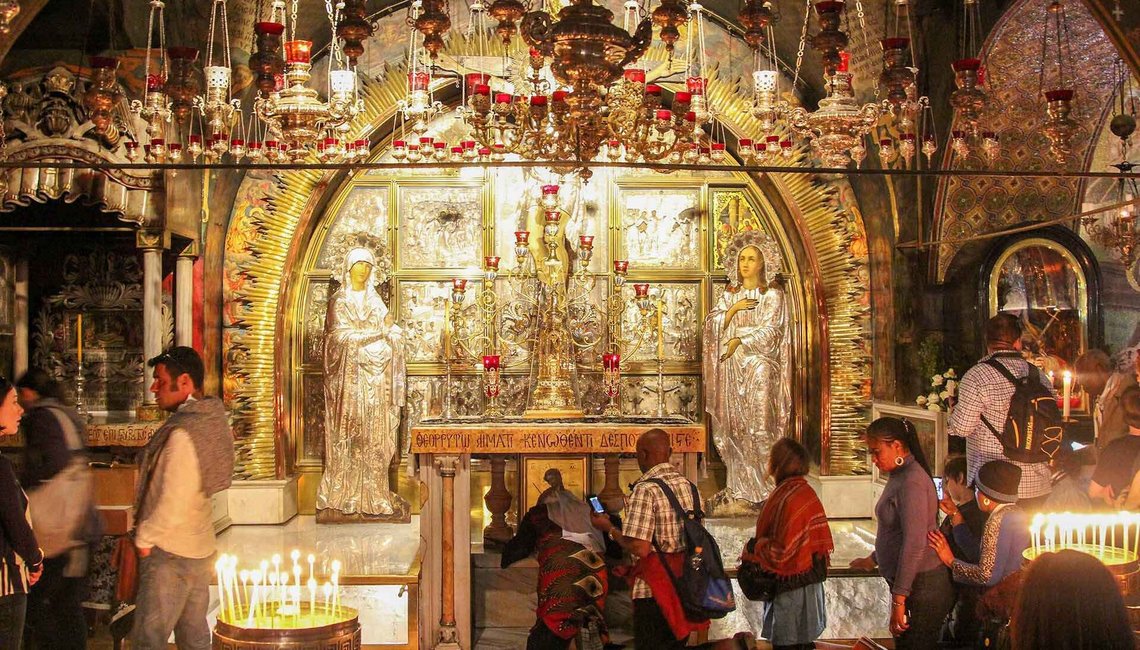


Italian archaeologists have uncovered remains of an ancient landscape beneath the Church of the Holy Sepulchre in Jerusalem that correspond with the descriptions in the New Testament of the place where Jesus was crucified and buried. The findings are presented in a preliminary study in the archaeological journal Liber Annuus.
The excavations are being led by Francesca Romana Stasolla of Sapienza University of Rome. They began in 2022 in connection with the restoration of the church floor and continued in 2025. Beneath the church, researchers found an abandoned quarry, cultivated areas with traces of olive trees and vines, several tombs cut directly into the rock and a landscape that can be described as a mixture of burial ground, garden/agricultural area and grazing/livestock pasture.
The Church of the Holy Sepulchre, one of Christianity’s holiest sites
This accords with John 19:41:
«Now in the place where Jesus was crucified there was a garden; and in the garden a new sepulchre, wherein was never man yet laid.»
Other biblical texts also describe the crucifixion as having taken place near Jerusalem, but outside the city gate, and the tomb as having been cut out of rock. In Jesus’ time, the quarry lay precisely outside the city walls of the period.
Stasolla has said that the team has found «evidence of a landscape shaped and used specifically for burials and the cult of the dead», together with small areas planted with vines and olive trees, in keeping with the Gospel’s reference to a green area between Golgotha and the tomb.
'True tomb' of Jesus Christ found after 2,000 years – and it matches the Biblical telling https://t.co/Obawtq89Ii pic.twitter.com/g1edsnd3Ak
— New York Post (@nypost) August 27, 2026
The Church of the Holy Sepulchre, also called the Church of the Resurrection and the Holy Sepulchre, was built in the fourth century under Emperor Constantine on a site that was already regarded at the time as the place of Jesus’ crucifixion and burial. One of the burial chambers was built over by the Romans under Hadrian before Constantine’s men removed the Roman structures and isolated the tomb as a holy site.
The archaeologists emphasise that the findings do not prove that the particular chamber is Jesus’ tomb. What has been uncovered is a landscape that corresponds with the topographical and functional features described in the Gospel – quarries that were subsequently used for agriculture and burials.
– The real treasure we are uncovering is the story of the people who made this place what it is by expressing their faith here, says Stasolla. Whether one believes in the historical identification or not, it is an objective fact that generations of people have done so.
The Church of the Holy Sepulchre is one of Christianity’s holiest sites and attracts millions of pilgrims annually. The traditional identification of the site has stood firm for almost 1,700 years. The new findings provide archaeological support for the fact that in the first century the area actually had the kind of landscape described in the Gospels – strengthening the traditional location without constituting definitive proof.
Armenia is building what will be the largest statue of Jesus Christ in the world 🇦🇲✝️ pic.twitter.com/karGINnLkJ
— Trad West (@trad_west_) May 18, 2026


