



Turkish Ismail Cüneyt Güzey from the “Bryggemoskeen” mosque, Det Muslimske Samfunnet(‘The Muslim Community’) in Trondheim, was among various religious leaders who lit candles at the national memorial service for King Harald at Nidaros Cathedral on Sunday. It was broadcast live on NRK TV, as was the memorial service at Oslo Cathedral earlier in the day. There, men in turbans took part in the candle-lighting and were allowed to say a few words about difference.
Solemn memorial services
There were solemn memorial services throughout the country on Sunday, two days after His Majesty King Harald died. The nation is in mourning, and people filled the churches to pay him their final respects and express their sorrow. Two of these services were televised, from Oslo Cathedral and Trondheim Cathedral, that is, Nidaros Cathedral.
Diversity in both Oslo and Trondheim cathedrals
Solemn and beautiful services, but the two cathedrals had also chosen to give them a distinct character of “diversity”, in the form of participants from other religions being actively brought to the fore in the service.
– Through his work, the King acknowledged the diverse Norway – and opened the community to everyone, said Anne Sender from the lectern in Oslo Cathedral. She is a convert to Judaism and was formerly head of Det Mosaiske Trossamfund.
This was followed by candle-lighting involving, among others, Bishop Fredrik Hansen of the Catholic Church, and two men in turbans, who were not introduced. We can perhaps assume that they are Sikhs?
– We light candles for children and young people, for faith in the future and hope, said one of the men in turbans.
Lit candles for difference
The other was also supposed to say something, but was more or less lost for words. NRK, however, subtitled what he was presumably supposed to have said:
– We light candles for unity in our differences and respect in our encounters with one another.
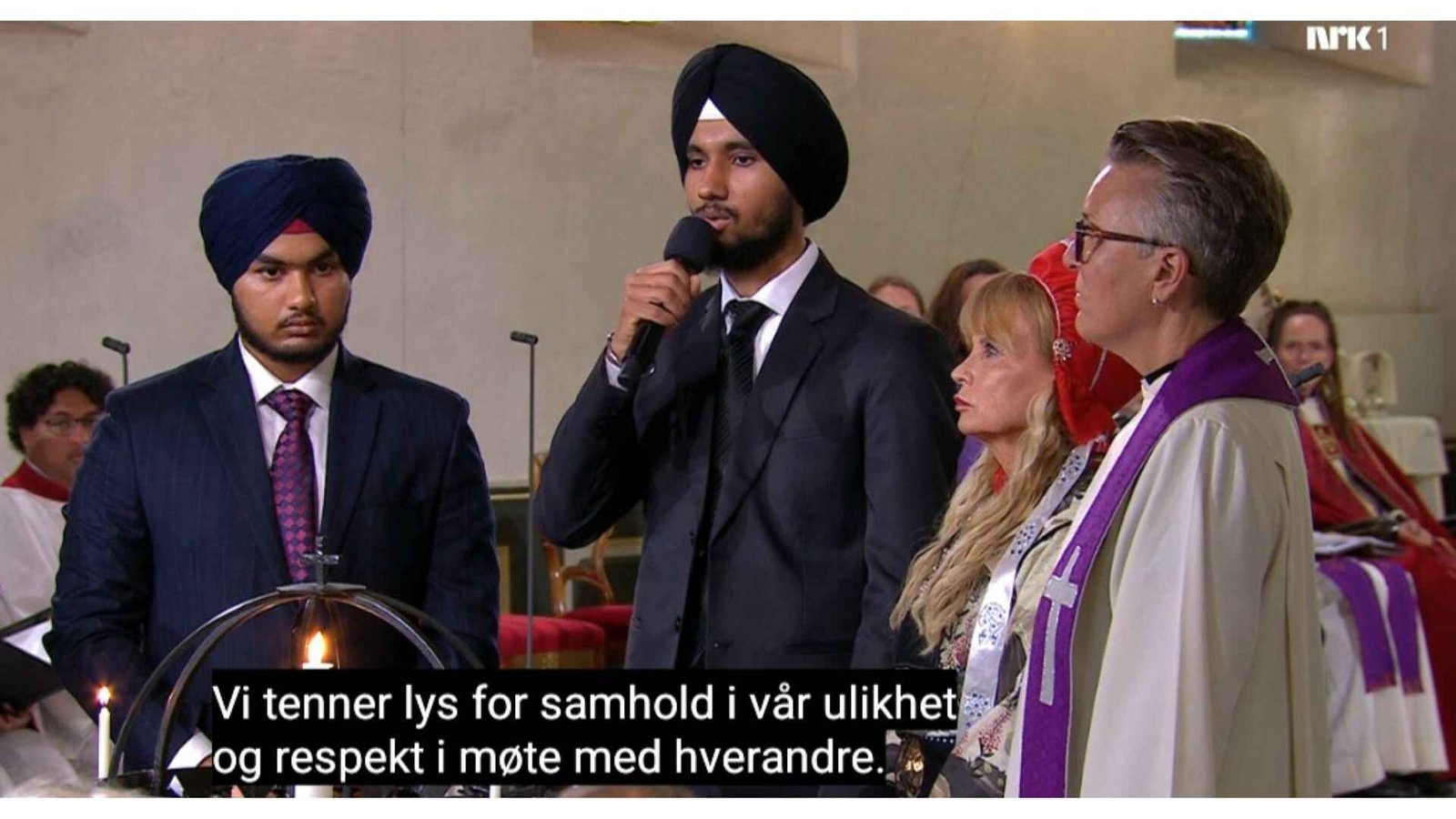 Two men in turbans lit candles for difference during the memorial service at Oslo Cathedral on Sunday, 30 August 2026. NRK did not give the names of those lighting the candles. Photo: NRK.
Candle-lighting is a Christian tradition
Lighting candles for our dead is an ancient Christian tradition. Jesus himself said:
“I am the light of the world,” and that “Whoever follows me shall not walk in darkness, but have the light of life.”
Nevertheless, it is important for our foremost churches to involve other religions in important services. There was a little about the Koran as well in the Christmas service broadcast live from Nidaros Cathedral in 2024.
Mosque leader in front of the altar
In Trondheim, mosque leader Ismail Cüneyt Güzey was among the four who took part in a candle-lighting ceremony up in front of the choir and high altar in Nidaros Cathedral. The other four were introduced by name by NRK, but in addition to the Muslim leader, one wore a Jewish skullcap, one had a large cross and was possibly an Orthodox Christian, while no information was given about who the female representative was.
Ismail Cüneyt Güzey is Turkish, has been involved in Trondheim’s largest mosque since its inception, converts Norwegians to Islam, and is the mosque’s public face at Ramadan celebrations, whether these are held in the city’s schools or sports halls. Güzey is a professor at NTNU in his day job, but also a guide at the mosque, something we experienced under the auspices of this year’s Olavsfestdager.
https://www.document.news/editorials/2026/08/olavsfest-concludes-with-mosque-visit-and-pilgrim-mass
King Harald’s no – to de-Christianisation
King Harald was a Christian. When the Storting in 2008 wanted to remove the provision in Article 4 of the Constitution requiring the King always to profess the Evangelical-Lutheran religion, King Harald said no. He would not have it. He defied the parliamentary majority and used his veto to stop the constitutional amendment at the time. “God bless our good King”, Kjell Skartveit now writes about that matter.
In 1991, King Harald chose to be consecrated at Nidaros Cathedral when he became King.
“May God preserve our country,” King Haakon VIII said as he concluded his first address as King. You can read it here.
We must believe that, like his father, he meant our Christian God.
“I am the way, the truth and the life. No one comes to the Father except through me,” Jesus said.
https://www.document.news/editorials/2026/08/king-harald-is-dead-the-last-king-of-the-old-norway/


