

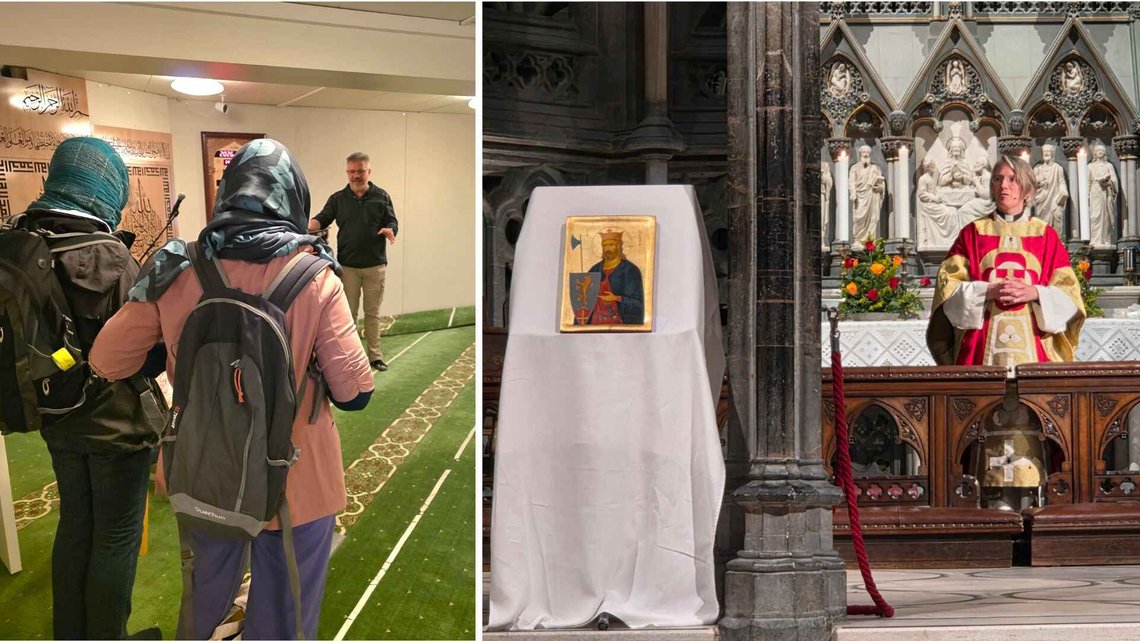


The Olsok festival in Trondheim, Olavsfest, offered a visit to the “Bryggemoskeen” mosque in Kjøpmannsgata towards the end of the festival. It provided a stark contrast to the pilgrim Mass on the same day, when the Flame of St Olav was brought into Nidaros Cathedral, after having been carried from Stiklestad.
Church festival since 1963
Olavsfestdagene in Trondheim, the country’s largest Christian cultural and music festival since 1963, has been de-Christianised by the new management, which now calls it a festival of values, and which is inviting ever more Islam and Muslims into the traditional church festival. Given that the Muslim rapper Jonas Benyoub was allowed to use Nidaros Cathedral to hold a late-night concert there this year, it is not so surprising that Olavsfest also offered a visit to a mosque. This time with the Council for Religious and Life Stance Communities (Samarbeidsrådet for tros- og livssynssamfunn, STL) as guide.
Olavsfest with mosque visit
The mosque of Det Muslimske Samfunnet in Trondheim (MSiT) receives visits from thousands of schoolchildren every year, but the visit organised by Olavsfest was not quite so overwhelming. There were four or five of us ladies, plus lawyer Leif Strøm, who took up the offer. This included tour leader Ragnhild Folkestad, who as recently as 2023 was a student humanist under the auspices of the Norwegian Humanist Association (Human-Etisk Forbund) in Trondheim.
 From the Olavsfest tour of the “Bryggemoskeen” mosque. NTNU professor Ismail Cüneyt Güzey of Det Muslimske Samfunnet in Trondheim and Ragnhild Folkestad of the Council for Religious and Life Stance Communities (STL). Photo: Bente Haarstad.
Bryggemoskeen is building a grand mosque
The MSiT mosque is housed in a listed warehouse dating from 1760, in the row of warehouses facing the River Nidelva in Trondheim. The mosque has 3,400 members and has long had plans to convert the warehouse into a grand mosque extending across all four floors of the ancient warehouse. The conversion is expected to cost NOK 76 million, NOK 42 million initially, and fundraising has been under way for several years, as these people, too, do not appear to take out interest-bearing loans in order to spread Islam in Trøndelag.
We were not given a tour of the floors where construction work is under way. The work is fairly extensive when a Norwegian warehouse is to be converted into mosque premises for men, separate premises for women, for new Muslims whom they expect will convert, and for a Koran school for children and young people.
Instead, we were accommodated in a meeting room with a huge safe in one corner, a picture with the name “Allah” rendered in 50 different ways, and a view of good old Trondheim, with the River Nidelva and the row of warehouses on the other side of the river.
Mosque leader and professor at NTNU
Ismail Cüneyt Güzey was the person who was to “tell us about how truth is conceived and practised in Islam and in their community. Those who wish to do so will also have the opportunity to attend prayer time and experience how Muslim prayer takes place.”
The Turkish Güzey works as a psychiatrist at Trondheim’s university hospital, St Olav’s, in a 100 per cent position, in addition to being a professor at NTNI in a 20 per cent position, he told us. In addition, with his multifaceted background, he is often the mosque’s public face. Such as when Adresseavisen produces colourful Ramadan reports. As in 2024, when NTNU dean Monica Rolfsen also took part in the celebration marking the breaking of the fast. Güzey also said that it was he who, in his time, got Muslims in Trondheim to buy the ancient warehouse in the early 2000s, after the Muslim organisation was established in 1990 by Muslim students who had made their way to Trondheim.
Professor and psychiatrist Güzey naturally had much that was positive to say about Islam. There was no great enthusiasm when it came to the question-and-answer session, but lawyer Leif Strøm, who works, among other things, with immigration law, spoke about conversations with young Somalis who believed that Islamic sharia stood above Norwegian law.
Güzey dismissed this by saying that they were young, eager and knew little. Such as the fact that Muslims in non-Muslim countries are required to abide by the laws of the country. He said nothing about what might happen if non-Muslims eventually become a minority. As they did, among other places, in his home country, Turkey. This followed the Muslims’ vigorous use of the sword, with the result that Christians now make up only about 0.1 per cent of the formerly Christian country.
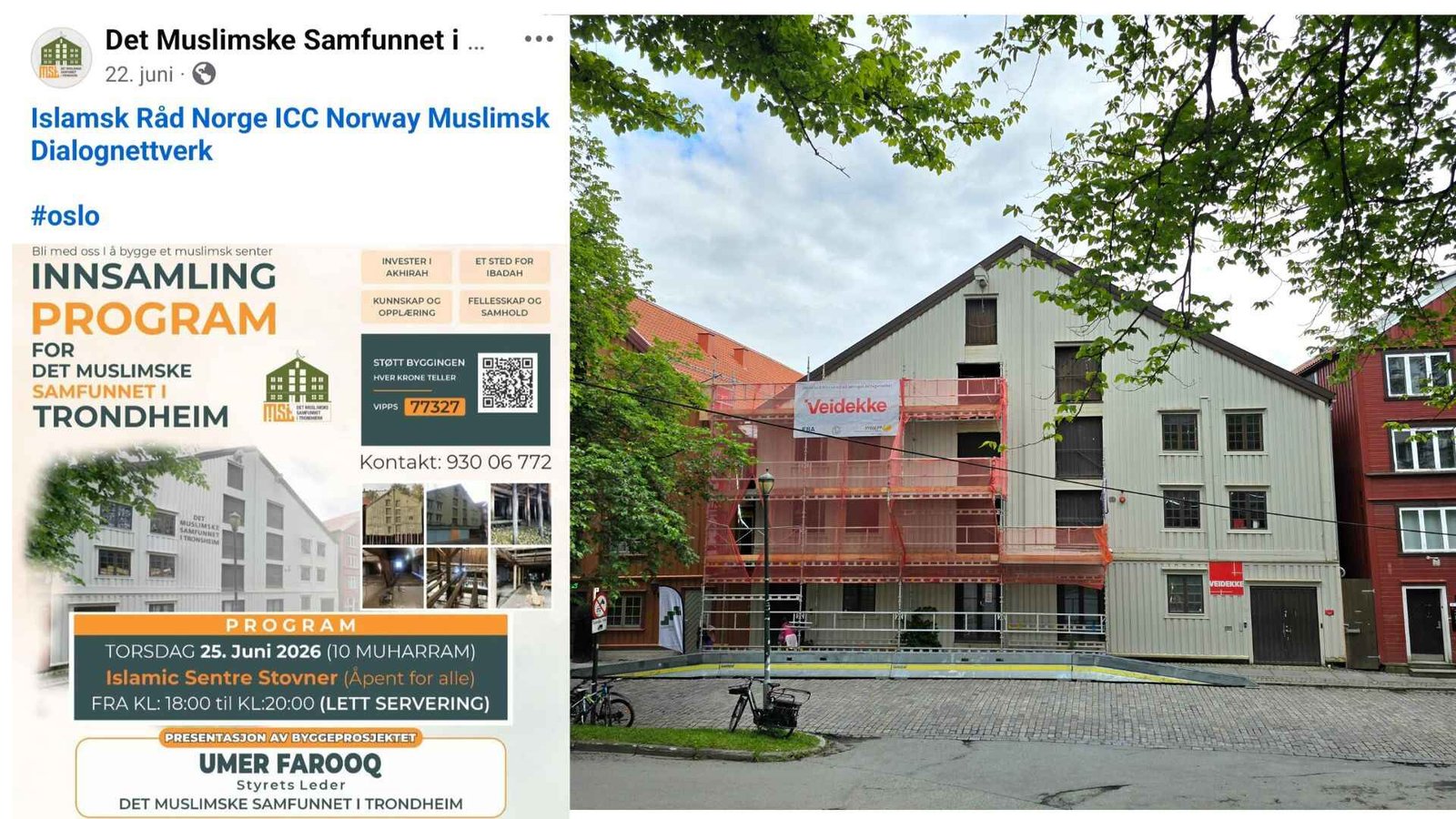 Det Muslimske Samfunnet in Trondheim was not allowed to retain the green colour of the warehouse it uses as a mosque. Mosques and Islamic organisations around Norway are helping to raise money for the conversion of the Bryggemoskeen into a grand mosque. Photo: Facebook/Bente Haarstad.
We heard about how expensive it was to convert a warehouse into a grand mosque, and about how much trouble they had had with the Directorate for Cultural Heritage and the heritage authorities. Nothing was said about why they wanted a mosque in an ancient, historic building when it is easier to build a new one outside the city centre.
– We were not even allowed to retain the green colour on the outside of the mosque, but had to paint it a white colour that had been the original one. It cost us a great deal, and we only had 20 per cent of the additional cost covered, said Ismail Cüneyt Güzey.
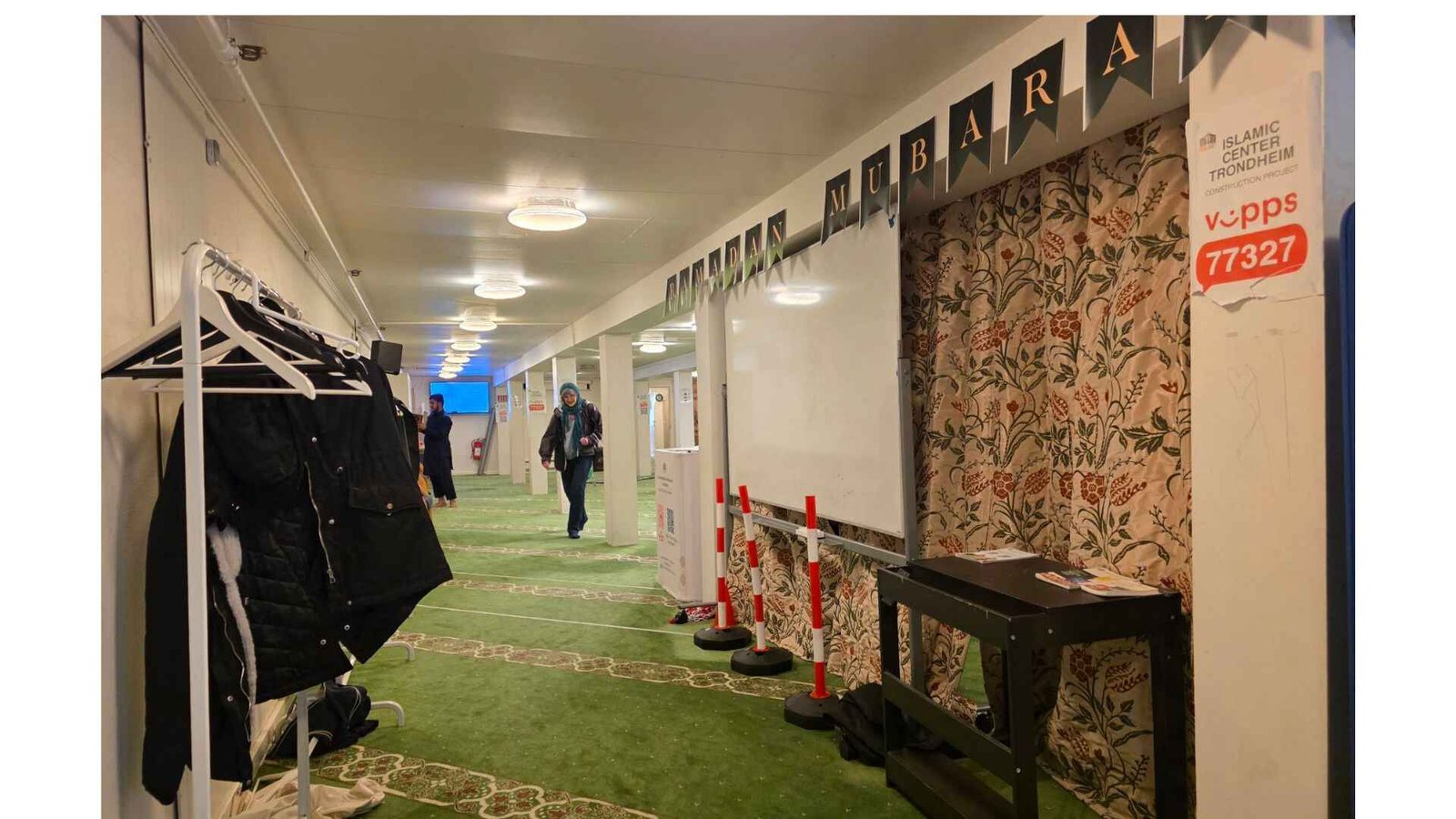 On the way out, we passed the women’s section of the Bryggemoskeen (right), which was screened off by curtains. It was also very small, but that will probably be different when a separate section is built solely for women. That is to say: They will presumably be allowed to bring small children with them. Photo: Bente Haarstad.
Then it was out into the prayer room, which is now far too small, so they have to build a new and large one. There, the visiting women covered their heads, even though there is normally no requirement for non-Muslims to do so. Then chairman Umer Farooq arrived with “goodie bags” for the guests. They contained two Islamic texts that I have not yet had time to read.
The Flame of St Olav arrived at Nidaros Cathedral
It was a relief to go to Nidaros Cathedral afterwards, since Olavsfest has traditionally celebrated St Olav and Christian cultural heritage, and not its opposite. There, the Flame of St Olav was to be carried into the cathedral, after having been transported on foot from Stiklestad.
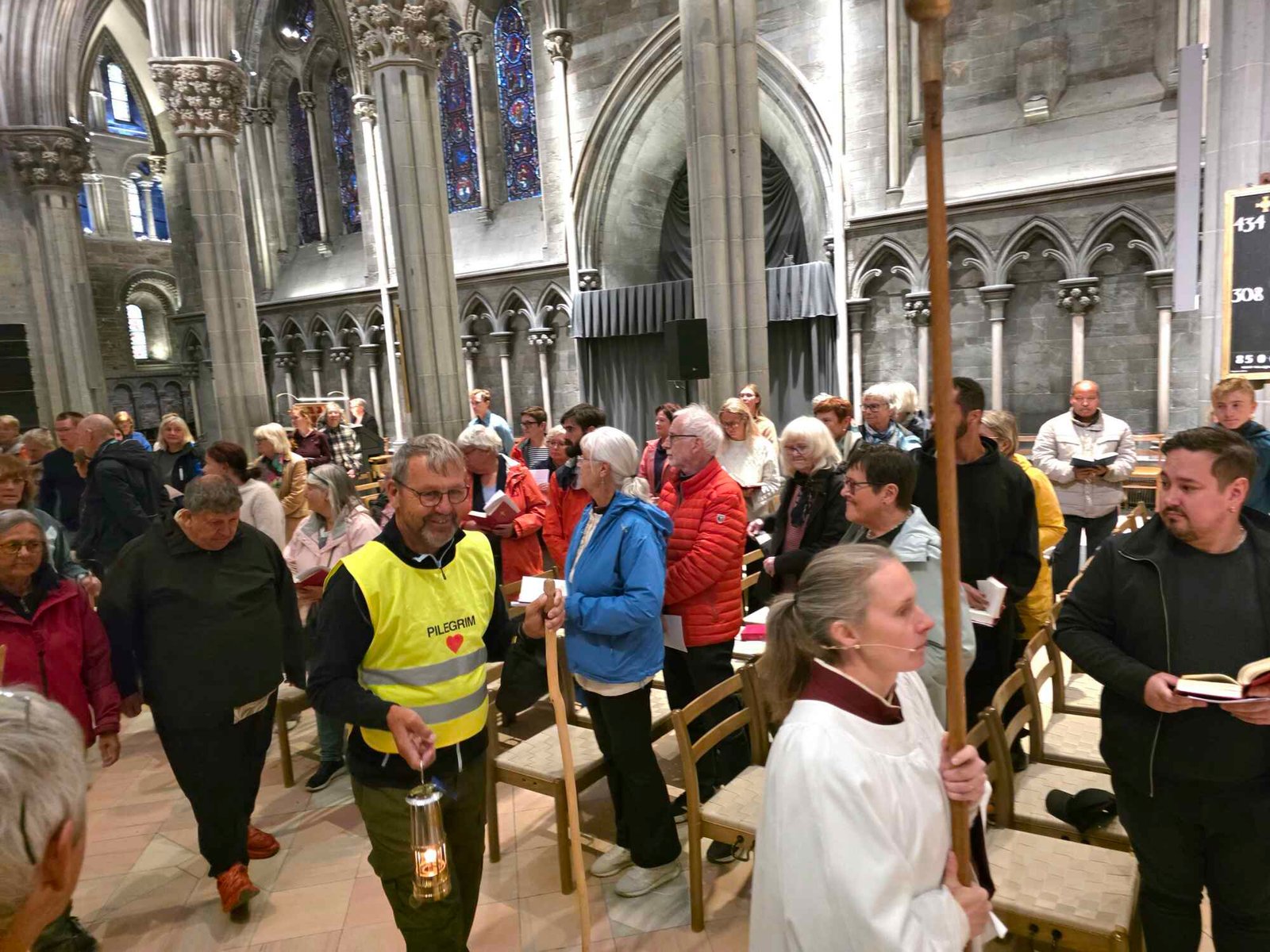 Olav Reitan of the Pilgrim Fellowship in Sandefjord brought the Flame of St Olav from Stiklestad to Nidaros Cathedral. On foot. Several others from the pilgrim fellowship also took part. Photo: Bente Haarstad.
It was a very solemn occasion, and the pilgrim Mass that followed was well attended, after the altar candles had been lit with the flame brought from Stiklestad, where the Flame of St Olav was lit on 29 July 2020 and is to burn continuously until the millennium of Norway’s Christianisation in 2030. Sorry: it is now called the “National Jubilee”, in the interests of inclusivity, and a Muslim from Tehran is, moreover, the head of the planning committee, since that event too appears somewhat de-Christianised, like Olavsfest.
 Pilgrim priest Ingrid Bolstad Kunzendorf, together with Olav Reitan of the Pilgrim Fellowship in Sandefjord, who brought the Flame of St Olav from Stiklestad to Nidaros Cathedral. Photo: Bente Haarstad.
Splendid pilgrim Mass
Parish priest Andreas Hilmo Grundy-Teig spoke about St Olav in his sermon, and only a tiny bit about the climate, while pilgrim priest Ingrid Bolstad Kunzendorf spoke only a little about being mindful of and respecting people of other faiths, and mostly about a Christian message to pilgrims and others. So, all in all, it was a very rewarding occasion in Nidaros Cathedral, right at the end of this year’s Olavsfestdagene. Which the organisers now call Olavsfest.
Muslim får låne Nidarosdomen for nattkonsert under Olavsfest


