

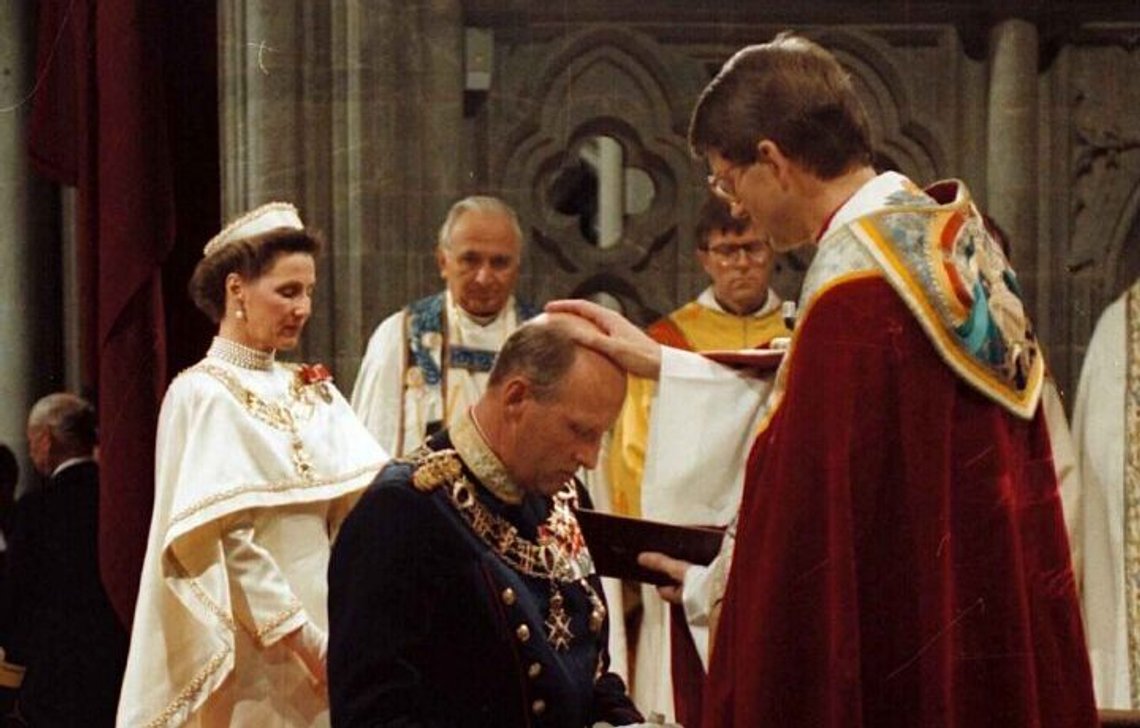


God bless our good King!
Bless him with strength and courage,
bless home and palace!
Shine upon him through Your Spirit,
bind with Your strong hand
holy bonds of loyalty
around people and sovereign!
Solemnly swears Norway’s man,
each in his calling, his station,
loyalty to his sovereign.
Faithful in life and death,
valiant in war and distress,
always our Norway obeyed
God and its sovereign.
When King Harald died on Friday morning, a beloved king passed away. His position as the people’s king was unique. With a presence, empathy and interest in Norway’s inhabitants, he created a sense of unity and community that was not contrived.
King Harald showed how it was possible to give the monarchy significance in a postmodern chaos. It must be permissible to say that he reflected a biblical ideal of kingship without being a king who had the authority to act according to this ideal. He appeared as someone who saw, listened to and cared about the entire people, including those who did not support the government, and in a very special way marked the continuity between the generations.
But it was not a given that it would turn out this way.
When Norway acquired a constitutional monarchy in 1814, this meant that the King had very different powers from those the King has in our own time. This power was greatly reduced with the introduction of parliamentarianism in 1884. When the union with Sweden was dissolved in 1905, the Storting wanted Norway to remain a monarchy, and at the insistence of the Danish Prince Carl, the question was put to the people. An overwhelming majority voted to offer him the Norwegian throne.
But the Christian faith remained a central part of the monarchy. King Haakon VII, King Olav and King Harald have all always had clear ties to the Church and the Christian faith.
Nor should we underestimate the importance of good leadership, including for constitutional kings. King Haakon VII will forever be remembered for his refusal to submit to Germany in the days of April 1940 and for his subsequent efforts during the war. King Olav managed to create a new role for the monarchy in post-war Norway. His tram journey during the oil crisis of 1973 showed us that equality before the law should not be an empty ideal.
Many were therefore eager to see how King Harald would fulfil the role of King. Would he be a blessing to the people, as his father and grandfather had been?
Although, with parliamentarianism, the King had lost most of his independent political power, King Olav and King Haakon VII demonstrated that they still had room for manoeuvre within which they could perform their duties. King Harald could therefore not “rule justly” in the biblical sense in the same way as a king with real political authority. But he appeared to be conscious of the opportunities that still remained.
And King Harald demonstrated something of this in 2012.
Until 2012, Article 4 of the Constitution required the King to profess the Evangelical-Lutheran religion and, under Article 16, gave him responsibility for “ordering all public Church and Divine Service”.
In practice, this meant that the executive power had a constitutional responsibility for the organisation and activities of the Church.
When the constitutional amendment was adopted on 21 May 2012, the King’s responsibility for the Church was removed, but the requirement to profess the Christian faith was retained. Article 4 was somewhat reduced, but the King was still required to “profess the Evangelical-Lutheran religion”. The provision requiring him to “uphold and protect” this religion was removed.
What is interesting is that King Harald himself expressed a desire for the revised Constitution to retain the requirement of a duty of confession. What we witnessed was a king who wanted the King’s Christian confession still to have a place in the Constitution. This suggests that he believed this duty still had significance for the country. We have acquired a society in which it has become difficult to speak of God as a reality, including in political contexts. But through King Harald’s efforts on behalf of the duty of confession, faith remains written into the Constitution as a prerequisite for the office of King, and that is no small achievement given the spirit of the age.
As a Christian, I experienced King Harald as a king who understood his role within strict constitutional limits. It is therefore difficult to judge him for certain speeches he has given, and for what he may not have been permitted to say and do. In any event, he demonstrated a care for his people that resonates both in our history and in biblical history. The Bible uses strong words about what a good king should be to his people: one who sees the poor, hears the helpless and seeks justice. I believe many experienced King Harald in this way.
We must therefore pray that King Haakon VIII takes up the legacy of his forefathers. There are many who believe that the monarchy is outdated, but given how circumstances have developed, everything suggests that, paradoxically, we need the stability that a healthy, well-functioning Royal House can provide us.
May God bless King Haakon VIII and Queen Mette-Marit.


