

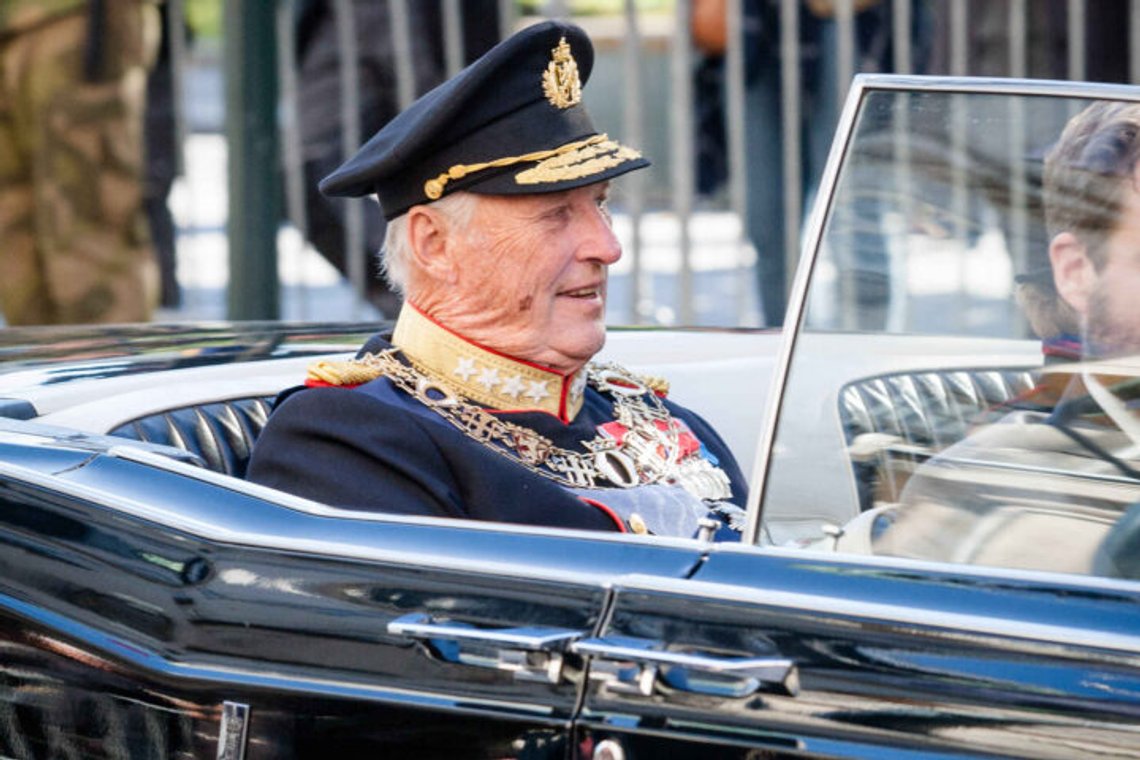


King Harald V has died at the age of 89. He was a dutiful king, a warm and humorous man, and a unifying head of state in the nation’s darkest hours. But he never became the people’s king in the way his father, King Olav, had been. Harald inherited a royal house at the height of its popular authority. He leaves it in one of its most difficult situations since the war.
King Harald died at 6.35 a.m. on Friday, 28 August 2026, the Royal House announced.
He is succeeded by his son, Crown Prince Haakon, who becomes King of Norway.
Harald V occupied the throne from 17 January 1991, when King Olav died. For more than 35 years, he carried out his duties with a profound sense of duty.
When other European monarchs began to abdicate, Harald made it clear that the oath he had taken was for life. He kept that promise.
Born into history
Harald was born at Skaugum on 21 February 1937, the son of Crown Prince Olav and Crown Princess Märtha. He was the first prince in the direct Norwegian line of succession to be born in Norway in 567 years.
His childhood was marked by war from an early age. When Germany attacked Norway on 9 April 1940, the three-year-old prince had to flee with his mother and his sisters Ragnhild and Astrid. The family stayed first in Sweden and then in the United States, while Crown Prince Olav and King Haakon continued the struggle from London. Only after the liberation in 1945 could the family return home.
Harald thus belonged to the last generation of the Royal House with a personal connection to the Second World War. He grew up knowing that Norway could lose its freedom, and that the position of the Royal Family rested not only on constitutional provisions and ceremonies, but on the role King Haakon and Crown Prince Olav had played during the occupation.
It was a weighty inheritance. It gave the Royal House a moral authority that no subsequent generation could simply take for granted.
When King Haakon VII died in 1957, Olav became king and Harald crown prince. Harald underwent military training and studied, among other subjects, history, economics and social sciences at Oxford.
His love for Sonja
In 1959, Crown Prince Harald met a woman who would determine not only the future of the Royal House, but also that of Norway. Love triumphed over duty, and that too had its price. Sonja was a commoner, and marriage between an heir to the throne and a woman without a royal background was still regarded as problematic. The relationship was kept secret for nine years. This suggests that King Olav would have preferred someone of royal birth to ascend the throne.
In the end, Harald made it clear that if he were not allowed to marry Sonja, he would remain unmarried. The line of succession could thus have ended with him.
King Olav eventually gave his consent. The couple married in Oslo Cathedral on 29 August 1968.
Here Harald displayed a firmness that was not always as evident later in life. He put both his own future and the continuation of the dynasty at stake to marry the woman he loved.
Queen Sonja became his most important support throughout a long life. Together they had Princess Märtha Louise in 1971 and Crown Prince Haakon in 1973.
Olav was the people’s king
When King Olav died in 1991, Harald inherited what was probably Europe’s most beloved monarchy.
Olav was the people’s king. The bond between him and the Norwegian people seemed immediate and effortless. The image of the King taking the tram during the oil crisis became an enduring symbol of the closeness between the Royal House and the population.
Harald was different. He had warmth, humour and self-deprecation. Over the years he became well liked, and he could be very funny. But he never became the people’s king in the sense that his father had been. There was a greater distance between Harald and the old Norway than there had been between Olav and the people over whom he reigned.
The difference was not merely one of personality. Norway changed fundamentally during Harald’s reign. The country he inherited in 1991 was already entering a new era. Mass immigration changed the population, while political and cultural elites sought to give the very word “Norwegian” a new meaning.
No Norwegian king had previously experienced a comparable demographic transformation. When Harald ascended the throne in 1991, Norway had a population of around 4.25 million. By the time of his death, the population had grown to more than 5.6 million. Nearly one million were immigrants, and a further 238,000 had been born in Norway to two immigrant parents. Together, these groups accounted for nearly 22 per cent of the population.
This was not merely ordinary population growth. During the reign of a single king, Norway was transformed ethnically, religiously and culturally at a pace none of his predecessors had come close to experiencing. Harald therefore did not merely reign over a country undergoing change. He reigned through the transition from the old, relatively homogeneous Norway to a multicultural society – a historic transformation that also changed what it meant to be a unifying king.
King Harald did not choose to stand apart from this development. He used his royal authority to legitimise the sweeping changes.
The picture was nevertheless not unequivocal. During a state visit to Italy in April 2016, King Harald said that Europe had to do more in migrants’ countries of origin to stem the flow.
– We cannot take in the whole of Africa. It is not possible, the King said.
The statement showed that Harald also recognised the limits of Europe’s capacity to receive migrants. But only five months later, he delivered the speech that would stand as his clearest endorsement of the redefinition of the Norwegian community.
‘Norwegians have also immigrated from Afghanistan’
This was expressed most clearly in the speech at the King and Queen’s garden party in the Palace Park in 2016, when the King said:
“Norwegians are people from Northern Norway, Trøndelag, Southern Norway – and all the other regions. Norwegians have also immigrated from Afghanistan, Pakistan and Poland.”
He went on to describe Norwegians as people of different faiths, ways of life and sexual orientations, before concluding:
“Norway is you. Norway is us.”
The speech was greeted enthusiastically by politicians and the media. It was presented as a warm and modern expression of community.
But it also embodied a particular conception of the nation. Norwegian identity was detached from ancestry, history, culture and continuity. The historic Norwegian people were reduced to one of many groups that happened to reside within the borders of the same state.
For some, this was inclusive. For others, it was a sign that not even the King was willing to defend the old Norway or acknowledge that a country is more than a territory and a public administration.
The King is meant to be a unifying figure and king of all Norwegian citizens. But that is not the same as declaring that any distinction between a historic people and recently arrived immigrant groups is without significance.
Here Harald went further than merely welcoming new inhabitants. He placed the symbolic power of the Royal House behind the cultural redefinition of Norway.
This created a distance between him and many of those who regarded the Royal House precisely as a guardian of the nation’s history and distinctiveness.
The King in a time of grief
At the same time, a fair assessment of Harald must acknowledge his great strength as head of state when the country was struck by tragedy.
After the terrorist attacks of 22 July 2011, he faced a people in shock and grief. The King and Queen were there for the survivors and the bereaved, and Harald found words that united the nation without making himself the central figure.
– When one person can show so much hatred, imagine how much love we can all show together, he said at the memorial ceremony in Oslo.
At such moments, he demonstrated the significance of the monarchy. Politicians represent parties, interests and conflicts. The King, when he succeeds, can speak on behalf of something greater and more enduring.
During the coronavirus pandemic, too, Harald conducted himself with calm and dignity. He thanked those who kept society functioning and reminded Norwegians of their responsibility towards one another.
He was at his best when the task demanded human warmth, gravity and continuity. But here too he was called upon to enter difficult and divisive territory.
The sailor and the competitor
Behind the formal role was a competitive man. Sailing was Harald’s great passion. He represented Norway at the Olympic Games in 1964, 1968 and 1972, and carried the Norwegian flag at the opening ceremony of the Tokyo Olympics. He later became a world champion and European champion. He continued competing well into old age.
At sea, he could be something other than head of state. There he was skipper and team-mate, and results had to be achieved through preparation, endurance and skill.
Sailing revealed aspects of Harald that also characterised his kingship: loyalty, discipline and a determination to see things through.
The family as a burden
Towards the end of Harald’s reign, the standing of the Royal House was severely weakened.
Princess Märtha Louise’s relationship with Durek Verrett, the commercialisation of the princess title and the couple’s many pronouncements damaged the dignity of the Royal House. The boundary between private commercial activity and royal status was repeatedly challenged.
At the same time, the Crown Prince’s family was hit by the cases surrounding Marius Borg Høiby. The allegations and criminal proceedings triggered a crisis that concerned not only a private family member, but also the judgement and culture surrounding the future Royal Family.
The revelations about Crown Princess Mette-Marit’s connections also raised questions that could not be dismissed as mere sensationalist journalism.
Harald tried to protect his family and said little. That was understandable on a human level, but not always sufficient institutionally. The problems of the Royal House were allowed to develop over a long period without clear and visible intervention.
The decisiveness he showed when he fought to be allowed to marry Sonja was harder to discern when his own children challenged the boundaries surrounding the Royal House.
That must form part of an honest assessment of his legacy.
Harald inherited a monarchy sustained by the people’s love for King Olav. He left it to Crown Prince Haakon with significantly lower public support and a Royal Family marked by illness, scandals and uncertainty.
Not all of this was the King’s fault. But it happened in his house and under his responsibility.
Duty above all
Harald’s health became increasingly frail in his final years. He underwent operations, received a pacemaker and was repeatedly admitted to hospital. Crown Prince Haakon increasingly had to serve as regent.
Yet Harald refused to abdicate.
When Queen Margrethe of Denmark handed the throne to her son in 2024, the Norwegian King made it clear that he had no similar plans.
– I have sworn an oath to the Storting, and it is for life, he said.
It was more than a response to a question from the press. The words encapsulated his understanding of the office.
To be king was not a job one left when one’s health failed or one had passed retirement age. It was a lifelong calling and a duty he had undertaken towards the country.
At a time when responsibility is increasingly regarded as temporary and conditional, this was an attitude that deserved respect.
“Alt for Norge” (“All for Norway”) was the motto King Harald inherited from his father and grandfather. Haakon VII chose the words when he accepted the Norwegian throne in 1905. Olav V and Harald V carried them forward. Crown Prince Haakon has not yet chosen his motto; that will happen only when he becomes king. Whether he will continue with the same words remains to be seen. But the question is larger than the wording itself: What will “All for Norway” mean to the new King – and what Norway is it for which he will give everything?
King Harald promised to serve Norway for life.
And that he did.
Now it is for history to decide what remains of the Norway he served.


