

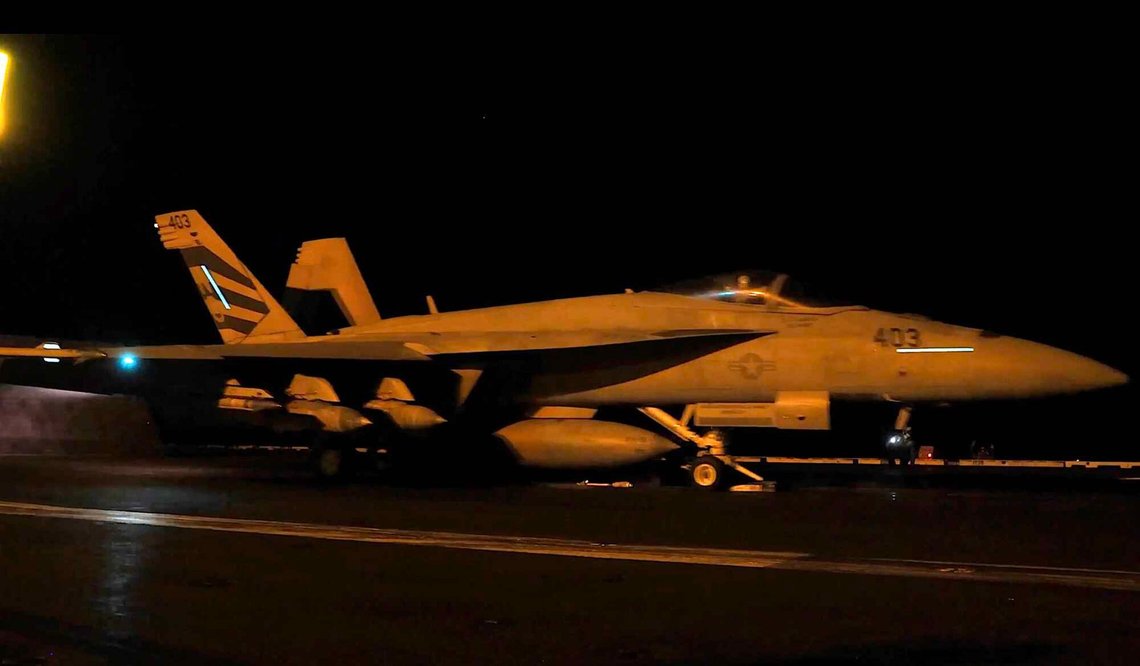


On Friday, 10 July, Iran was, according to the agreement with the United States, supposed to issue a declaration stating that the Strait of Hormuz was open to free maritime traffic. That was how the United States understood the agreement. Instead, however, Iran breached the agreement and that very day launched military attacks against approximately three large vessels passing through the Strait of Hormuz. In response, President Trump said that he believed the Memorandum of Understanding (MOU) should be regarded as dead. Since then, the United States has – for nine consecutive nights so far – carried out military strikes against Iranian targets. Iran, in turn, has responded by attacking Sunni Arab countries.
The question I will attempt to answer concerns the objectives of the parties: What is the United States trying to achieve? And what is Iran trying to achieve?
The first question is reasonably straightforward to answer. The United States’ objective is to compel Iran to keep the Strait of Hormuz open. For the United States, this was above all about international oil supplies – and thus about the global economy itself. If the Strait of Hormuz remains closed, prices rise across the world. If it remains open, prices stay more stable.
Verbally, this objective has been confirmed both by Trump himself and by his entire team. In practice, this objective is likewise confirmed when we examine the targets that the US Central Command (CENTCOM) states each day it attacked during the previous night. Iran’s southern coastline facing the Strait of Hormuz can be compared to an inverted V. Along this entire coastline are militarily significant facilities: military bases, Revolutionary Guard headquarters, naval bases, radar installations, coastal surveillance facilities, missile sites – in addition to hundreds of small boat harbours and mountain caves where Iran can conceal weapons intended for use against maritime traffic.
These are precisely the types of targets that CENTCOM reports every morning it has attacked. From the American perspective, therefore, words and actions appear to confirm one another. The United States is fighting to reopen the Strait of Hormuz.
The picture becomes far more enigmatic when we look at Iran’s attacks in the opposite direction. Some attacks are indeed directed against civilian vessels in the Strait of Hormuz, and there is nothing mysterious about that. Iran is deliberately seeking to keep the “Hormuz card” alive (to use Trump’s card-game metaphor).
What is puzzling, however, is the remainder of the Iranian pattern of attacks. Every day, Shia Iran has launched retaliatory strikes against Sunni Arab countries: Oman, the United Arab Emirates, Bahrain, Qatar – and even Saudi Arabia itself.
This Monday (20/07), it also became known that over the weekend Shia Iran had attacked Israel’s Sunni Muslim neighbour Jordan. More specifically, Iran launched at least four giant missiles at the port city of Aqaba (which lies immediately adjacent to the Israeli port city of Eilat, at the northern end of the Gulf of Aqaba). The United States intercepted three of the four incoming missiles using the Patriot missile defence system (the fourth missile struck uninhabited desert). However, large fragments of the destroyed missiles fell towards inhabited districts of Eilat, forcing Israel to shoot down the debris using its own missile defence system.
Thus, over the weekend Iran came perilously close to launching yet another attack on Israel (despite the fact that the entire world knows that the United States is currently asking Israel to remain as far as possible outside the July war over the Strait of Hormuz).
The question is: Why is Iran retaliating in this peculiar manner? While the United States attacks facilities of every kind along the coast facing Hormuz, Iran responds – apparently indiscriminately – by attacking neighbouring Sunni Arab states. Why? That is the military mystery of the past week. Iran says it is attacking American bases in those countries. Yet in practice it repeatedly misses those bases – by a wide margin (!) – and instead threatens civilian targets.
Actions do not confirm words. Instead, Iran’s actions revive the puzzling question: Why are the Shia Muslims attacking Sunni Muslims? I have read one proposed explanation for this mystery. It is that explanation I shall now examine.
The proposal comes from a retired Israeli general and military scholar. His name is Jaakov Amidror. On a day in June, he gave an interview to a couple of Israeli media outlets. There he explained that, alongside the “Hormuz card”, Iran had threatened the United States with what he called a “North Korea card”.
The “North Korea card” refers to how North Korea, some years ago, defended its illegal nuclear bomb by threatening South Korea. If the international community used force against North Korea’s nuclear programme, North Korea would devastate South Korea with bombardment. The international community realised that it could not defend South Korea. It therefore had no choice but reluctantly to allow North Korea to retain its illegal nuclear bomb.
During the negotiations with Trump in May and June, Iran allegedly threatened to use the “North Korea card” in the Middle East as well. Unless Trump allowed it to complete the eleven almost-finished nuclear bombs inside “Pickaxe Mountain” somewhere, Iran would respond by bombing the neighbouring Sunni Arab states. Inside Pickaxe Mountain near Isfahan, Iran is reportedly said to possess enormous undamaged underground mountain chambers containing enough highly enriched uranium for eleven nuclear bombs.
Iran’s strategic calculation, therefore, is that the United States and Trump would be so alarmed by attacks on their Sunni Arab allies that the “North Korea card”, together with the “Hormuz card”, would be sufficient to frighten the United States into keeping its hands off “Pickaxe Mountain”.
Conclusion (based on Jaakov Amidror’s thesis): Iran’s strategic objective during the “night war” must clearly be to make the Sunni states so desperate that they plead with the United States to leave Iran and “Pickaxe Mountain” alone.
Odd Sverre Hove is the former editor-in-chief of Dagen.


