

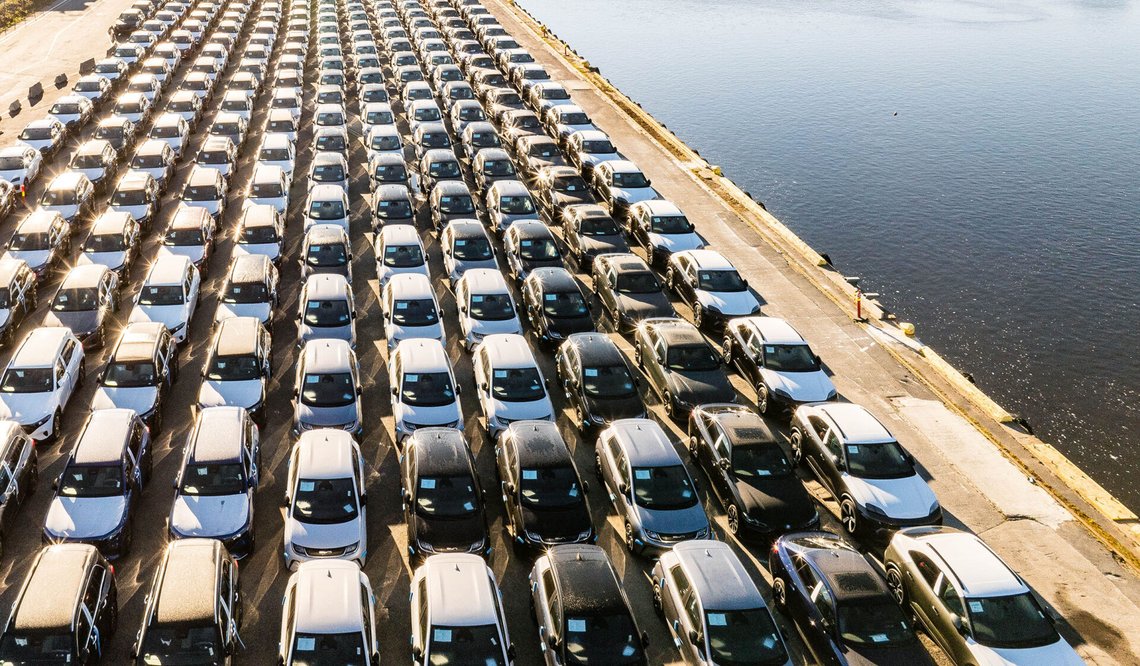
Slowly but surely the mainstream media are beginning to express some reservations about “the transition to electric cars” which is presented as a kind of natural law – while the exact opposite is happening in the rest of Europe and the USA: Sales of electric cars are falling. After history’s biggest buying spree for new cars (to save the environment from overconsumption), Norwegians too are beginning to worry a little about surprises and costs associated with car ownership, exactly as they have been warned about.
It is TV 2’s car magazine “Broom” that has received an email from “Svein”, who is complaining about uncertainty surrounding car ownership. He is worried about the combination of high spare part prices and expired warranty on battery cars. He says to “Broom”:
– For those who take the chance on buying one of the used electric cars that there are now many of on the market, the uncertainty is great about what costs MAY arise, writes “Svein”.
Broom quotes the latest edition of the EY Global Mobility Consumer Index, which shows that expensive battery replacement has suddenly emerged as the second largest of the five most important concerns about the transition to electric cars. In addition, expensive repairs and expensive maintenance have emerged as the fourth largest concern. Particularly in Norway and Sweden these objections are very visible, Martin Cardell, EY Global Mobility Solutions leader, tells Broom.
– There is a hierarchy of concerns around electric cars. When the first one is overcome, and the car is acquired, then the next one sets in, where high car ownership costs and long charging time dominate, Martin Cardell continues.
Sales of electric cars are falling in Europe and the USA
What Broom does not tell the public is that when governments remove subsidies on electric cars, sales fall, stocks pile up, used cars have to be sold at huge losses. The big car giants are also abandoning their ambitious electric car targets, closing electric car factories and writing off enormous losses after catastrophically poor sales. This applies particularly to countries such as Germany and the USA, where the subsidies have been removed.
The fact is that the whole point of buying a brand new car is to avoid worries. See? If a new car gives you worries, then you have made a bad purchase. In Norway, however, people cannot choose anything other than battery cars, because climate politicians have sabotaged the sale of petrol and diesel cars with insane taxes, so no one can afford them any longer. That is why the Norwegian car fleet is in the process of being “Cubanised” – people are clinging to increasingly old petrol and diesel cars, since the supply of new ones has stopped.
For most people who do not know about cars, this may seem completely strange. Why not just lease a new electric car, like everyone else? Or why not just buy a three- or four-year-old battery car? Well, because of money. Some people simply understand economics, and have realised what the depreciation on electric cars means. The clock is ticking down towards when the warranty expires after eight or ten years, and whoever owns the electric car then is left holding the black Peter.
Fantastic electric cars, for their purpose
Contrary to what many have the impression of, I have nothing against electric cars. I drive a Nissan Leaf myself at times, and it is a perfectly OK car to drive – for a car is a car. Steering wheel, wheels, motor and seats. What I do not like is that politicians decide what people need. And I like even less that people are misled into entering extremely expensive leasing agreements, or are tricked into believing that electric cars are cheap.
Electric cars are perfectly splendid vehicles for those who need an electric car. For commuters with 40,000 km a year and countless toll stations, it has been a pure goldmine for over ten years. But for most people an electric car is not cheap, which is due to the large and rapid depreciation. A new car has in fact never been cheap. It has always been reserved for those with plenty of money to spare, who can say: “Depreciation? Pfft.”
Buying a used car always involves risk, but a seven-year-old petrol or diesel car that is MOT-approved is usually a sensible purchase. Seven-year-old electric cars are an economic bear trap. Without warranty, electric cars are in practice worthless because of the extremely expensive drive battery, which after ten years costs more to replace than the car’s value. Poor families who buy a seven-year-old electric car, in the belief that it is cheap, are therefore taking a greater economic risk than if they buy a petrol or diesel car.
Small collisions can cause enormous economic blows
It is easy to bump into something, and in the year 2000 it only cost a few thousand kroner to fix such things. Twenty-five years ago the cars were digital, but much, much simpler, with better quality and masses of cheap used parts on the market, and an expensive headlight cost 2,000 kroner. Now it is completely new times.
If you smash a bumper or a headlight now (and the insurance company does not cover the bill), you risk ending up in economic trouble. A headlight can cost 50,000 kroner. A bumper: 70,000 kroner. If the cooling system for the drive battery breaks down, the workshop can demand 100,000 kroner. And if the drive battery breaks down after the warranty period? Think of a number, higher than the car is worth.
Modern battery cars are not cars. They are high-tech, mobile computers, from experimental production lines. And since all parts go into building new cars, the factories have to refrain from building a whole car if you need a new bumper or a door. Then it becomes expensive. Extremely expensive! Understand? And all this was thoroughly warned about before electric car mania set in at the Storting.
What kind of car should you buy?
This “development” towards higher digital complication and lower quality is completely unnecessary. Modern cars are made to satisfy political regulation and ever more unreasonable emission requirements, not to satisfy the customer with quality. That is why there are so many stories out there about car owners who constantly have “worries”, and the car at the workshop for weeks. (Except Tesla owners on Facebook, who have always driven a billion kilometres without a single fault.)
In the year 2000 it was very easy to give people good advice for safe car purchases. Now it is almost impossible, and with today’s quality problems on cars and customer service, something like recommending or advising against a car is something I have stopped doing. Many ask me, but I just say “this you must take responsibility for yourself”. Nevertheless it is possible to give some completely general advice.
• If you have plenty of money to spare, and can tolerate a depreciation of several hundred thousand kroner over a few years, you can buy a new battery car. Just make sure you buy one that suits your needs.
• If you have even more money, you can buy a new battery car on lease. Then it is the leasing company that sits with the depreciation problem after the contract ends, but it is of course you who has to pay regardless.
• If you are not quite so rich, you can buy a three-year-old battery car, but only make sure you press the price right down to the bottom, and make sure that warranty and insurance are rock solid.
• Never buy a used battery car with short or expired warranty. No, seriously: Never, never, never, unless you get it “for free”. These cars are worthless because the battery cost exceeds the car’s value.
• If you are poor, but still rich enough to have a car, consider an older petrol or diesel car that is MOT-approved, with zero rust, low mileage, of easily saleable make and colour, and with good access to parts.
• Be sceptical of hybrid cars, as these also have expensive drive batteries. Some hybrid cars, however, run fine even when the hybrid battery is dead.
• Buy a diesel car if you have long drives, many kilometres a year and live in areas without minus 20 degrees. If you have a lot of short trips or live in minus 20 degrees, buy a petrol car.
• Remember that cars after 2015 have lower quality. Never buy a used diesel car with AdBlue, which was introduced on models around 2018.
• Never buy a used car of obscure makes, luxury makes, unknown Chinese cars, or cars with little access to cheap used parts – unless you like gambling.
• Never buy a petrol or diesel car with automatic transmission that has gone over 200,000 km.
• If you need a car with driver assistance or self-driving function, hand in your driving licence and take the bus instead.
• Aim for safe quality makes without a luxury image, such as Toyota, Mazda, Honda, Volvo, Ford, Opel. Japanese makes from before 2015 are among the world’s most reliable cars, and they are cheap to maintain.
• Be sceptical of cars that have been driven in Oslo or in cities with high levels of road salting. Everything mechanical can be repaired, but rust is cancer.
• Learn to do repairs yourself, there is an incomprehensible amount to save. If you do not want to fill the basement with tools, find a workshop that agrees to fit used or non-original parts. Then the warranty often lapses, so it is a trade-off.
• If you know how to do repairs, and the basement is full of tools, you can consider a veteran car older than 1996, but be aware that this places completely different demands on maintenance, service and car care. Modern workshops often have little insight into or little interest in such cars.
These were some classic rules of thumb for car buying and car ownership, but I say again: A car costs money, and is always a trade-off between money, safety and gambling – so do not blame me. I could recommend cars in the year 2000. Now it is just chaos out there.


