

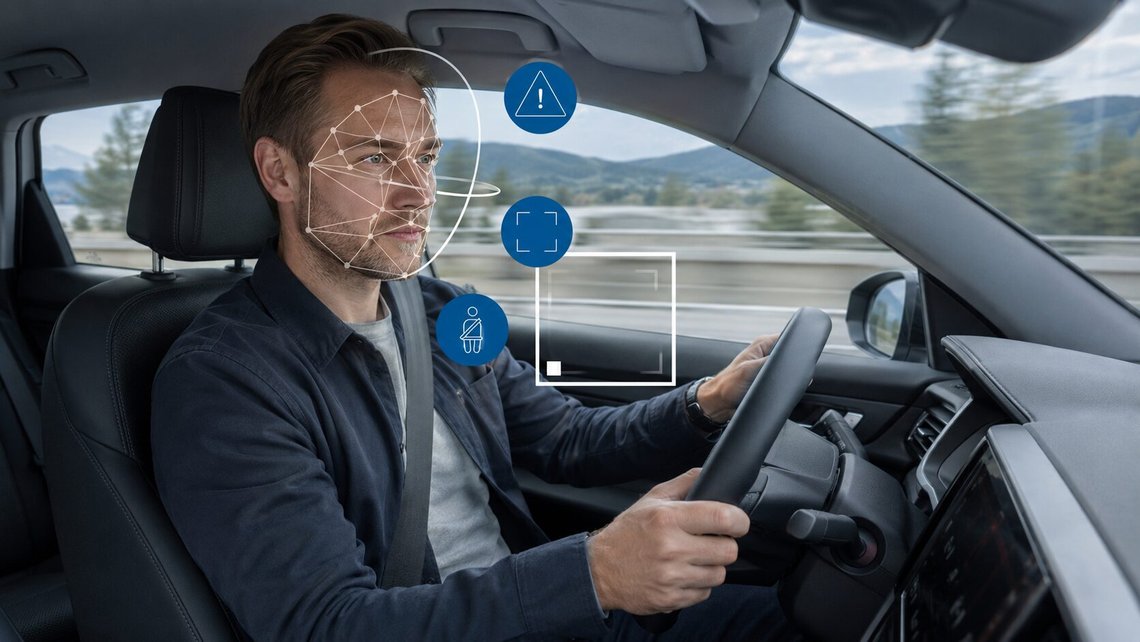


On Monday, the EU’s mandatory in-car camera requirement came into force: all new vehicles must have a system that monitors the driver’s eyes and head movements. On the same day, the European Parliament fast-tracked the revival of mass scanning of private messages.
From 7 July 2026, all new passenger cars and vans registered in Europe must be equipped with an Advanced Driver Distraction Warning (ADDW) system. A camera inside the vehicle monitors the gaze direction, head movements and attentiveness of the person behind the wheel.
The requirement is the final phase of the EU’s General Safety Regulation (GSR2), Regulation (EU) 2019/2144. The requirement has applied to new vehicle models since July 2024. It now applies to every new vehicle rolling off the production line.
Beeps after 3.5 seconds
The rules are detailed. The system must activate automatically at 20 km/h. If you are driving between 20 and 50 km/h and look away from the road for more than six seconds, the vehicle must warn you. Above 50 km/h, the limit is 3.5 seconds.
The warning must be visual, combined with either an audible alert or vibration in the seat, and must escalate until the driver looks back at the road.
The Swedish company Smart Eye, which supplies the technology to vehicle manufacturers, celebrated the milestone on Monday. The company estimates that the requirement covers around 15 million new vehicles a year – passenger cars, lorries and buses.
“7 July is a landmark day for road safety in Europe,” said Smart Eye CEO Martin Krantz.
“Stores nothing” – for now
The EU insists that the system must not use facial recognition and that the data will only be processed locally within the vehicle, in a closed loop. Nothing will be transmitted to the authorities.
For now.
Critics point to the obvious: the hardware is now mandatory. Cameras, sensors and software are being installed in millions of vehicles every year. The day someone decides to use the equipment for more than warning beeps, no new vehicle will be required – only a new regulation.
GSR2 already mandates an event data recorder in all new vehicles, a “black box” that records speed, braking and steering inputs. An Intelligent Speed Assistance system, which warns drivers when they exceed the speed limit, is also compulsory.
Same day: Chat Control returns from the dead
The timing is striking. On the very day the camera requirement entered into force, the European Parliament voted by 331 votes to 304 to fast-track the revival of Chat Control – the scheme that allows technology giants to mass-scan private messages.
Parliament rejected the scheme in March – by a single vote. The regulation expired on 4 April. A formally “new” proposal containing the same provisions has now been introduced through an emergency procedure during the final session before the summer recess. The final substantive vote on the proposal is scheduled for Thursday, 9 July.
Negotiations on the permanent Chat Control Regulation, which would make scanning mandatory, collapsed during the previous round on 29 June. Nevertheless, the EU is not giving up: further rounds have already been announced under the Irish Presidency.
Norway: Automatically adopted
Norway is not a member of the European Union. No Norwegian politician has voted on the in-car camera requirement. Nevertheless, the rules apply in full in Norway because the EU’s vehicle type-approval rules are incorporated into Norwegian law through the EEA Agreement.
Norwegians buying a new car from this week onwards will therefore get the camera as standard – whether they want it or not.
And the cost continues to rise. From 2027, the EU will introduce the ETS2 emissions trading system, imposing a CO₂ levy on fuel and heating. From 2035, the sale of new petrol and diesel cars will cease. Cars will become more expensive, fuel will become more expensive – and the vehicle you are allowed to buy will monitor you while you drive.
Everything is justified in the name of “safety”.


