

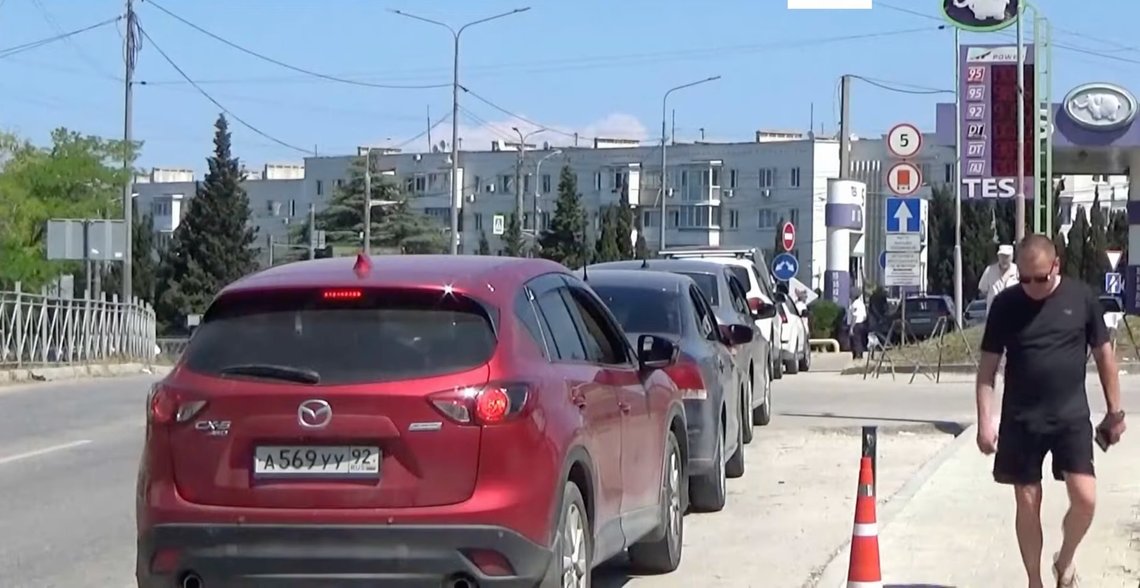
Ukraine’s drone attacks on Russian refineries are causing fuel shortages. The Kremlin is attempting to reassure the Russian population through various measures.
The situation has escalated to the point where a state of emergency has been declared in Crimea. Now an alternative is being considered that would have far-reaching consequences, writes Die Welt.
As a result of Ukraine’s drone forces, which have enjoyed considerable success in recent weeks, Russia is experiencing a fuel crisis affecting not merely a few regions, but the entire country.
According to Reuters, the country has lost approximately one quarter of its refining capacity following massive Ukrainian attacks.
According to official figures and sources, virtually all of the major oil refineries in central Russia have been forced to halt or reduce fuel production following Ukrainian drone attacks in recent days.
Moscow has already imposed a ban on petrol exports from April until the end of July.
Data from NASA’s infrared satellites indicate that more Ukrainian drones than ever before are reaching their targets inside Russia. This has led the Kremlin to declare a state of emergency in Crimea.
Crimea is facing a “difficult period”, in which the fuel situation is the most critical, stated the Moscow-appointed governor Sergei Aksyonov. The governor has already announced power cuts on the peninsula to counter the problems caused by the Ukrainian attacks.
https://www.document.news/news/2026/06/massive-drone-attack-on-moscow-oil-refinery-on-fire
Putin’s government is attempting to play down the situation. The fuel market is “difficult but manageable”, and the problems are due to “periodic logistical difficulties in certain regions”, Russia’s Deputy Prime Minister Alexander Novak said during a meeting with Putin.
For his part, Putin spoke of “terrorist outbreaks” from Kyiv, which he claimed would not alter the situation at the front.
But fuel shortages affect Russians more directly and more severely than the situation on the front line. On Tuesday alone, 15 regions introduced sales restrictions on petrol and diesel, including Khanty-Mansi in Western Siberia, at the very heart of Russia’s principal oil-producing region.
Powerful industrial leaders such as Rosneft chief executive and Putin ally Igor Sechin openly speak of an “unprecedented number of refinery failures”.
The Russian low-cost airline Azimut reports a critical shortage of aviation fuel, which is hitting Russian airlines financially. Kyiv therefore appears to be succeeding in its drone war. At the same time, the Russian economy will be hit hard if the Strait of Hormuz remains open, causing oil prices to fall.
The Kremlin is attempting to keep prices stable for consumers, regardless of the economic and geopolitical situation. But this policy is currently costing the Russian state the equivalent of two billion euros per month, and the cost will increase if oil prices continue to fall.
The Russian state continues to keep prices artificially low, thereby stimulating demand that cannot be fully met, according to Die Welt.
Sergey Vakulenko, former Head of Strategy at Gazprom Neft and now an expert at the American think tank Carnegie, calls this “madness”. Given the massive budget problems caused by wartime expenditure, the “damper” would be the perfect candidate for spending cuts. At the same time, the state would then be able to regulate demand for a scarce commodity through pricing.
Removing the price damper, however, would send fuel prices soaring by 40 per cent overnight, which would generate considerable discontent on Putin’s home front, both among households and within the business community.
One possibility is stricter regulation and, in the worst case, rationing, says Vakulenko. But then what Putin calls the “special military operation”, and which Western media, citing what appears to be a constructed rationale, consistently refer to as the “full-scale war”, would also feel more like a real war to the Russian civilian population, as it is experienced in parts of Ukraine.
This could drive up inflation and hit the Russian economy hard.
The best solution to the Kremlin’s fuel concerns would be an end to the Ukrainian attacks – but the Russian state appears willing to accept them for the time being.
The willingness to make peace between Russia and Ukraine unfortunately appears to be in short supply, having infected both the Kremlin, Kyiv and most European capitals, with Brussels leading the way.
The civilian populations of both Russia and Ukraine are feeling the consequences, and European taxpayers are also being hit hard by the economic crisis brought about by the war, a crisis that continues to be intensified by European politicians.
But by far the highest price is being paid by tens of thousands of Russian and Ukrainian soldiers.
Yesterday, 25 June, European leaders gathered in Poland to accelerate investment and assistance that could contribute to the reconstruction of Ukraine. Ukraine’s Prime Minister Yuliia Svyrydenko took part.
 Ukraine’s Prime Minister Yuliia Svyrydenko. Photo: Instagram
The absence of Ukraine’s President Volodymyr Zelenskyy was probably due to the ongoing dispute with Poland’s President, who has stripped Zelenskyy of a Polish decoration.
European authorities appear willing to spend freely, increasing public debt in order to allow taxpayers to finance the massive support for Ukraine. But they are working against the tide, NTB-AFP wrote.
Ukraine needs close to NOK 6 trillion to rebuild the country, according to estimates by the World Bank, the UN, the EU and Ukraine itself.
There is little doubt that Russia, too, will require enormous sums for reconstruction following any conclusion to the “special military operation”.
But sympathy for the aggressor is understandably largely absent, even though it is the civilian population that suffers the most and is, to a great extent, made up of innocent victims.


