

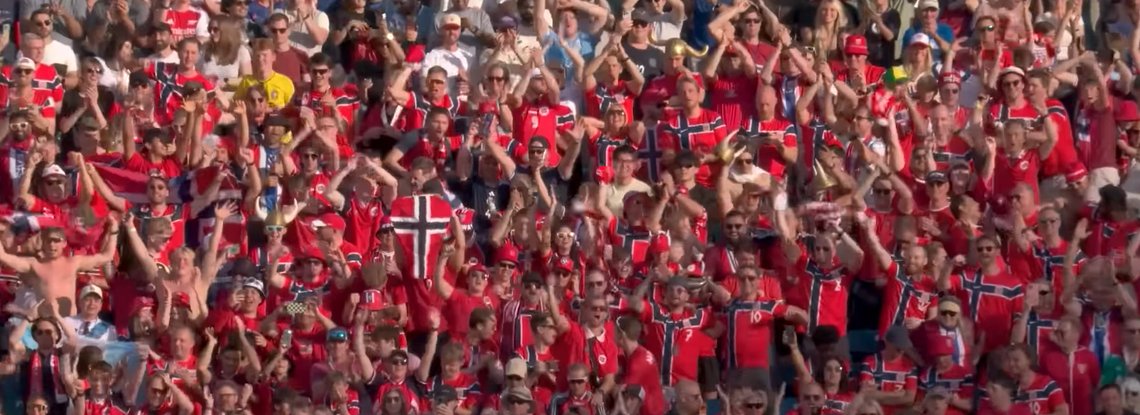
The first thing Norway proved against Iraq was not that they can win a World Cup match.
It was that they can hurt a World Cup opponent quickly enough to change the mood of an entire country.
That matters after 28 years away. Norway’s 4–1 win in Foxborough was not some nervous, scraped-through return to the tournament. It had goals, authority, set-piece threat, and the one thing every opponent in Group I already knew was coming but still could not stop: Erling Haaland turning ordinary defending into panic.
Haaland scored twice on his World Cup debut as Norway beat Iraq 4–1, with Aymen Hussein equalizing for Iraq before Norway pulled clear through Leo Østigård and a late own goal.
On paper, that looks like a comfortable opening night. It was not quite that simple.
Reuters also described Norway’s overall play as inconsistent at times, with miscues and ineffective passes despite the commanding scoreline. That is where the real post-match analysis begins.
Norway looked like they belonged.
They did not yet look like a team that can survive France without improvement.
That is the useful truth from the opener. Not the gloomy truth, not the supporter-club truth, and not the “Haaland saves everything” truth. Norway got exactly the result they needed. The scoreline gives them belief, goal difference and a platform before Senegal. But the performance also left enough evidence for future opponents.
Iraq found space, confidence and an equalizer.
That should not be ignored just because Haaland did what Haaland does.
His first goal settled Norway, and his second punished the kind of defensive mistake that elite strikers are paid to smell before everyone else has even noticed the danger. That is the luxury Norway now have. They do not need to dominate every passage to score. They can be untidy for ten minutes, slightly stretched for five more, and then suddenly Haaland is in the penalty area and the match has changed.
There are not many teams in the tournament with that kind of weapon.
But there is a difference between having a weapon and having control.
That difference will define Norway’s group stage.
Against Iraq, Norway’s attacking structure carried enough threat to win the match. Martin Ødegaard did not need to produce a full conductor’s performance for Norway to create decisive moments. Norway found enough attacking variety to keep Iraq under pressure. The set pieces mattered. Østigård’s header in the second half was the kind of goal that changes a tournament match because it removes doubt at the exact moment doubt is trying to return.
Still, the equaliser was the paragraph Senegal and France will read most closely.
Iraq were not expected to control long stretches, but they did enough to show where Norway can still be reached. When Norway’s distances opened, the back line looked more exposed. When the midfield did not fully control the second balls, Iraq could move forward with more confidence than Solbakken would have liked. A better side will not need many invitations.
France certainly will not.
France opened their own campaign by beating Senegal 3–1. That result matters for Norway because it frames the group immediately. France are not waiting politely for anyone else to settle into the tournament. Norway may have the emotional story, the returning nation, the generational striker, and the supporters who have waited since 1998. France have the expectation of control.
That is a different burden, and a different standard.
Norway do not have to become France to compete with France. That is not the assignment. Norway’s path is more practical: be compact for longer, make fewer cheap errors, protect the spaces beside and behind the centre-backs, and make sure Haaland is not asked to turn every loose passage into a rescue operation.
The encouraging part is that Norway’s flaws appeared inside a winning performance. That gives Solbakken a clean week of work. Coaches would rather correct defensive spacing after a 4–1 win than explain attacking failure after a draw. Football is funny like that. Everybody listens more calmly when the scoreboard has already done its job.
There was also something important in the way Norway handled the second half. They did not collapse into caution. They did not treat the lead like a glass vase in a house full of toddlers. Østigård’s goal pushed the match away from Iraq, and the late own goal gave the scoreline the shape of a statement.
But statements can mislead.
The tournament does not care how long Norway waited to return. Senegal will not care. France definitely will not care. The next opponents will see Haaland’s finishing, Østigård’s set-piece value and Norway’s ability to punish mistakes. They will also see Iraq’s equaliser, the moments of loose defending, and the passages where Norway looked less in control than the final score suggests.
That is why this was the perfect opening result, but not a perfect opening performance.
Norway are back where they wanted to be. They have a striker who looked ready for the stage immediately. They have a squad that can score in different ways. They have momentum.
Now comes the harder question. Can Norway look like they belong when the opponent does not help them?


