

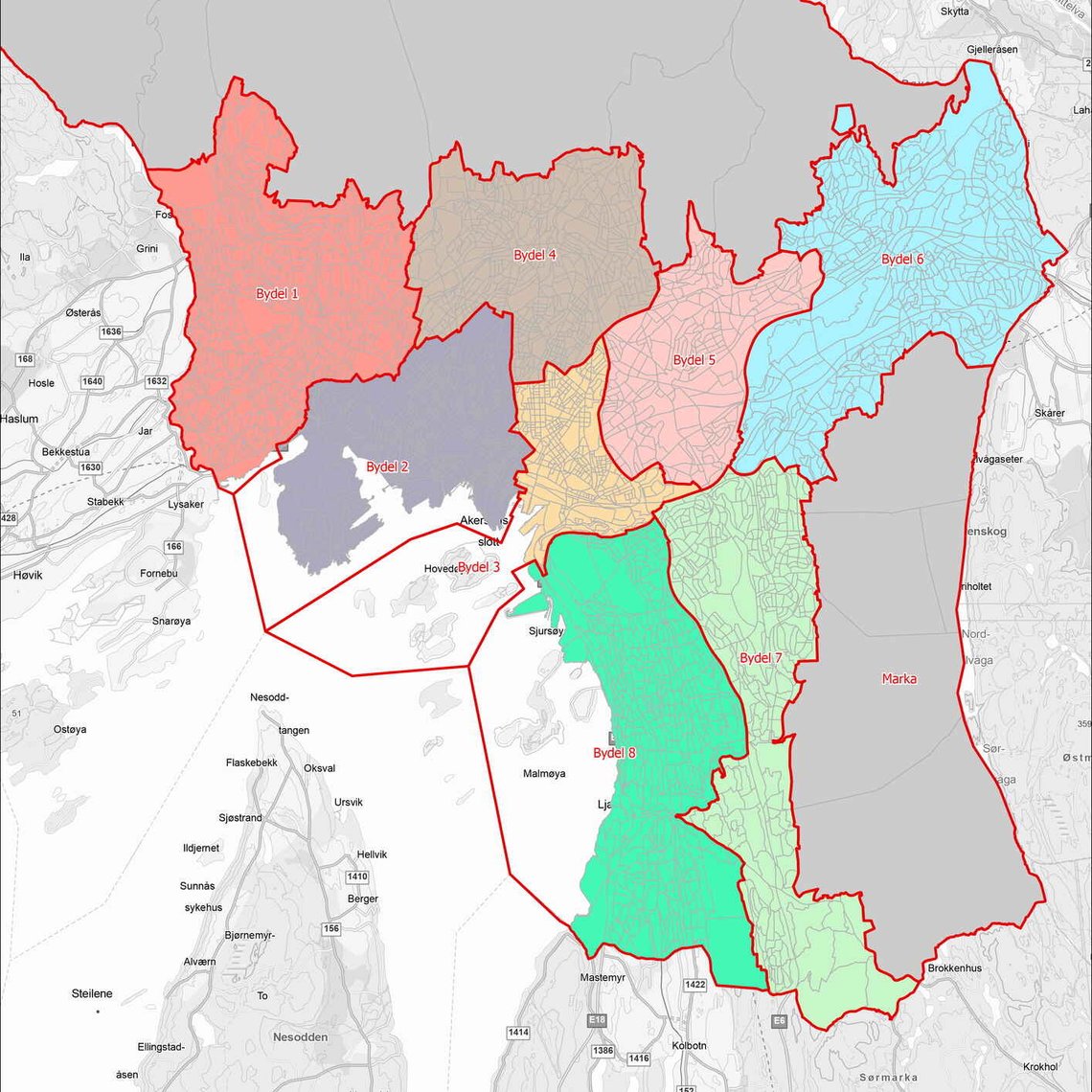
A large majority in Oslo City Council will decide on Wednesday that the city’s 15 boroughs shall be reduced to eight from 1 January 2028. Six of the eight “new” boroughs will be larger than Fredrikstad, Norway’s tenth-largest city.
After the City Government secured the support of the Labour Party (Ap), the Progress Party (FrP) and the Christian Democratic Party (KrF) on Friday last week, there is now an overwhelming majority in favour of the borough reform ahead of Wednesday’s vote.
The merged borough of Alna, Grorud and Stovner alone will be larger than the municipality of Drammen (106,000 inhabitants) – with 115,000 residents – and almost as large as Kristiansand, Norway’s sixth-largest city. All eight boroughs will have larger populations than Sandefjord, Norway’s thirteenth-largest city.
Efficiency and equalisation
Among the arguments in favour are cost savings and more efficient operations, better coordination and more consistent quality in health and care services, as well as more stable finances for each individual borough. Equality in services provided to residents across the boroughs is highlighted as a decisive consideration.
The debt that the boroughs have currently accumulated (to varying degrees) is to be written off according to what may be described as a burden-sharing and equalisation principle. The eight “new” boroughs will then be allowed to make a fresh start, with almost clean slates, according to the City Government – the Conservative Party (Høyre) and the Liberal Party (Venstre), now supported by Ap, FrP and KrF.
Greater distance
Dedicated local health centres in each borough are intended to help equalise the quality of services. At present, where one lives in the city has in fact played a role in determining what level of healthcare and other services one can expect. A better distribution of municipal housing is also included in the merger plan.
The Socialist Left Party (SV) (and Red Party (Rødt)) do not support the merger of the boroughs and argue that the distance between residents and elected representatives will become radically greater. In addition, SV’s Audun Westad believes that the current borough of Søndre Nordstrand will become isolated and alienated within its own borough, reports Avisa Oslo.
These will be Oslo’s new boroughs, ranked by population:
- Alna, Grorud and Stovner (115,000 inhabitants)
- Nordre Aker and Sagene (109,000 inhabitants)
- Gamle Oslo and Grünerløkka (108,000 inhabitants)
- Frogner, St. Hanshaugen, Amalienborg, Sjølyst, Madserud and Søndre Skøyen (106,000 inhabitants)
- Ullern and Vestre Aker (90,000 inhabitants)
- Bjerke, Hasle, Løren, Teisen and Helsfyr (88,000 inhabitants)
- Østensjø, Bjørndal, Mortensrud and Bjørnerud (78,000 inhabitants)
- Nordstrand, Holmlia Nord, Holmlia Sør and Prinsdal (77,500 inhabitants)


