

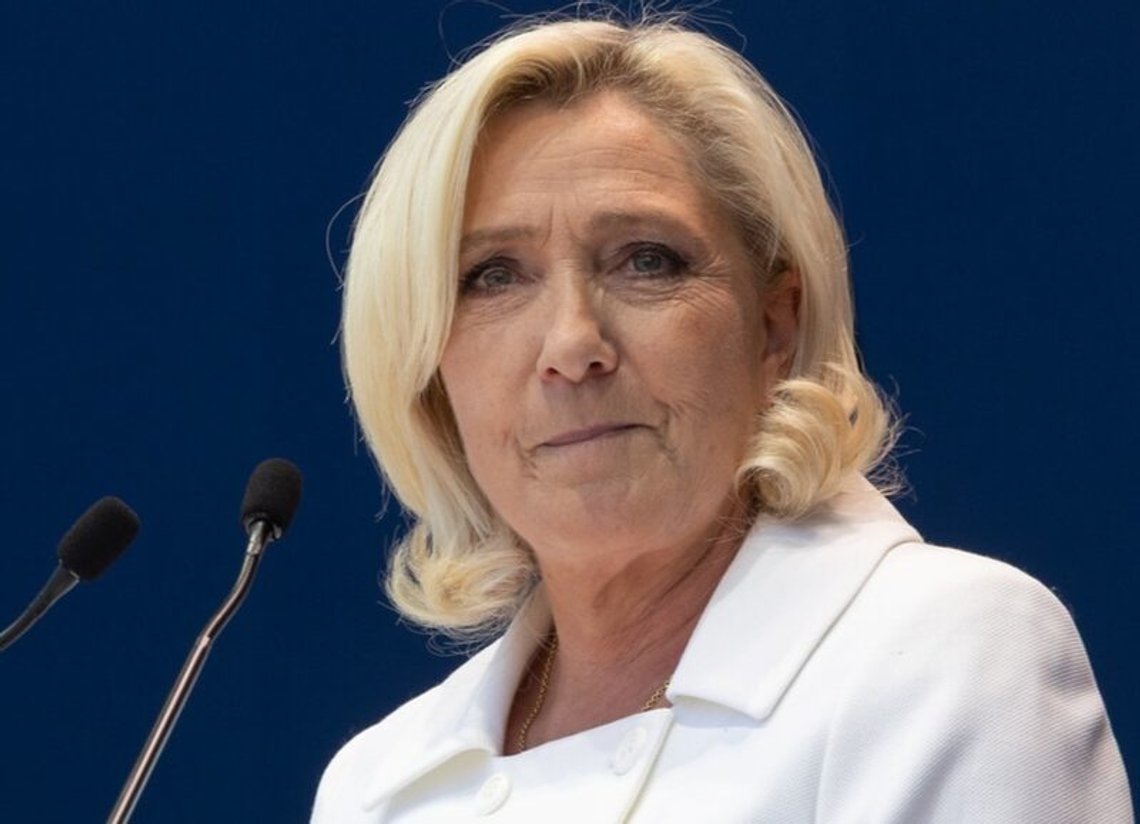


Marine Le Pen has changed her stance on same-sex marriage. Previously, she wanted to repeal the law that allowed gay people to marry. Now she believes the law can remain in place. This is far from the only issue on which the French nationalist has changed her mind. Frexit, the euro, the death penalty and dual citizenship are among the positions she has abandoned. And she recently declared that Islam is fully compatible with the French Republic.
“I have changed my mind on same-sex marriage. It has not led to surrogacy, as I previously feared. One can evolve politically; there is no shame in that,” wrote Marine Le Pen in a post on X on Sunday.
The statement comes following an interview with the French TV channel LCP, in which a 15-year-old interviewer reminded her that in 2013 she had wanted to repeal the law allowing same-sex marriage.
“No, I have definitely changed my position,” she replies.
Le Pen explains that at the time she feared the law would pave the way for surrogacy, i.e. women carrying children for others. She does not believe this has happened. At the same time, she emphasises that she remains opposed to surrogacy.
From Frexit to EU reforms
Marine Le Pen has for many years been the figurehead of the nationalist right in France. As leader of the Front National, later the Rassemblement National (RN), she has distinguished herself as a staunch opponent of immigration, supranational governance and the established political system. However, several of her former campaign issues have faded from view.
During the 2017 presidential election campaign, Le Pen wanted France to leave the euro and reintroduce its own currency. She also advocated a referendum on French EU membership, a so-called ‘Frexit’.
Following her election defeat by Emmanuel Macron, she changed course. In the 2022 presidential election campaign, both withdrawal from the euro and Frexit had been shelved. Le Pen now wants to reform the EU from within, limit the Union’s power and give nation states greater autonomy.
Islam is compatible with the Republic
In September, in an interview with the TV station LCI, Le Pen adopted a conciliatory stance towards the country’s Muslim population:
‘A Muslim believes in God and respects others. An Islamist believes in God and massacres others. On the one hand, we have a religion that deserves respect because it is respectable. On the other hand, we have a totalitarian ideology that must be fought and eradicated.”
This statement was not an isolated incident. In October, another statement was made that attracted even greater attention. During an interview on CNews on 15 October, Le Pen declared that she does not regard Islam as a problem.
“Islam is compatible with the Republic. I’ve said that ten times,” she stated. “What is not compatible with the Republic is Sharia. What is not compatible with the Republic is Islamist fundamentalism.”
Marine Le Pen says:
“Yes, Islam is compatible with the Republic; I’ve said it ten times”
No, Marine, it isn’t.
What’s got into you? 🤨
https://t.co/614JlZreVI— Lozzy B 🇦🇺𝕏 (@TruthFairy131) 16 October 2026
Despite her attempts to distinguish between Islam as a religion and political Islamism, the tone is decidedly different from that which many associate with the Front National’s previous profile. And her political motive seems obvious. In the same interview assured Le Pen assured French Muslims that they had no reason to fear her as president, and that they would still be able to practise their religion.
“French Muslims who are considering leaving the country if I am elected are mistaken. This is their country. They are French. We are not like LFI (Unbowed France). We respect all French people.”
Regrets her opposition to dual citizenship
In the very recent interview with LCP, Le Pen also distances herself from her previous desire to abolish dual citizenship. The proposal had long been a key part of the party’s policy. French citizens holding citizenship of countries outside the EU would have had to choose which citizenship they wished to retain.
“I think I made a mistake,” Le Pen now says.
She believes the proposal could have given the impression that she suspected French citizens with dual nationality of being less loyal to France. The proposal was abandoned in 2022, but as recently as 2024, the RN wanted to bar people with dual nationality from certain sensitive public positions.
From the death penalty to life imprisonment
Le Pen has also changed her stance on criminal policy. In 2012, she called for a referendum on reintroducing the death penalty in France. She argued that the most serious crimes should be punishable by death. By 2017, this demand had been removed from her election manifesto. Instead, she advocated life imprisonment without the possibility of release. She has since confirmed that she no longer wishes to hold a referendum on the death penalty.
We find the same pattern in energy policy, but here the shift in direction has been in a different direction. In 2012, Le Pen called for a gradual phase-out of French nuclear power. Ten years later, she argued in favour of new nuclear reactors and the reopening of decommissioned nuclear power stations.
– You’re a weathervane, Ms Le Pen
Her latest statements have sparked reactions in the comments section beneath Le Pen’s post on X. One commenter lists several of these U-turns and accuses her of bowing to external pressure.
“You’ve done an about-turn on the issue of Frexit, on the euro… Now the LGBT lobby is starting to make itself felt too! (….) Perhaps your members will soon see the light… perhaps. You’re a weathervane, Mrs Le Pen.”
Others are celebrating the change of course and interpreting it as a welcome step away from religious conservatism towards more secular attitudes.
“She doesn’t need to bow to a vanishingly small minority of extremist fools who believe in an old, imaginary bearded man, and who, in any case, will never be able to secure her election victory on their own.”
Where does the line lie?
It must be said: Marine Le Pen has not abandoned all her previous positions. She still wants drastic restrictions on immigration, a tougher approach to crime and greater French autonomy in relation to the EU. National priorities, particularly in welfare policy, remain central to her agenda. Nevertheless, there is little doubt that the party has changed since the days of the Front National.
Le Pen herself believes that politicians must be able to learn from their mistakes and change their minds. Critics see something else: a politician who is gradually abandoning the positions that made her a genuine alternative to the established parties.
The question is whether this more moderate line is a strategy that will win her new voters, or whether she simultaneously risks alienating some of those who have supported her all these years.


