

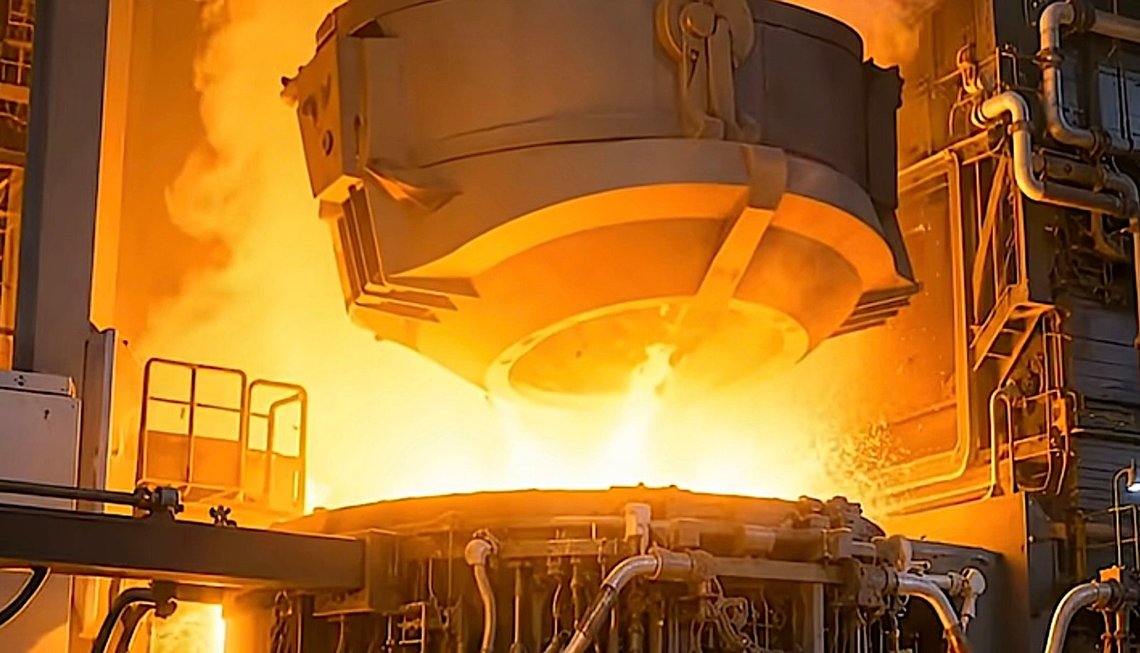


Italy’s largest steel producers are suspending parts of their operations because high gas and electricity prices are making production unprofitable.
With the price of electricity approaching 300 euros per megawatt-hour (MWh), some industry players have already gradually halted production, and now the Italian steel industry’s trade association, Federacciai, is sounding the alarm over declining competitiveness, reports Corriere della Sera.
Some of the problems stem from past climate policies:
For steelworks, particularly those using electric furnaces to melt scrap, energy is one of the most significant cost items. When prices rise too much, it can become unprofitable to produce steel. This is the paradox highlighted by Federacciai: the Italian steel industry is amongst the lowest-carbon in Europe, but also amongst those hardest hit by electricity costs.
Barbara Beltrame Giacomello, one of the top executives at the AFV Beltrame Group, a leading player in the sector, comments on the situation:
The problem concerns not only price rises, but the very ability to organise industrial operations. ‘A steelworks operates on a continuous basis and relies on planning, but today steelworks are no longer able to plan production, guarantee fixed delivery times to customers or organise their employees’ work on a continuous basis. It is the price of energy that determines when and how much is to be produced, not the company itself.”
Production stoppages also have negative knock-on effects:
The consequences extend far beyond the factory gates. “The closure of a steelworks is never just the closure of a company: it is the closure of an entire supply chain.” Beltrame Giacomello is therefore calling on the government to take “structural and swift measures for energy-intensive companies” and to adopt an energy policy that can support the industry.
Also in the background are the potential effects on employment and on businesses that use steel as a raw material.
The price crisis could lead to a permanent reduction in industrial capacity, says Beltrame Giacomello:
The danger, she warns, is that the crisis will develop into a permanent loss of production capacity: “The risk lies not only in reducing production, but in gradually losing industrial capacity in Italy”.
Italy has a significant steel industry and regards maintaining it as a strategic priority. However, the EU’s climate and energy policies may make this difficult. Prime Minister Giorgia Meloni has already warned her European colleagues of the consequences. The question is whether this could trigger a crisis in Italy’s relations with the EU.
The Meloni government is not entirely without room for manoeuvre at the national level; it has retained coal-fired power stations and is keeping them on standby or operating at low capacity in anticipation of energy crises. The two largest of the country’s four coal-fired power stations are not currently supplying electricity to the grid.


