

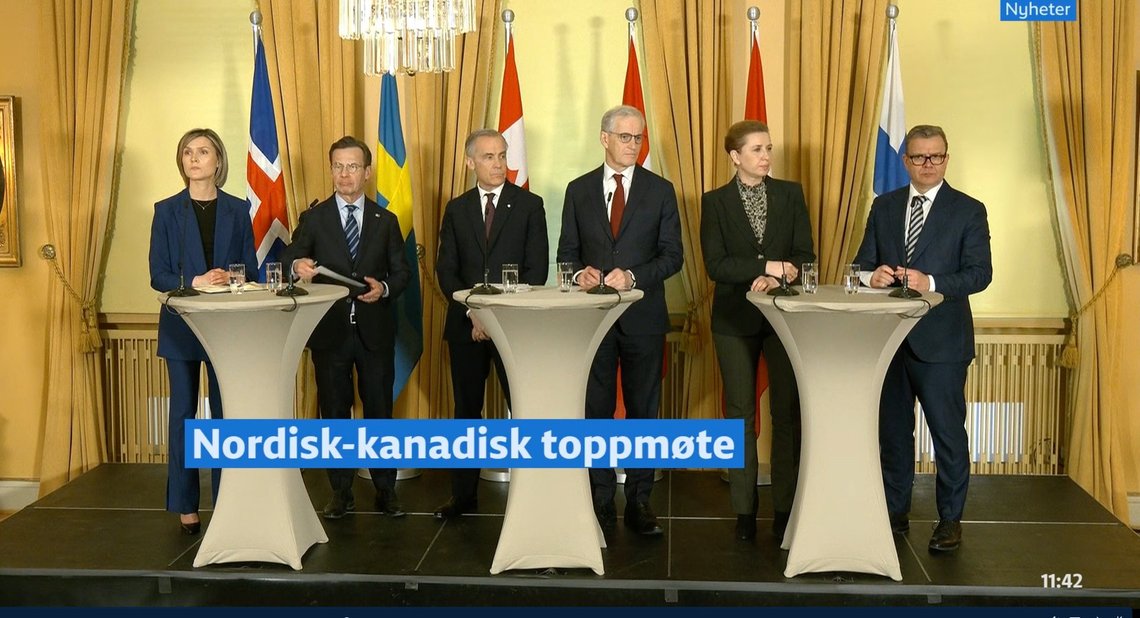


– We must build a new world order, said Denmark’s Prime Minister Mette Frederiksen almost explicitly during her visit with Støre on Sunday, where the other Nordic heads of government and Canada’s Prime Minister Mark Carney were present.
NRK quotes Frederiksen:
– We must stand even more united in the world as it is now, where the old world order is gone and probably will not return, said Frederiksen.
– We must build something new, and it must be a world order that is based on the values that we represent.
Frederiksen spoke with the grave pathos that characterises today’s European political class. A new system. A new world order. New values.
The only thing missing was an answer to the most elementary question in the world of politics: What on earth is this to be built with?
For while Europe’s leaders speak of new orders and new systems, the continent has systematically dismantled the very foundation of any power politics: energy, industry and production.
One cannot build geopolitics on conferences, one cannot build strategic autonomy on press releases, and one certainly cannot build a new world order on political platitudes.
Yet this is precisely what Europe is attempting.
Over the course of three decades, the continent has moved large parts of its industrial base to Asia. Steel production, the chemical industry, metallurgy, electronics and heavy industry – all that once made Europe the economic engine of the world – has gradually been outsourced.
At the same time, Europe has turned energy into a luxury good.
Electricity, which previously formed the basis of industrial competitiveness, has become a politically managed scarcity resource. Energy prices in Europe are in many cases three to four times higher than in the United States. The result is predictable: industry relocates.
Production follows energy. It always has. When energy becomes expensive, the factories move. When the factories move, expertise disappears. When expertise disappears, capital follows.
In the end one is left with what Europe increasingly resembles: a continent that regulates more than it produces.
And in the midst of this process, Europe’s political leaders declare that they will build a new world order.
It is difficult to read this without historical associations. For East Germany – the German Democratic Republic (DDR) – was also a society in which the grand words steadily grew in step with the shrinking economic reality. The weaker the system became, the more elevated the rhetoric became. Plans. Visions. Values. Future. There was never any shortage of grand words in the DDR. What was lacking was production.
The similarity does not lie in the systems, but in the dynamics. When reality becomes more difficult to handle, politics moves from economics to morality. From production to values. From realities to rhetoric. That is exactly where Europe now finds itself.
In the real world, something entirely different is happening. China is building industry at a pace reminiscent of Europe’s own industrialisation in the nineteenth century. The United States is experiencing a reindustrialisation driven by cheap energy and strategic industrial policy. India is emerging as the world’s next production economy.
All these powers are doing what great powers have always done: they build factories. Europe, by contrast, builds directives.
This does not mean that Europe is without resources. The continent still has capital, technology and educated populations. But political energy is increasingly used to administer decline – while at the same time speaking of future greatness.
Therefore the statement “we must build something new” appears less as a strategy and more as a psychological defence mechanism. For the truth is that Europe today is attempting to define a new world order at the very moment it is losing its industrial weight.
Great powers do not arise from moral declarations, but from steel, energy and production.
Geopolitics is in the final instance not a debate about values, but about capacity: How much energy do you produce? How much industry can you mobilise? How quickly can you build?
In all these areas Europe is moving in the wrong direction. Therefore it is difficult to see the meeting in Oslo as anything other than a piece of political theatre. A gathering of leaders speaking about world order on a continent that has increasingly outsourced its own reality.
One can build many things in politics. One can build institutions, alliances and strategies. But one cannot build a world order without an economy that sustains it. Yet that is precisely what Europe is now attempting.


