

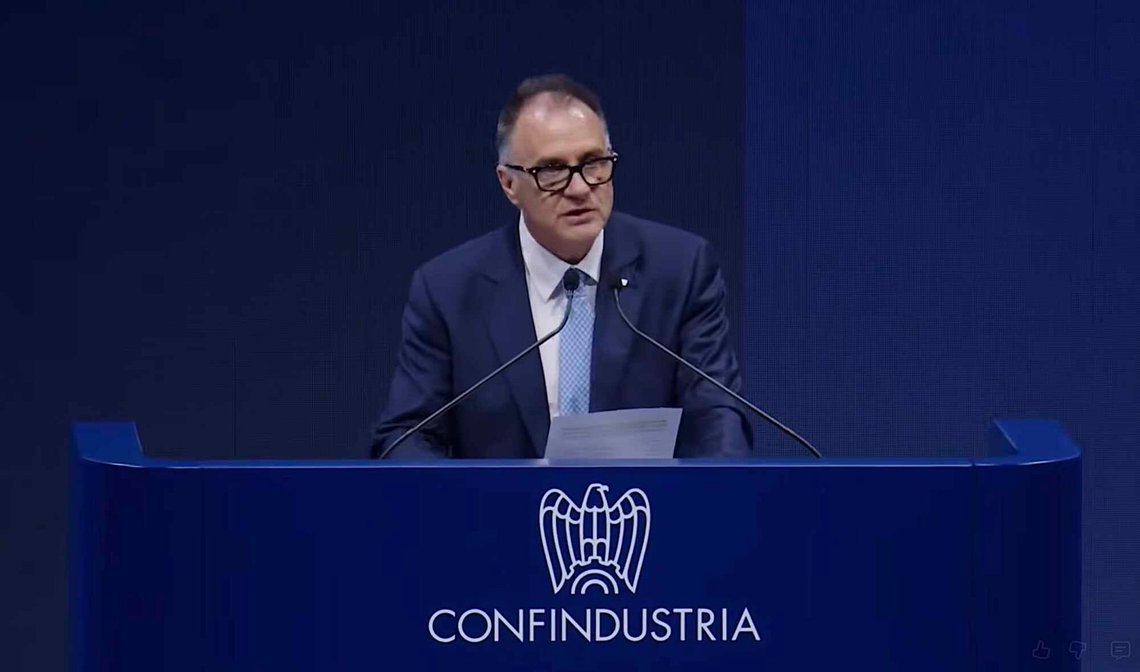


– The deindustrialisation of Europe risks turning the continent into an industrial desert, says the head of the largest industrial federation in Italy, Emanuele Orsini.
The incendiary statement from the Italian industrial leader came in the presence of both Prime Minister Giorgia Meloni and President of the Republic Sergio Mattarella during Confindustria’s annual meeting in Rome on Tuesday, which is discussed by Corriere della Sera.
Orsini placed significant portions of the blame for the decline of industry in Italy and Europe on the EU, which he tore apart issue after issue, whether bureaucracy, climate and energy policy or the Union’s openness towards China, above all by having opened the EU markets “wide open” to Chinese exports.
Emanuele Orsini adopts an unusually harsh tone for an industrial meeting. “The moment of truth has arrived”, he says in the 2026 report, transforming Confindustria’s traditional annual meeting into a long warning about the industrial situation in Europe and Italy.
The political point in the speech lies entirely in the word that recurs several times: deindustrialisation. Orsini describes it as a process already under way, no longer as a theoretical risk. “Over the past two years, we have witnessed a veritable collapse of the European industrial system”, he says.
“The entire European basic industry is under pressure”, warns the president of Confindustria, mentioning paper, steel, glass, the chemical industry, cement and ceramics as sectors now squeezed between energy costs, European regulations and Asian competition.
“China is colonising our markets”, Orsini states in his speech, and this is the moment when he receives by far the strongest applause from the hall.
In the EU system, they understand nothing of what is taking place, thunders the Confindustria chief, who says that Brussels does not know what competitiveness is.
In the absence of a functioning Union, he envisages sensible countries joining together around practical solutions:
The proposed solution is therefore “enhanced cooperation”, namely a group of countries ready to act together immediately regarding energy, the capital market and common industrial policy. This is probably the most political paragraph in the entire report, because it implies a recognition that the EU with 27 member states, as it exists today, risks being unable to react quickly enough to global competition.
Orsini repeats the demand to scrap the EU’s emissions trading system for greenhouse gas emission allowances (ETS):
“The ETS system has turned decarbonisation into a product of financial speculation”, he claims, calling the mechanism that forces European companies to purchase emission quotas while competing with American and Chinese companies “pure madness”.
Hence comes the strongest demand: to suspend ETS immediately. Not merely reform it, but freeze it in order to avoid – Orsini claims – further closures and relocations.
Orsini does not place all the blame on the Union, but also on member states pursuing a self-destructive energy policy. In that connection he does not spare his own Italy either, which shut down nuclear power a few years after the Chernobyl accident, a decision he believes is long overdue for reversal.
With deindustrialisation, Europe’s economy is weakened so severely that wage levels become too weak both to maintain birth rates and domestic demand, Orsini states, thereby seeing not only an industrial crisis, but also an existential crisis for Europe.
Orsini has issued similar warnings several times before, but this time the gravity is deeper. In his view, Europe does not have much time left to save itself.
Giorgia Meloni also addressed Confindustria’s annual meeting, where she essentially agreed with Orsini in his diagnosis, above all regarding the EU, which she calls a bureaucratic monster that has been unstoppable in its multiplication of the regulatory burden. According to the Prime Minister, Brussels ought to learn from its previous mistakes and simply begin concerning itself with fewer matters, reports Corriere della Sera.


