

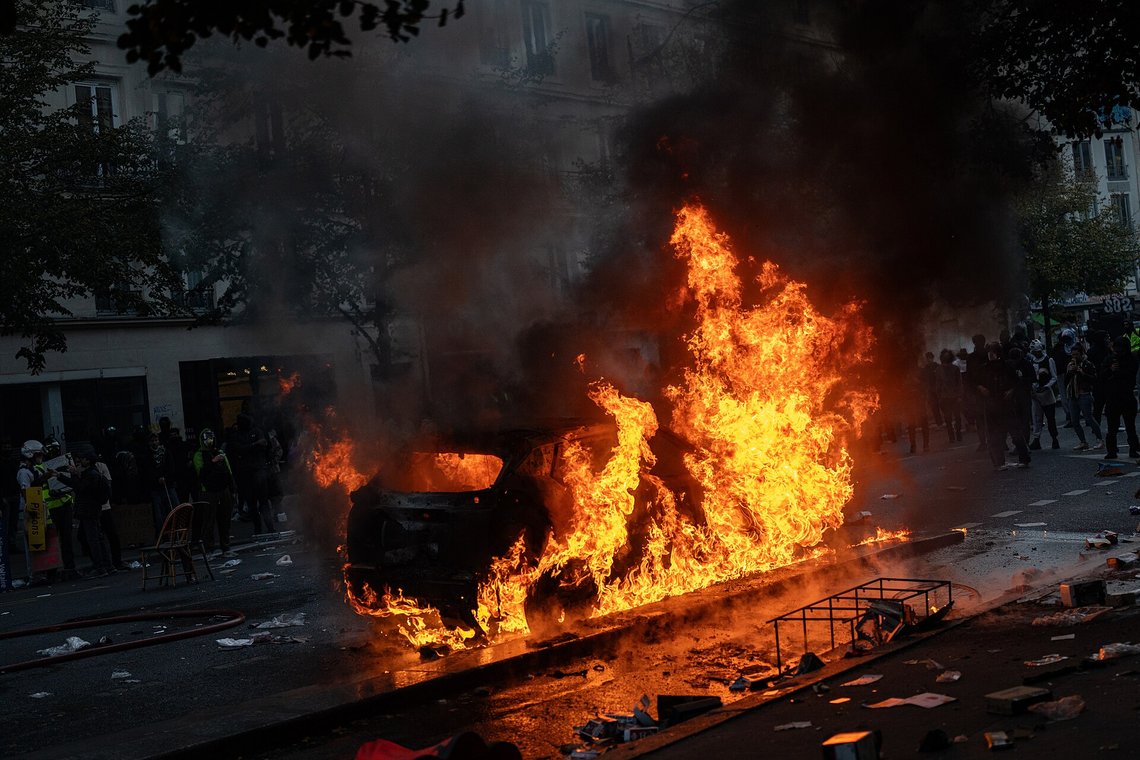


Whilst major European cities are gripped by violence and unrest, the Norwegian media portray protesters as victims and the police as aggressors. But what happens when journalism stops asking the toughest questions?
I am struck by how superficially the Norwegian media cover the serious unrest affecting parts of Europe. What is happening in Paris, Milan, Germany and Spain? Who is behind the violence? What are they shouting in the streets? What political and religious ideologies are mobilising them? And why do Norwegian readers so rarely get a comprehensive analysis of what is unfolding?
It is not just the riots themselves that concern me. It is also the way in which they are presented.
When TV 2 News reported on youth unrest, citing dissatisfaction with the school system, textbooks and high housing costs, I was left with a fundamental question: Is this an adequate description of what is actually happening?
If people are demonstrating peacefully against house prices or the school system, it is of course legitimate to report on it. But if the situation also involves group violence, robbery, looting, threats and attacks on the police, journalism must describe the full picture. Economic frustration may explain the discontent. It cannot be used as an automatic explanation or excuse for violence and crime.
When does a demonstration turn into a riot – and why does it seem as though this distinction is becoming increasingly important in the media’s choice of words?
When the victim narrative takes precedence over reality
One of journalism’s most important principles is that events should be described on the basis of what can actually be documented. Nevertheless, the angle from which a news story is presented can have a decisive impact on how the public perceives it.
If the camera primarily shows confrontations in which the police use force, whilst the events leading up to the clashes are omitted, the public only gets part of the story. If young people are referred to as demonstrators, without any examination of acts of violence, possible offences or ideological messages, the picture also becomes incomplete.
The police must, of course, be held accountable for any unlawful or disproportionate use of force. The police do not have carte blanche. But the same critical standard must apply to those who attack the police, threaten other people or damage other people’s property.
It is not balanced journalism to spare one side from critical questions simply because it is portrayed as socially vulnerable.
Nor is it balanced journalism to reduce all unrest to a question of poverty, house prices or dissatisfaction with the education system if there are, at the same time, other motives that deserve to be investigated.
What do the religious and political slogans mean?
A particularly important question concerns religious and political expressions during demonstrations and riots.
When demonstrators raise Palestinian flags, chant religious slogans or express support for Islamist movements, journalists should investigate what this means in the specific context. Which groups are organising the protests? What demands are they making? Is it a matter of solidarity with Palestinian civilians, support for specific political organisations, religious mobilisation, or a mixture of different motives?
These are not necessarily the same thing. A Palestinian flag is not in itself an expression of Islamism, and being a Muslim does not mean that one supports violence or wishes to abolish democracy.
However, if slogans are chanted calling for the world to become Muslim, or if Islamist ideas and hostility towards Western societies are expressed, this constitutes relevant journalistic information. In such cases, the media must examine the message, put it into context and ask what kind of society the demonstrators are calling for.
The same applies to any glorification of religious leaders or ideologies that are at odds with democratic freedoms.
Why is it so difficult to discuss such issues openly and precisely?
Freedom of religion and freedom of expression also entail the right to criticise religion, political Islam and ideologies that seek to restrict the freedom of others. It must be possible to ask critical questions without any criticism of Islamist movements being treated as a general condemnation of Muslims.
Europe is not a society without freedom
Many European countries offer their citizens extensive rights, free or publicly funded education, healthcare, social security and opportunities that millions of people elsewhere in the world can only dream of.
This does not mean that European societies are perfect. Housing crises, economic inequalities, unemployment and integration problems are real challenges. Young people have the right to criticise the authorities and demand improvements.
But it is also reasonable to ask what happens when people who have been given the opportunity to live in free democratic societies simultaneously take part in violent riots or express contempt for society’s fundamental institutions.
Freedom of expression, freedom of religion, equality, the rule of law and the right to live free from religious coercion cannot be taken for granted. They are the result of long historical struggles and political developments.
These values must be defended.
However, it is important to distinguish between people who commit criminal offences, political movements that reject democratic principles, and immigrants who live peacefully and respect the country’s laws. The responsibility for violence lies with those who commit it, not with everyone who shares a religion or comes from a particular country.
Where is Macron – and where are the authorities?
When a European capital is hit by serious unrest, it is legitimate to ask what the country’s political leadership is doing. Are the authorities present? Do the police have sufficient resources? Is the safety of residents being safeguarded? And what measures are being taken to restore peace and order?
French President Emmanuel Macron and other European leaders must be held accountable for their handling of serious security issues.
If there is evidence that a political leader is attending a cultural event whilst serious riots are taking place, this may be relevant. However, this must be substantiated, and the timing and scale of the unrest must be investigated before any conclusions are drawn.
The same applies to the question of whether the military should be deployed. In a democracy, the police are normally the primary authority responsible for dealing with public unrest. Military assistance may be appropriate in certain situations, but must take place within the framework of the law. The crucial point is that the state protects the population, restores peace and order, and enforces the law.
A society that is no longer able to protect its citizens from violence and threats risks the population losing trust in the authorities.
The ideological bias must be examined
My concern relates not only to individual news stories, but to a broader question regarding the media’s priorities and perspectives.
Do the Norwegian media tend to explain unrest in terms of social conditions when it comes to groups they perceive as marginalised, whilst in other contexts they place greater emphasis on ideology, responsibility and crime?
Are certain demonstrators primarily presented as victims, whilst the police’s actions are scrutinised far more thoroughly than the violence that triggered the confrontations?
And is religious extremism discussed with sufficient clarity when it is in fact documented?
These are questions that should be examined through specific examples from Norwegian news coverage. It is not enough to claim that the media are left-wing. The criticism becomes stronger if one highlights which events have been omitted, what information is missing, what words are used, and how alternative explanations are treated.
Journalism should not be tailored to a political narrative – neither on the right nor on the left. It must seek to establish the truth.
We need journalism that dares to ask the uncomfortable questions
Throughout history, Europe has been characterised by conflicts, ideological struggles and major social changes. It would be irresponsible to conclude that all of today’s riots have the same cause, or that European societies are facing a single, unified religious conflict.
But it would be just as irresponsible to dismiss the possibility that extremist ideologies, failed integration, social unrest and political complacency may play a role in some of these events.
Norwegian readers deserve to know what is actually happening. They deserve reports from the affected areas, interviews with the police and local residents, investigations into who is organising the demonstrations, and analyses of the ideologies being expressed.
They deserve to know when the police use unlawful force – but also when the police themselves are attacked. They deserve to know when protests are about the cost of living – but also when documented slogans or actions point to religious extremism or anti-democratic attitudes.
Demanding safety, law and order, and respect for democratic values is not right-wing extremism. Nor is it the role of journalism to shield anyone from criticism simply because they belong to a vulnerable group.
A free society depends on a free press. But a free press must also be willing to examine its own blind spots.
If the Norwegian media wish to retain the public’s trust, they must stop settling for the simplest explanation. They must present the full sequence of events, examine all relevant motives and dare to ask questions that are uncomfortable for political leaders, activists and their own readers alike.
For what is happening on the streets of Europe is too important to be reduced to a simple narrative of peaceful protesters and a violent police force. The reality is more complex. That is precisely why we need journalism that takes it seriously.
https://www.norwaytoday.com/rss3/gutter-fra-black-bloc-til-tv-2-vi-skal-knuse-alt-678087.html
https://apnews.com/article/france-school-protests-yellow-vest-44b9d3ba91ffad4029f975dced7e31cb


