

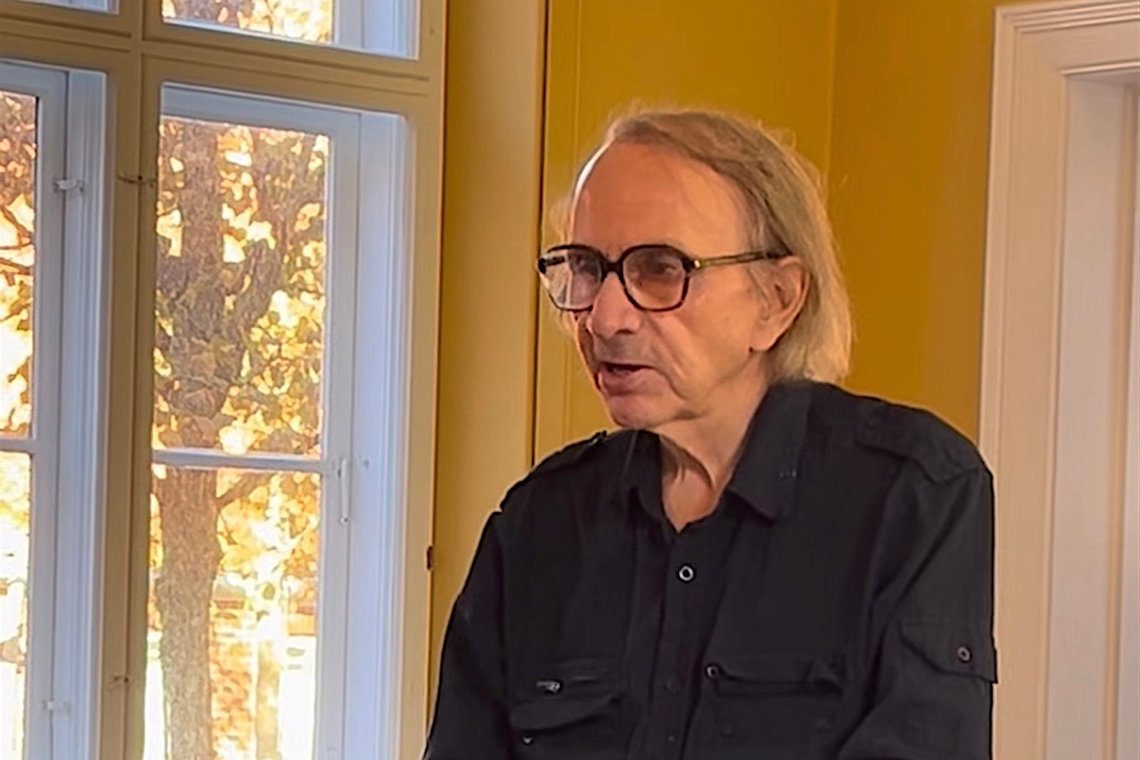
On Friday, the world’s most important living author, Michel Houellebecq, visited Denmark. The event took place for a small group of invited guests in the beautiful town of Ribe. Much has been written about this acclaimed and controversial author, so let me highlight here some of the most important and less frequently discussed perspectives on his extensive body of work.
In 2002, the historian of ideas Daniel Lindenberg published a study of ‘the new reactionaries’, which included Houellebecq, amongst others. According to Lindenberg, the common denominator was hostility towards mass culture, sexual freedom, human rights, egalitarianism and Islam.
It was intended as a critique, but can rather be read as a sort of table of contents for Houellebecq’s novels, and Houellebecq’s response in *Le Figaro* a few months later was, in fact, a confirmation of the significance of the reactionaries, not a rejection. Lindenberg conjured up the very movement he had warned against.
Conservative or reactionary
Is Houellebecq a conservative?
I asked the author this question myself during the event in Ribe, and he – who is not otherwise known for giving clear answers – replied in the affirmative. But it is probably more accurate to call him a reactionary, if a conservative is someone who wishes to preserve, and a reactionary is someone who recognises the loss of culture and mourns what has been lost.
Houellebecq is the cartographer of loss. He maps out areas of our shared life that no longer exist. His strength lies in cultural criticism, not in an uplifting message.
Let me give some examples from *The Elementary Particles* (1998) and *Submission* (2015).
The demonic side of liberation in *The Elementary Particles*
‘The Elementary Particles’ shows how the two half-brothers, Michel and Bruno, pay the price for sexual liberation, which is seen as an extension of the market. Love becomes a competition that produces few winners and many losers. The 1968 uprising is, in fact, not the antithesis of liberalism, but its fulfilment.
This becomes clear when their mother, Janine, leaves her children to fulfil herself, leaving them with an unimaginable sense of loss and a longing for love. The contrast is the grandmother, who raises Michel with selfless devotion. As is often the case, the grandparents are the only worthy characters in Houellebecq’s books, significantly representing precisely the generation preceding the self-centred ’68ers.
The New Age scene, where Bruno seeks redemption, is portrayed, by contrast, as the empty temple of therapy, which promises transformation but delivers only even greater loneliness. It is the therapeutic culture as a false substitute for charity and faith.
‘Submission’ and the Decline of the West
‘Submission’ depicts in greater detail what happens to a society that has lost the Christian faith.
The novel depicts how, in the near future, Ben Abbes’s Muslim party wins a presidential election in France, supported by socialist and centre-right parties against Le Pen. France is succumbing to Islamisation, not because of a large-scale invasion, but because the elite have become jaded, decadent and spineless.
The protagonist, François, is a researcher at the Sorbonne, a broken man who has nothing to defend in a country that has degenerated into a vast spiritual void. He ends up, like so many others, converting to Islam – at least, this is strongly implied.
Islam, in fact, fills this void and prevails, because it possesses the faith that the West has lost. Religion is portrayed in the novel as a real force. It is not merely a symptom of socio-economic conditions, as a left-wing author might describe it.
The Necessity of Christianity
A key scene in the novel depicts François’s encounter with the Black Madonna, a small wooden figure of the Virgin Mary standing in the Chapel of Our Lady in the pilgrimage town of Rocamadour. François senses the immeasurable attraction emanating from the figure, and he is on the verge of being swept away by its redemptive power, but she slowly slips into the mist of the past and vanishes from his sight. Disillusioned, he returns to the car park, feeling more forsaken than ever.
Houellebecq’s familiarity with the Christian iconography is also evident in the fact that the conversion to Islam by which François is tempted is portrayed as a pact with the devil. The one being tempted is a scholar, middle-aged and melancholic. The tempter – the university rector and Islamic convert Robert Rediger – is cultured, charming and persuasively cunning, appealing to the void within François. He is offered a high salary and a permanent post at the university, and two wives: an older one who can cook for him, and a young one with whom he can have sex. It is the serpent who tempts him. Why not? Think about it. Couldn’t that be a good thing?
As Søren Ulrik Thomsen has put it: The devil flatters vanity and tempts with quick gains.
A Catholic without faith
Houellebecq has also, in his own name, levelled sharp criticism at the West. A civilisation that legalises active euthanasia forfeits the right to respect, he wrote a few years ago. He is a Catholic in the sense that he expresses fear of a world without God. One might call him the archivist of sorrow, who in a way preserves what has been lost, but only by recording its disappearance. He does not believe in a conservative restoration of what has been lost and has no uplifting message to offer. Not directly, at any rate.
But all the more critical power there is in his books, which are hereby recommended for an increasingly spiritless age.


