

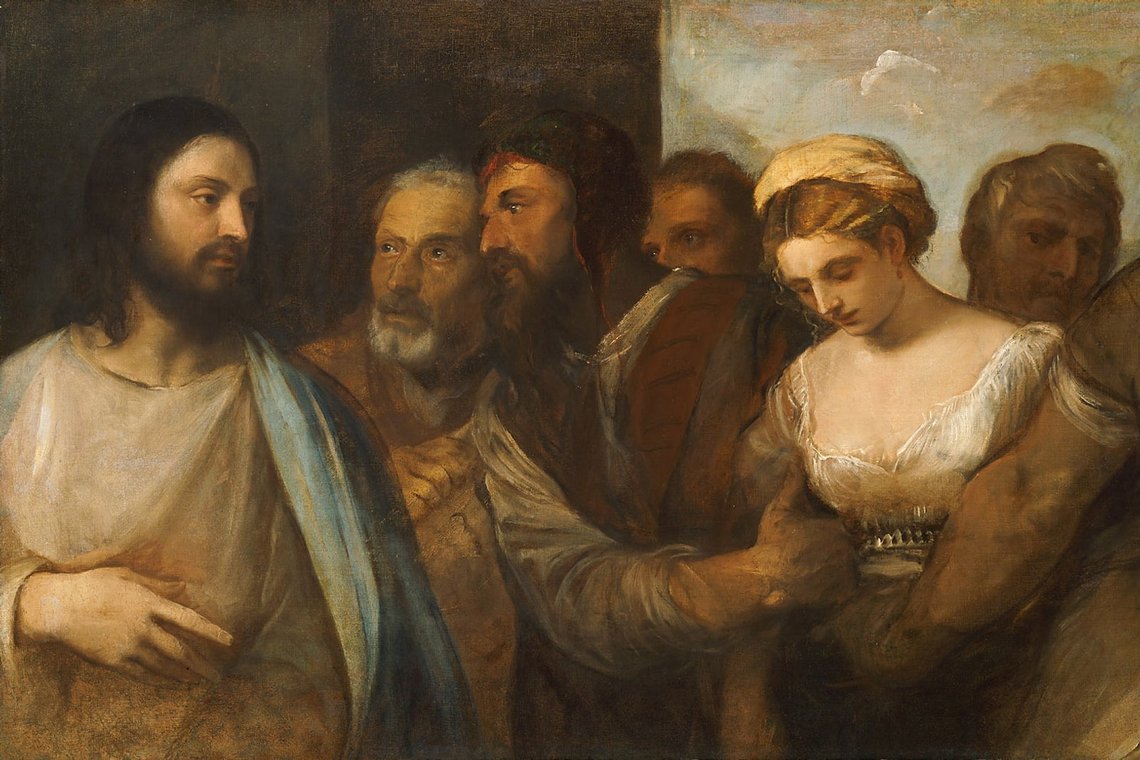
1 and Jesus went to the Mount of Olives. 2 Early the next morning he came to the temple again. The crowd gathered around him, and he sat down and began to teach them. 3 Then the scribes and the Pharisees brought a woman who had been caught in adultery, and they made her stand before them 4 and said: ‘Teacher, this woman was caught in the very act of adultery. 5 In the law Moses commanded that such women should be stoned. What then do you say?’ 6 They said this to put him to the test, so that they might have something with which to accuse him. Jesus bent down and wrote on the ground with his finger. 7 But when they continued to question him, he straightened up and said: ‘Let the one among you who is without sin cast the first stone at her.’ 8 Then he bent down again and wrote on the ground. 9 When they heard this, they went away, one after another, the elders first. In the end, Jesus was left alone with the woman standing there. 10 Then he straightened up and asked: ‘Woman, where are they? Has no one condemned you?’ 11 She replied: ‘No one, Lord.’ Then Jesus said: ‘Neither do I condemn you. Go, and from now on sin no more!’
John 8:1–11
The Pharisees came to their senses when Jesus said that the one who is without sin may cast the first stone at the adulteress. Confronted with such spiritual authority, each of them acknowledged to himself that he was certainly not without sin.
This passage from the Gospel, which is one of the texts in the church year for this Sunday, illustrates something of the essence of Christianity: Human beings are fallible creatures who cannot avoid doing wrong, yet they are so deeply loved by their Creator that they can receive forgiveness for their sins.
A civilisation could hardly have a better script than this: We must all examine our own conscience and ourselves refrain from judging too quickly, lest we ourselves be judged. – Our Constitution was made only for a moral and religious people. It is wholly inadequate to the government of any other, said John Adams, the second President of the United States, who had himself been one of the Founding Fathers (and it was self-evident that ‘religious’ at that time was synonymous with Christian). That the same applies to our own laws is something we can have confirmed every single day.
In the modern Western societies that emerged with Christianity as one of their fundamental pillars, it has naturally not been the case that one can never be punished. But our spiritual heritage helped bring about state apparatuses that could not exercise arbitrary cruelty and injustice as easily as in dictatorships. The state existed for the people and could not do whatever it pleased to its citizens.
In today’s Europe, not much remains of this heritage. At the beginning of this millennium, the EU set out to write a constitution of its own for the Union. In 2003, Pope John Paul II urged the Union to acknowledge its Christian roots in the preamble to the constitution, but no such references were included when the document was completed the following year.
This was to become only one of numerous indications that the EU is actively anti-Christian. Subject to the same spirit of the age and in its capacity as an EU province, Norway has also followed the same path.
One consequence is that both Norway and the Union have acquired governments that more readily treat their citizens abominably. And the nastiness has spread to many of the citizens as well: They themselves have become a kind of Pharisee and scribe; they find it very easy to see sin in their fellow citizens (never their own), and they are more than willing to cast the first stone – to punish political sin, not sexual sin.
Anyone can surely think of their favourite examples of conformist herd mentality that is to be imposed on others, if necessary by throwing stones.
From the perspective of power, it is ingenious for the people to be one another’s wardens. The Roman Empire knew something about power, and it did not have the capacity to micromanage everything that happened in every province. As long as taxes were paid and soldiers were sent to the army, Rome gave the provinces a high degree of self-government.
Judea in the time of Jesus was subject to the Roman Empire, which had its local representatives. But the Pharisees and the scribes wielded considerable political power, which was convenient, albeit not without problems, for Rome. As the Easter Gospel tells us, it was, after all, they who persuaded the Roman governor to crucify Jesus.
Fast-forward to the present day, and the Roman Empire has been replaced by an EU that no longer grants a particularly high degree of self-government to its members and subjects. There is a reason why someone coined the expression ‘the European Soviet Union’.
But similarities still remain: In every country, our own included, there are Pharisees and scribes who wield considerable influence. The difference is that today they more readily do the bidding of those in power. In Norway, they also include those who were supposed to be the watchdogs of power. It could hardly be better for those in power when they have Pharisees and scribes who are actually supposed to keep them in check doing their dirty work for them.
Is it any wonder if some people happen to exclaim that the EU is the Antichrist? Suggestions are welcome for a more appropriate term for an authoritarian political apparatus that drastically weakens our continent’s ability to create wealth, that admits millions of people who hate and want to replace our spiritual heritage, that gives them substantial portions of a dwindling wealth to which very few of them have contributed, and that harasses anyone who protests against this development.
Buy ‘Veien fra ateismen til det totalitære’ (‘The Road from Atheism to Totalitarianism’) by Olavus Norvegicus. You can also buy the e-book here.


