

Christianity has some sharp edges. One of them is sin. But sin and freedom are intimately connected. No freedom without sin. Everything is connected. But many modern people do not like the concept of sin. For the wages of sin is death, and that sounds brutal.
That is why the Church is now embellishing the message it has been entrusted to administer.
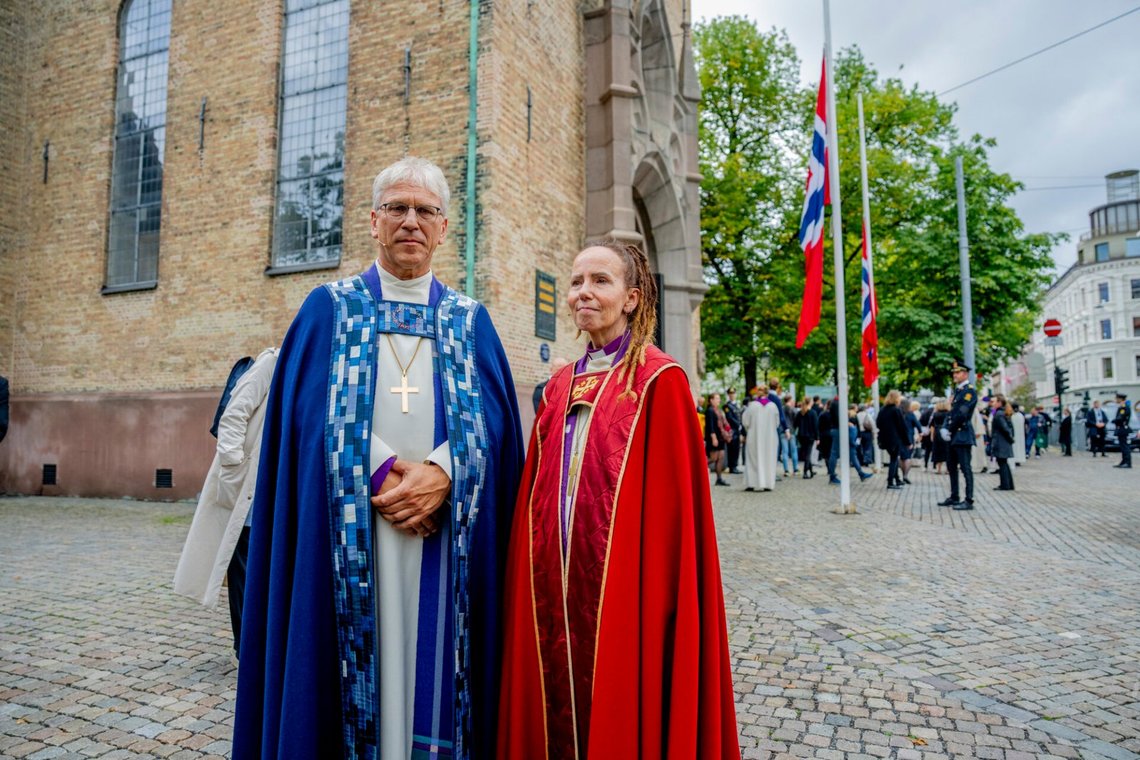
The Bishop of Oslo, Sunniva Gylver, reveals that a discussion is under way at the highest levels of the Church about removing John 3:16 from the funeral liturgy.
Everyone who grew up in the old Norway learnt this verse by heart at school. It is called ‘the little Bible’.
For God so loved the world that he gave his only begotten Son, that whosoever believeth in him should not perish, but have everlasting life.
Gylver believes that this requirement of faith versus perdition is too brutal for mourners. These are thoughts shared by her colleagues.
– There is an ongoing discussion in the Bishops’ Conference (Bispemøtet), the Theological Commission (teologisk nemnd) and among several others working on the revision of the funeral liturgy. As far as I have understood, there is fairly broad agreement that it is not appropriate virtually to begin the funeral with this Bible verse.
During King Harald’s funeral in Oslo Cathedral, the Presiding Bishop (preses), Olav Fykse Tveit, made his own version:
‘God loved the world so greatly that he gave his Son, his only Son, even into the darkness of death, so that we should not perish, but have eternal life.’
Here something fundamental is missing: the Resurrection, the victory over Darkness. Here Jesus sacrifices himself so that we may live. But that is not what the Bible is about. The Gospel is not a buffet from which you can pick whatever suits the audience. It is a complete package. If the Church’s leaders themselves begin to change the message, the entire edifice will collapse. It will, at any rate, lead to even emptier churches. Why go and listen to false doctrine?
The message has become a stumbling block.
Jesus uses the image of the builder who chooses the stone that the others have rejected.
Here Gylver and the Presiding Bishop discard what is sharp and causes offence.
She believes that ‘perish’, which was the wording used by the Presiding Bishop, is more appropriate because one believes first and foremost that God is the source of all life.
– For some of us, the Bible verse quickly becomes an implicit threat: ‘yes, what about the others?’. I wonder why we do not include verse 17. For it says there that Jesus came not to judge, but to save.
Appropriate? In relation to whom? If one begins to grade Christianity according to ‘threat’, one might as well shut it down. This is hippie Christianity.
The cracks in the New Norway are to be plastered over. Christianity can be bent and stretched so that the message fits into every context. But that is not Christianity.
On the contrary, it may prepare the ground for an Islamisation of Norway.
That the Presiding Bishop betrayed John 3:16 during the King’s funeral was a historic moment of great symbolic weight.
– If there are two outcomes of life, then one is eternal life with God, and the other is non-life. The cessation of life, Gylver replies.
The Bishop says that she has received a great deal of criticism for having spoken about the subject previously. She finds the idea of torment without end difficult.
But what about the torment in the Islamic hell, where those who sit in paradise watch the others perish from thirst without giving them anything?
Hippie Christianity believes that good intentions trump everything.
It is a self-centred faith, and in order to achieve it, Christianity’s sharp edges must be filed down until nothing remains of it.
Behind the goodness lurks submission.
Kirkens preses fusket bibelsitat under kong Haralds gravferd


