

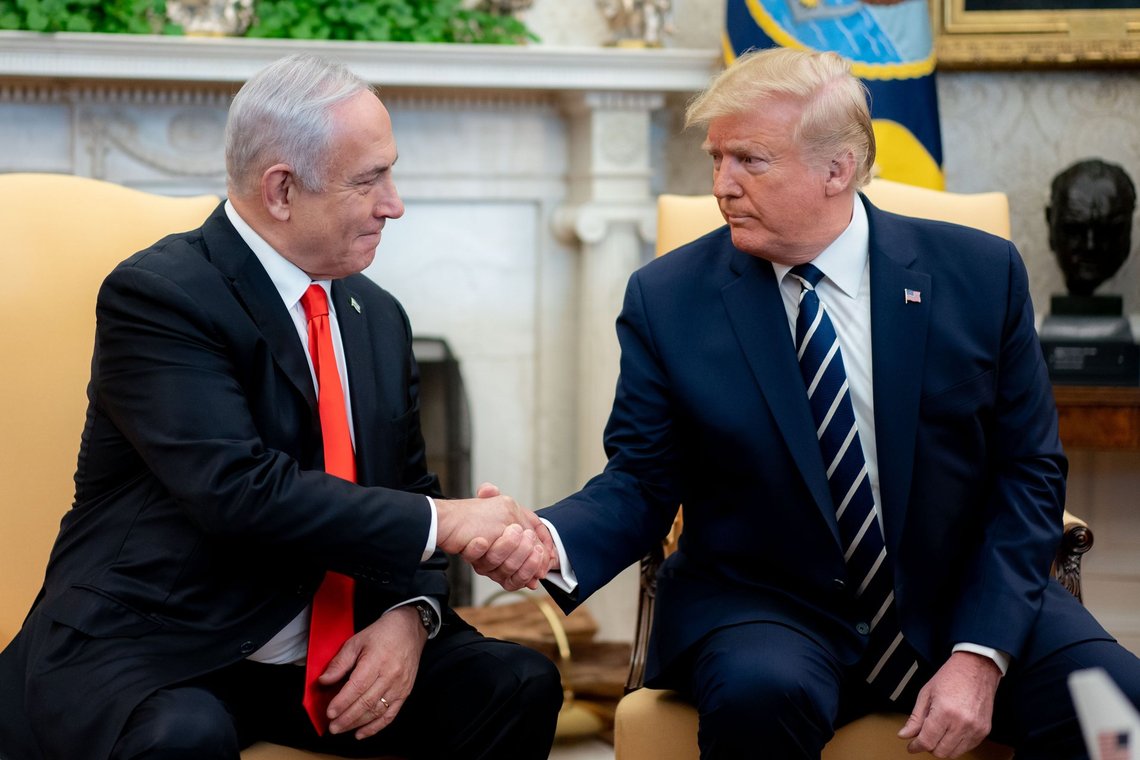
What Israeli Prime Minister Benjamin Netanyahu and US President Donald J. Trump have done is not merely to combat terrorist groups. They have prevented these groups from achieving their main objective: taking over Western civilisation.
The core ideology of groups such as Hezbollah, Hamas and the Houthis – like that of the Iranian regime – is not about influence, trade or partnership. It is about ideological domination. Their efforts consist of trying to eradicate all non-Muslims, as well as other Muslims whom each group considers not Muslim enough.
Doctrinally, all Muslims are obliged to kill polytheists (such as Hindus) and to rule over ‘infidels’ such as Christians and Jews – as well as to pursue the broader project of imposing their worldview on the subordinate, secular West with its man-made laws (as opposed to Islam’s divine, Allah-created sharia law). Democratic institutions are an abomination to Islamists.
The Iranian constitution itself enshrines this hegemonic ambition. Its preamble declares that the document ‘provides the necessary basis for ensuring the continuation of the Revolution at home and abroad’. It further commits the Islamic Republic of Iran to cooperating with other Islamic and popular movements ‘to prepare the way for the formation of a single world community’ in accordance with the Quranic verse describing the faithful as one community under one God: Allah. The same constitution charges Iran’s army and the Islamic Revolutionary Guard Corps not only with defending Iran’s borders, but also with carrying out ‘the ideological mission of jihad [war to advance the cause of Islam] in God’s way; that is, extending the sovereignty of God’s law throughout the world’.
Exporting the revolution is not an optional foreign-policy objective for Iran’s rulers; it is an obligation.
The late Supreme Leader Ayatollah Ruhollah Khomeini, founder of the Islamic Republic of Iran, once said: ‘We shall export our revolution to the whole world. Until the cry “There is no god but Allah” resounds throughout the world, there will be struggle.’ This formulation leaves little room for coexistence with secular, liberal or non-Islamic systems. The objective is not influence, trade or partnership; it is ideological domination.
This project has already produced tangible results outside the Middle East. Iranian-backed networks such as Hezbollah have established financial, logistical and operational footholds throughout Latin America. The tri-border area between Argentina, Brazil and Paraguay has long served as a hub for money laundering, counterfeiting and fundraising that supplements Iranian support and spreads Islam among people they promise to help. In Venezuela, successive regimes have issued passports to individuals with ties to Hezbollah, hosted training facilities and deepened state-to-state cooperation with Iran. Reports in recent years have pointed out that hundreds of Hezbollah operatives and their families have moved to South American countries, including Brazil, Colombia, Ecuador and Venezuela.
Parallel activities – document forgery, cooperation with drug cartels and the use of diplomatic cover – extend the reach of these networks towards the southern entry points to the United States. Cultural centres, media outlets and educational programmes have also sought to cultivate sympathetic audiences.
The method, which is gradual and multi-layered, begins with social and charitable work that builds local legitimacy. It continues with cultural and religious institutions that shape narratives, and ultimately produces political actors who penetrate state bureaucracies, legislatures and governments. Once inside, they can shape legislation, policing priorities and foreign-policy objectives.
The Iranian revolution itself followed a comparable path: years of ideological groundwork, infiltration of institutions and then a sudden consolidation of power that few outside observers fully anticipated before it was complete. Similar patterns have been visible in Lebanon, where Hezbollah developed from a militia into a dominant political and military force that has veto power over the state.
Israel’s military campaigns against Hamas in Gaza, Hezbollah in Lebanon and Iranian regime and military assets are not merely counter-terrorism operations. They weaken the military and economic capacity of regimes whose objective is to destroy Israel, and undermine the societies they control or that provide them with refuge.
Trump’s approach – combining sanctions with maximum pressure, diplomatic isolation of Tehran and open support for Israel’s right to defend itself – has aimed to deprive the Iranian regime of the resources and international legitimacy it needs to sustain its network of proxies, thereby limiting their ability to exercise power and spread ideology throughout the Middle East and into North America, Latin America and Europe.
If no serious resistance emerges, the same gradual process that transformed Iran into a hell for its people and hollowed out Lebanon’s sovereignty could take root in Western democracies. Demographic changes, parallel legal systems, political infiltration and systematic threats against critics create the conditions for a deliberate, step-by-step takeover. Even demographically, such a transformation becomes impossible to reverse.
The struggle that Trump and Netanyahu are currently waging is not merely intended to neutralise terrorist organisations. It seeks to prevent Western civilisation, democracy and freedom from falling under the control of an extremist ideology that openly seeks to replace these things.
The least European and other Western countries can do is support these efforts – militarily, economically and diplomatically – by refusing to denigrate the countries that are courageously fighting to preserve their freedoms, won at the cost of so many lives, and by refusing to legitimise terrorist groups such as Hezbollah, Hamas, the Houthis and the regime in Iran, whose constitution and leaders have committed the country to a global struggle until their vision prevails.
Dr Majid Rafizadeh is a political scientist, Harvard-educated analyst and board member of the Harvard International Review. He has written several books on US foreign policy. He can be contacted at dr.rafizadeh@post.harvard.edu. Follow Majid Rafizadeh on X.
The article was originally published by the Gatestone Institute on 19 September 2026.


