
 Bente Haarstad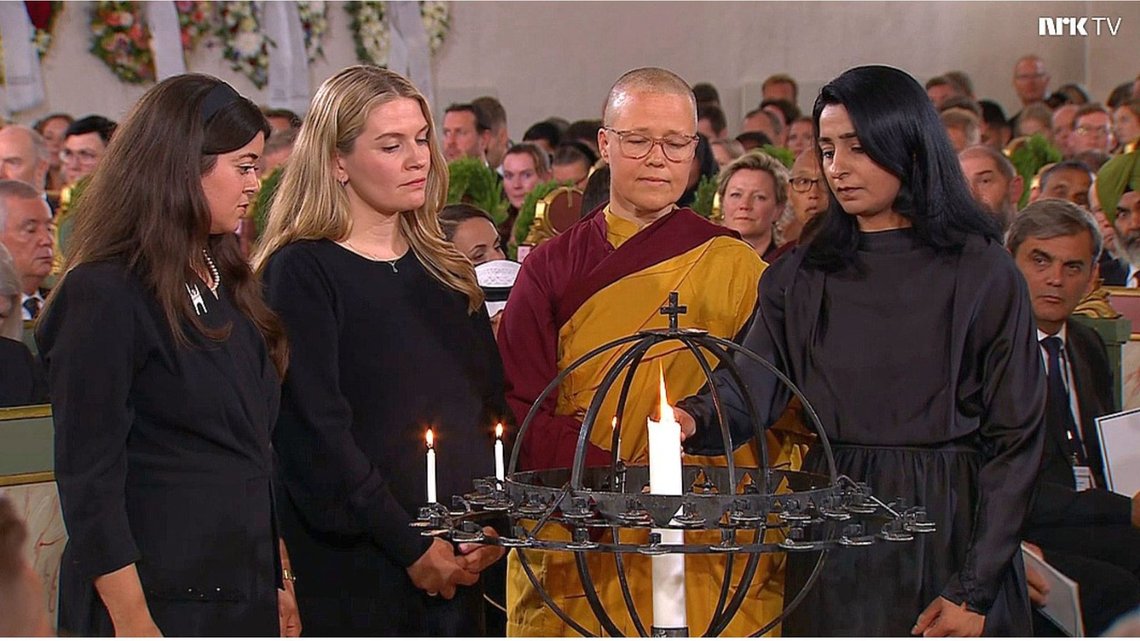
Atheists, imams and others from non-Christian organisations were given considerable prominence in connection with King Harald’s funeral, both beforehand and during the solemn ceremony with its procession and church service. The four people selected to light candles in Oslo Cathedral were Islam activist Bushra Ishaq, Nancy Herz, Lebanese, formerly Muslim, now employed by the Norwegian Humanist Association (Human-Etisk Forbund), Ani Chökyi, a Buddhist, and Rachel Mizrachi, a Jewish Pathways guide (jødisk veiviser).
Candles for God, Allah, the Universe and Nothing
– We light candles in gratitude for King Harald’s life and service. We light candles in gratitude for what unites us. We light candles in gratitude for warmth and laughter. We light candles in gratitude for diverse communities, for faith in the future and for hope, said the Catholic nun Else-Britt Nilsen as the non-Christians lit candles.
The funeral of King Harald V shows that the monarchy still stands strong in Norway. Large parts of the Norwegian population followed the poignant television broadcast, and thousands of Norwegians filled the streets of Oslo to pay their final respects to a much-loved king. That people of different faiths were among the prominent guests in the Cathedral is natural when royalty and heads of state from large parts of the world are invited. It is another matter when people of other faiths are given central roles during the church service.
The church interior cannot be used by non-Christians
The whole thing also appears to contravene not only all tradition, but also the Church’s own rules:
§ 1. Purpose The church is consecrated for use for worship services and ecclesiastical acts and shall through its use serve the glory of God and the edification of the congregation.
And:
§4: The church interior may not be used by non-Christian religious and life-stance communities for the practice of their faith or religion.
Does lighting candles constitute the practice of another faith or religion? We do not, after all, know what the thinking behind it was, or what the candle-lighters were thinking, but lighting candles in a church involves an ancient Christian symbolism. Or is supposed to.
The light of Christ
Since antiquity, the lit candle has been regarded as a symbol of the light of Christ. “Jesus came into our world of sin and death to bring us God’s light. This idea is expressed in the Gospel of John: I am the light of the world; whoever follows me shall not walk in darkness, but have the light of life”, writes a Catholic website about a Christian tradition that has also become increasingly common in Protestant churches.
It also states that lit candles should remind us of the first, persecuted Christians who celebrated Mass in the catacombs by candlelight.
Islam activist lit candle
Bushra Ishaq, one of the four specially selected candle-lighters at the King’s funeral, fought for Islamic prayer rooms at Blindern in 2009, and must be said to have been an activist for Islam ever since. Most recently through her appointment at the former MF Norwegian School of Theology (Menighetsfakultetet) (as was the imam from Islam Net), even though she is trained as a doctor. Document wrote about how, through her research at what used to be our school for clergy, she concluded that Muslims enjoy better health precisely because they are Muslims.
Bushra Ishaq is also an old friend of Oslo Bishop Sunniva Gylver, and the two previously wrote a Muslim-Christian devotional book together. At the time, in 2018, Gylver wrote a piece in which she asked herself whether it was right for her, as a priest, to highlight Muslim texts. The answer amounted to a kind of yes.
We do not know whether it was Bishop Sunniva who came up with the idea of inviting Bushra Ishaq to contribute to the service at the King’s funeral, but the Bishop has described the episode on Facebook:
Something that is not so common at funerals in church is candle-lighting. At this funeral, candles were lit by representatives of several faiths and life stances, to highlight King Harald’s and the rest of the Royal Family’s commitment to a diverse and inclusive Norway – of which we are pleased to be a part. Thank you to Catholic Sr Else-Britt Nilsen, humanist Nancy Lystad Herz, Buddhist Ani Chökyi, Jewish Rachel Mizrachi and Muslim Bushra Ishaq, who contributed to this.
Atheist and former Muslim
Another candle-lighter at the King’s funeral was Nancy Herz. She had been Muslim since birth in Lebanon, but is today employed by the Norwegian Humanist Association and is an advocate for atheism, but also for the hijab.
She regards hijab activist Iman Meskini from the television series ‘Skam’, and from the Norwegian Armed Forces, as a role model. Herz appeared as a candle-lighter with the emblem of the non-believers’ organisation clearly visible.
Jew and Buddhist
The final two candle-lighters were Rachel Mizrachi, who has been a Jewish Pathways guide and works at the HL-senteret, and who said in an interview with Aftenposten in 2021 that, as a Jew, she felt the threat from far-right circles – and Ani Chökyi, who is a Buddhist. She is Norwegian and was once called Runa, but her full name now is Karma Lodrö Chökyi.
– I grew up with a mother who is an active humanist, and I come from a family with three generations of religious sceptics, so things could hardly have gone more wrong in my case, Chökyi told Østlandets Blad earlier this year. There, she said that as a teenager she was interested in art and theatre and dreamed of becoming a director, but that a mental breakdown in her late teens caused her to reconsider. So she became a Buddhist. After nine years in Nepal, she ended up back in Norway, as a Buddhist nun.
She still wanted to live as a secluded nun, but there were no Buddhist monasteries with orders of nuns in Norway. According to Ani Chökyi, there is only one other Buddhist nun in the entire country. The solution was some old wooden cabins in the forests of Nordre Follo, owned by Karma Tashi Ling, the Buddhist community to which she belongs.
So that’s how things can turn out.
“In addition to the candle-lighters, the full breadth of Norway’s organised religious and life-stance diversity was invited to the funeral through STL’s leaders’ forum”, writes STL Norge – the Council for Religious and Life Stance Communities (Samarbeidsrådet for tros- og livssynssamfunn) – on Facebook. The organisation has been allowed to take part in most things concerning the King’s death, the period of mourning and the funeral itself. Both Christian Lomsdalen, head of the Norwegian Humanist Association, and Faruk Terzic, imam and chairman of Muslimsk Dialognettverk, are among those from STL who not only attended Oslo Cathedral, but also allowed themselves to be photographed together with the King’s coffin.
Nor was the full breadth of Norwegian religious communities invited to the funeral. There were several Christian churches that were not invited. Neither Frikirken Norge, the Baptist Church nor the Methodist Church was allowed to attend the funeral, as we wrote the other day:
Something similar happened when two services of mourning were shown on NRK television two days after King Harald died. On that occasion, candles were lit with an imam in Nidaros Cathedral and with Sikhs in Oslo Cathedral, something that was covered by Document:
Mangfold i kongens sørgegudstjenester: Moskéleder deltok i Nidarosdomen
But otherwise, it was a magnificent, solemn and splendid royal funeral.


