

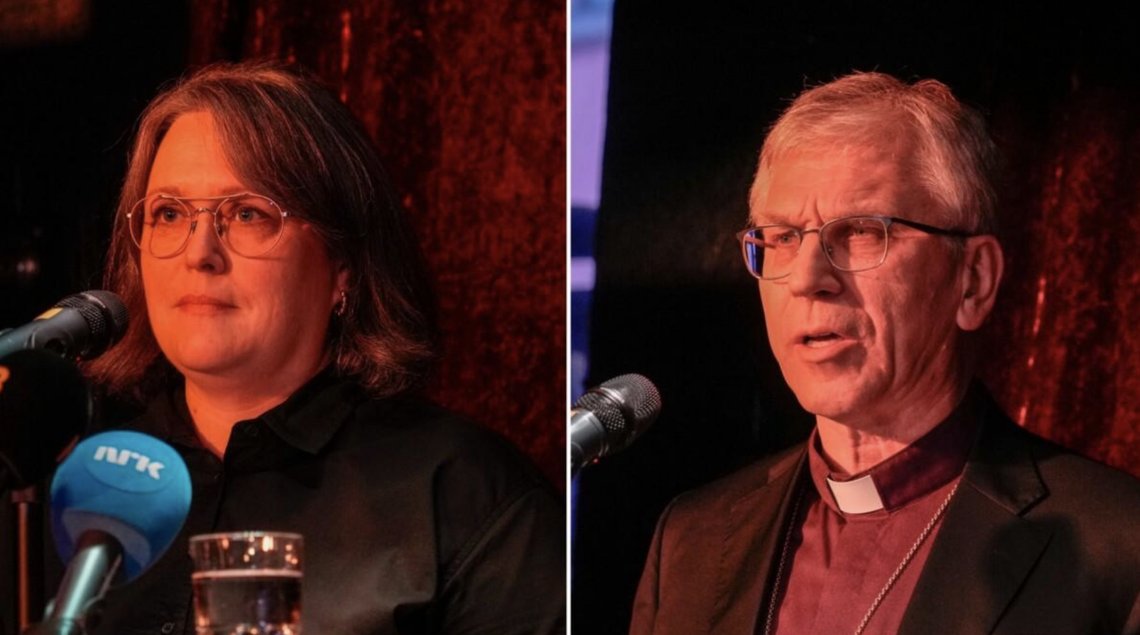


It is wrong to approach people from other religions who come to church on the assumption that they are idol-worshippers, says Sven Thore Kloster, Head of Research at the Institute for Church, Religion and Worldview Research (Kifo). This week, the Bishops’ Conference is to consider whether the 2016 guide Interfaith Encounters at Church Services should be revised. The researcher believes it is high time, and he would like to see more interfaith participation in the church.
Guidelines for weddings, baptisms and school services
The current guidelines provide guidance on how church staff should relate to other religions during weddings, baptisms, funerals, school services and other church ceremonies.
The guidelines emphasise that terms such as ‘idols’ and ‘idolatry’ are polemical and may be perceived as condescending, and that Christians should avoid using these words when referring to other religions. Head of Research Sven Thore Kloster believes that this is not enough. He believes the guide is too preoccupied with avoiding the mixing of religions, and that it is based on a theological premise that other religions practise idolatry. Kloster doubts that such language can help to build trusting and positive interfaith relations.
The Head of Research believes the Church of Norway should look to guidelines in Finland and Sweden, where priests are encouraged to a greater extent to assess the content of the religious elements.
– ‘Assessments become too simplistic if one focuses solely on religious differences. One must be able to ask whether the content of an action is something that can be defended ethically and theologically,” the researcher tells *Vårt Land*.
The newspaper gives some examples from the current guidelines for interfaith meetings:
A Christian may pray at the same time as others, but not in the form of a joint prayer.
A Christian should not take part where people of different faiths simultaneously recite the same prayer, so-called interfaith prayer.
A funeral cannot take place as part of a single joint ceremony in which the participants represent different religions, and where the content is drawn from several religious traditions.
The reason the Bishops’ Conference is to review the guidelines is said to be that Norway has changed. One must assume this relates to demographics.
The documents relating to the matter to be considered by the Church’s leaders refer to previous debates. The Church’s role as a co-organiser of Muslim iftar meals and the breaking of the fast is highlighted in particular. Such events in churches may trigger further related debates, according to the case document.
Church-organised Islamic celebrations are a topic on which *Document* has written extensively. Among other things:
Interfaith baptism in the church
Vårt Land has spoken to yet another critic of the current guidelines for interfaith services in the church. That is, the Priests’ Association, which is now part of the organisation Spir, and its leader, Eva Klokkerud.
– As a parish priest, you receive requests to read a passage from the Qur’an or a poem from a new religious tradition. Dilemmas can also arise when multicultural families are to have a christening, as you cannot simply baptise a child based on the wishes of just one parent. That is why it is absolutely vital that we have a guide, says Klokkerud.
Klokkerud also believes that the concept of idolatry is challenging in an interfaith context.
– As a matter of principle, one does not refer to other people’s faith as idolatry. That should be a guiding principle for all dialogue between religious communities, she tells the newspaper.
The priests’ representative also points to the multi-faith ceremony at King Harald’s funeral as a good example of how this can be done.
Document wrote a little about that service:
Islamic activist and atheist chosen as eulogists at the King’s funeral


