

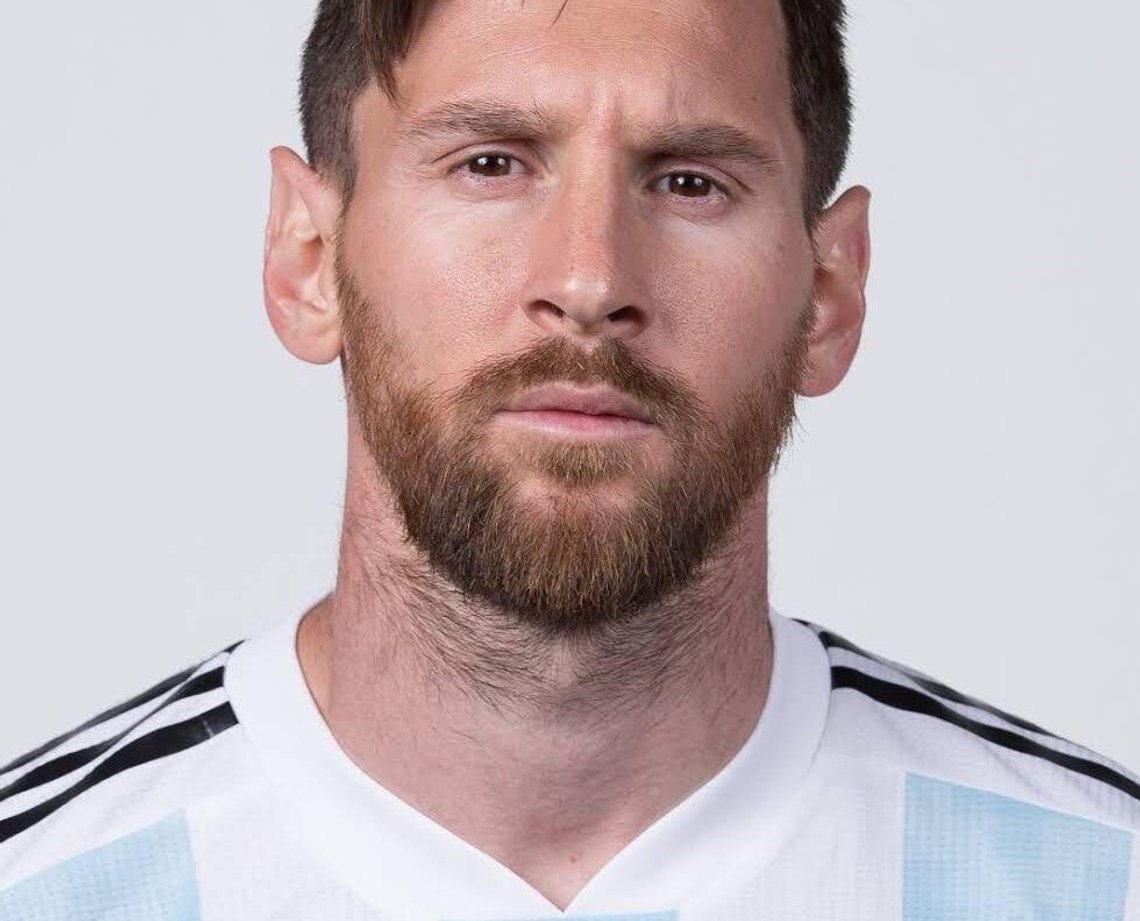


Lionel “Leo” Messi was a little boy with serious growth problems. But he could play football. Barcelona recognised his talent and paid for his treatment. The rest is history.
The greatest player of all time suffered in childhood from a condition that prevented him from growing normally. He was able to develop thanks to the medical treatment financed by Barcelona. Lionel Messi changed the history of modern football.
He was born on 24 June 1987 in Rosario, Argentina. He came from a working-class family; his father worked in a steel factory, while his mother looked after the children and worked part-time as a cleaner. The little boy found joy in playing with a ball from an early age. It was his grandmother, Celia Oliveira Cuccittini, who first recognised that little Leo had a special talent.
It was Grandma Celia who ensured that Messi got his chance. After playing in the streets for several years, she took Messi to a proper football club training session when he was only four years old. Messi was at least two years younger than the other players, and he was also very small for his age.
Messi himself has recounted how Celia pressed the coach to let the little boy onto the pitch during a match.
My grandmother used to tell them: “Put him on.” And they replied: “No, no, he’s too small.”
“Put him on, he’ll decide the match,” she said. “They argued for a while, then they put me on. In the end I scored two goals that day,” Messi said in an interview with TyC Sports.
It is his beloved grandmother that Messi points to after every goal, when he gestures towards the sky. It is a ritual he has repeated countless times since her death.
In 1994, at the age of seven, he began playing for Newell Old Boys, a club Messi loved. He remained there for six years and scored 234 goals in 176 matches in the youth ranks. But when he was 10 years old, the club’s doctor noticed that Leo was unusually small for his age. He also did not appear to be growing at a normal rate.
He was examined, and the diagnosis was a form of growth hormone deficiency, which affected his physical development and posed a threat to his future football career.
Messi was only 130 cm tall when he turned 11. He had the height of an average eight-year-old. Tests were carried out to determine whether he needed specialist treatment so that his muscles and bones could begin to develop.
The doctors concluded that there was only one solution. But the treatment was expensive, and although the family was not poor, they could only afford a few months of it. That was when FC Barcelona stepped in.
The Catalan club signed Messi and paid for his treatment. They had recognised little Leo’s talent and decided it was worth the investment.
Every evening Messi had to receive injections that stimulated his growth process. It was both traumatic and painful for a little boy. Yet despite the pain, Messi continued to train.
In the 2000–2001 season he began training with Barcelona’s Under-13 team. He was then seven centimetres shorter than average. Nevertheless, he quickly made an impression. At the same time, however, his medical condition persisted.
The treatment caused him to grow, but he never became taller than 1.70 metres. Without treatment, it is estimated that he would have been around 155 cm today.
Messi scored 89 goals in 97 matches for Barcelona’s youth academy. Eventually he was promoted to the first team. He played 778 matches for Barcelona, scored 672 goals and provided 303 assists. These are astonishing figures sustained over a long period, and Messi is not even an out-and-out striker, but rather more of a wide player.
Some of the goals were spectacular, memories for life for those who were present in the stands or for those of us who watched the matches on television.
What made Messi so good?
Messi is small, and he is not particularly physically strong. Nor is he especially fast. Physically, he has few advantages. How, then, could he nevertheless become the greatest player in history?
The obvious answer is, of course, that he possesses superb technique and ball control. But countless others do as well, and that is not the main point.
Physically speaking, balance is Messi’s greatest strength. He can change direction with extraordinary speed and never loses his balance. All of this happens at blistering pace while he maintains complete control of the ball.
But his greatest strength of all is his extraordinary vision. His eyes are constantly moving; he knows where every player on the pitch is at any given moment. So when he receives the ball, he already has the plan formed in his mind.
Messi is known for walking for much of the game; one could almost believe he was lazy. But it is precisely during these moments that he gains a complete overview of where everyone is on the pitch, while his subconscious works through possible solutions.
He then finds the ideal position on the pitch, frees himself, and immediately receives the ball, since his team-mates are trained (and willing) to ensure that Messi gets the ball as soon as he asks for it. Then the show begins.
This is actually something that has been researched. The results were clear. Players who gained an overview by scanning the pitch more frequently in the seconds before receiving the ball were quicker to make their next pass, more likely to turn with the ball in an attacking direction instead of playing it safely backwards, and more inclined to make a forward pass that genuinely threatened the opposition.
Once again: many players possess excellent awareness and vision. There are many brilliant physicists as well, but only one Albert Einstein, who managed to understand how light itself could be bent.
Messi is also intelligent enough to understand that, although he is the world’s best individual player, football is a team sport. If a team-mate is in a better position, Messi gladly gives up the ball and celebrates goals scored by his colleagues just as enthusiastically.
In an emotional message today, only hours before the World Cup final against Spain, Messi praised his team and the success they have enjoyed in recent years.
“Whatever happens tomorrow, this group of players has already written a history we will never forget and that no one can erase,” wrote the 39-year-old veteran. (NTB-DPA)
In this respect he differs greatly from Cristiano Ronaldo, who appears to think primarily about himself and can therefore never hold a candle to Messi.
Messi does not really dribble; he simply moves with the ball at extraordinary speed. Tiny changes in direction and tempo leave world-class defenders sprawled on the ground. Others can do this too; just look at Michael Owen’s goal against Argentina at the 1998 World Cup. It could hardly have been more beautiful. He scarcely dribbles anyone; he cushions Beckham’s pass elegantly and simply runs away from everyone while maintaining complete control of the ball.
This is a fundamental principle I have tried to teach the youngsters I have coached: play the ball beyond your opponent while changing direction and tempo. If you do this correctly, your opponent cannot stop you. Then all that remains is to maintain control of the ball and have a clear plan for your next move.
Cristiano Ronaldo, on the other hand, stands there waving his legs over the ball with his ridiculous stepovers; it is painful to watch.
The only rival Messi has ever had was another little magician from Argentina: Diego Armando Maradona. No one has ever matched the level Maradona displayed at the 1986 World Cup. But Messi has maintained an extraordinarily high standard for more than twenty years, something Maradona never managed.
Messi and another little magician, the Croatian Luka Modrić, who is almost two years older than Messi, are the only players to have appeared in six World Cup final tournaments, beginning in 2006. At this year’s World Cup Messi is 39 years old and relatively weak physically. Nor is he particularly fast any longer, yet he is still capable of producing miracles. The reason is that he has not lost his vision or his passion, combined with a fundamentally superb technique and touch far beyond that of almost everyone else.
Added to this is his geometric understanding. Messi understands the relationship between the speed of the ball and the movements of the players, enabling him to calculate the precise angle and weight required for a perfect pass. This is a quality that our own Martin Ødegaard also possesses in abundance.
Today Messi leads Argentina into the World Cup final against a formidable Spain. It will almost take a miracle if Argentina are to win. Leo is unlikely to finish as the tournament’s top scorer, since Mbappé is two goals ahead. But it is not entirely impossible.
Argentina, and the entire football world, has had the privilege of living at the same time as a unique player who eats miracles for breakfast. So although I still expect Spain to win tonight, I hope for Messi.
The most important honours Messi has received:
11 league championships, including ten in La Liga and one in France.
4 UEFA Champions League titles.
Olympic gold medal in 2008.
Copa América winner (2021, 2024).
FIFA World Cup winner in 2022.
Winner of the Ballon d’Or as the world’s best footballer
in 2009, 2010, 2011, 2012, 2014, 2015, 2019, 2021 and 2023.
World Cup Best Player in 2014 and 2022.
In addition, Messi has scored more World Cup goals than anyone else, with 21.
Tomorrow I may write about the tournament as a whole: the experience, the entertainment, the drama, the presentation and the enthusiasm. But first the final must be played, so that the winner of the 2026 World Cup can be decided. At the centre of attention stands the 39-year-old Lionel Messi.
The World Cup final between Argentina and Spain kicks off at 21:00 tonight.


