

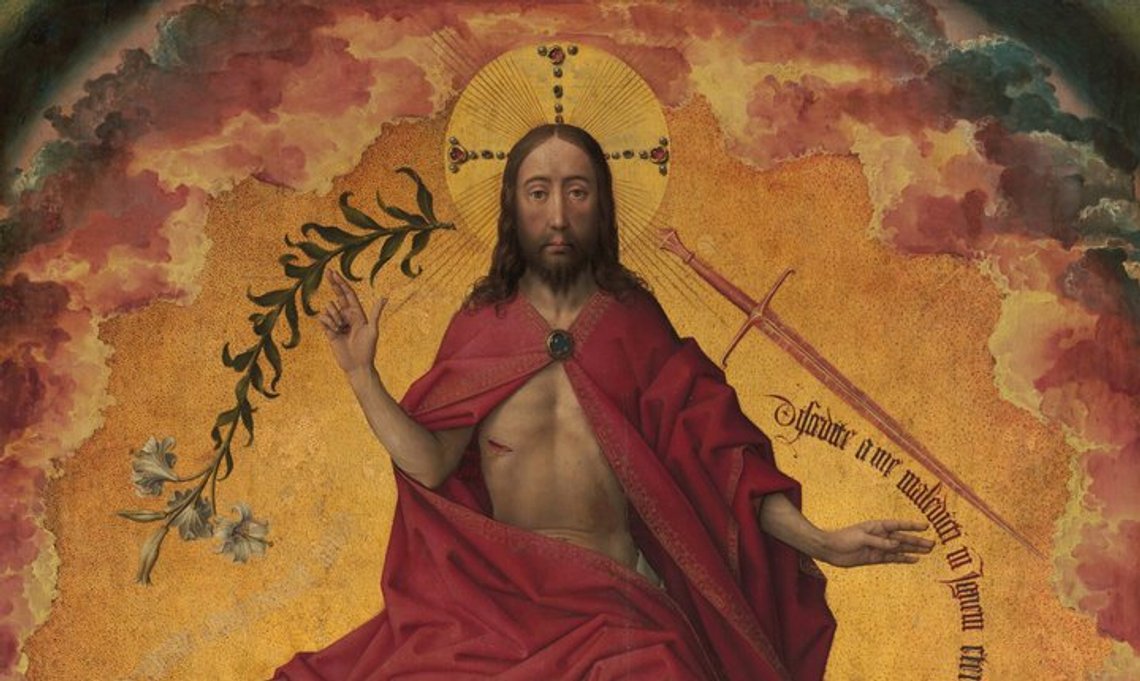


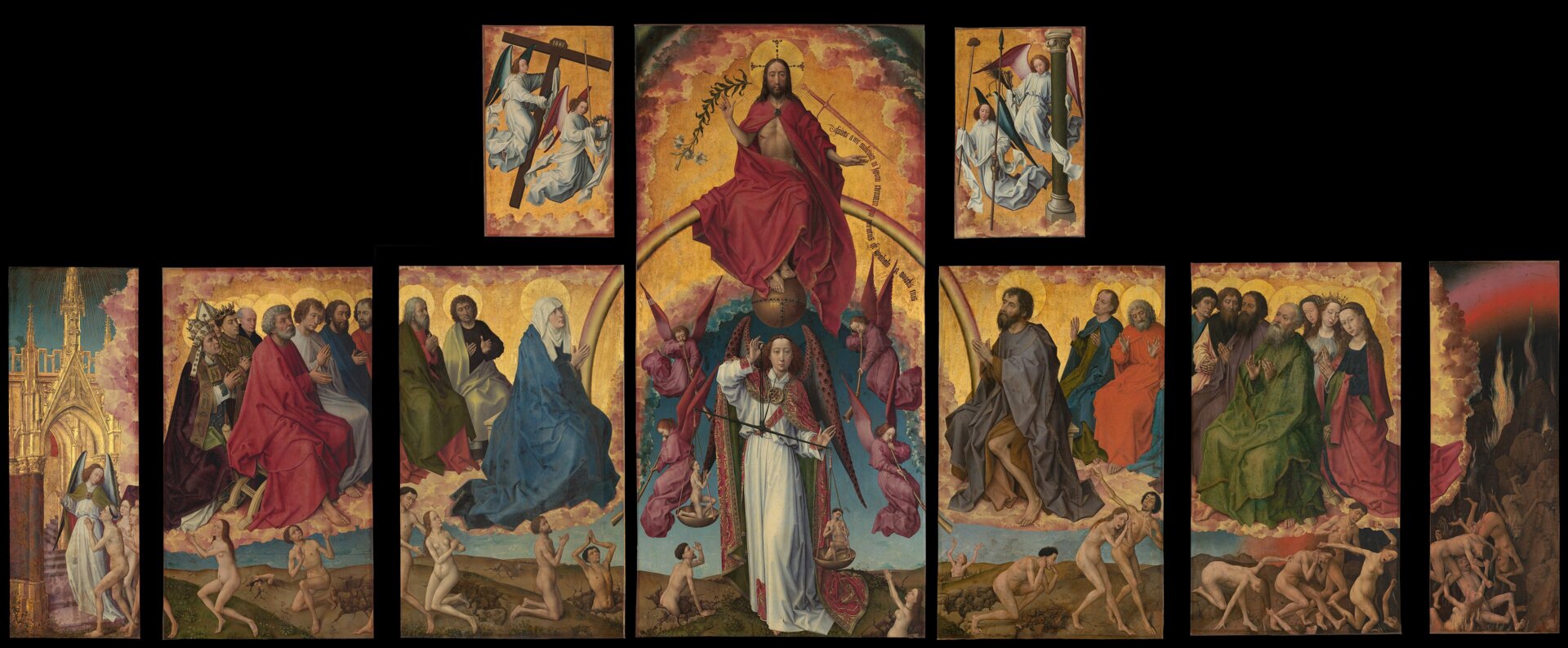
Rogier van der Weyden (c. 1400–1464), ‘The Last Judgement’, altarpiece at the Hôtel-Dieu, Beaune.
11 And I saw a great white throne and the One seated on it. The earth and the heavens fled from His presence and were no more. 12 And I saw the dead, both great and small: they stood before the throne, and books were opened. Then another book was opened, the Book of Life. And the dead were judged according to what was written in the books, according to their deeds. 13 The sea gave up the dead who were in it, and Death and Hades gave up the dead who were in them, and everyone was judged according to their deeds.
Revelation 20:11–13
Writing a text based on today’s theme – what we call Judgement Sunday – is a challenging task, but I would like to turn it into something positive. It is about justice and the basis of judgement: a universally valid moral code and a God who loves us.
Few claims provoke opponents of Christianity more than the claim that morality is founded in God. As proof that people do not need God to live morally, they often point out that even non-believers can have strong moral principles. They believe that we do not need a moral compass rooted in religion to be able to distinguish between right and wrong.
Now, no Christian would say that people must be Christians to have moral principles. What we are saying is that it is God who has instilled this understanding in us from the very beginning. We also point out that people who disregard this compass lose the ability to understand the truth about right and wrong. For Christianity does not preach a morality developed through an evolutionary process, but a morality that is true and right regardless of the era. It is only in this way, then, that a judgement can be just.
If it were the case that everyone were free to shape their own moral principles and understanding of right and wrong, we would never be able to judge anyone. Any criminal code would become irrelevant. Therefore, our own criminal code is not neutral either, given its origins. There is thus a diametrically opposed difference between a view of reality in which morality is perceived to have a divine origin, and one in which morality is privatised and becomes a tool for the majority or a dictatorship.
The challenge is that this is where we have, to a large extent, ended up. De-Christianisation comes at a price that should concern most people, and it is about the indifference that relativisation brings with it – what the majority is prepared to defend. We believe we have become more moral, when in reality we have become more indifferent.
We recently witnessed an example of this in the Netherlands.
Ingrid Bijleveld was a Dutch mother of two who, some time ago, applied for permission to undergo euthanasia at a Dutch hospital. She felt her life was meaningless and no longer wished to live. She had two sons of primary school age. She was struggling with mental health issues, and in 2024, a blow to the head following an accident is said to have intensified her desire to die. Her GP would not grant her assisted dying, but she took her case to the Dutch Euthanasia Centre. Following a thorough assessment, her application was approved, and she was subsequently assisted in dying at a public hospital.
In the Netherlands, children under the age of 12 have also lost their lives following their parents’ applications for euthanasia.
The Netherlands has an euthanasia law because the country regards the option of receiving assistance to die as a right, and therefore considers it ethically correct to offer this to its citizens.
What we should take note of is how a law such as this is becoming increasingly liberalised. In the Netherlands, the right to euthanasia was originally rooted in society’s compassion towards the terminally ill and dying, but over time the emphasis has shifted towards the patient’s right to self-determination and their own experience of suffering.
We see a clear parallel between the right to active euthanasia and the right to abortion. Arguments for extending the limits of abortion or euthanasia are always based on a new understanding of morality, or ‘that we are mature enough’ for an expansion of our rights.
This illustrates what happens when we no longer have a moral compass to guide us, but only the majority’s belief in their own standards – or lack thereof. The ethical arguments they use to convince us of their moral superiority are therefore just as unconvincing as Marxism’s claim that a classless society is the answer to the injustice of poverty. The fact that something is true for them is of no consequence to me or you. The fact that Protestant Christians in the Netherlands, in their time, also defended the right to euthanasia says more about their spiritual death.
What, on the other hand, characterises Christianity is a God who never allows Himself to be persuaded or swayed by whatever a majority decides. He never becomes ‘mature enough’ for changes in moral standards. Rather, He is bound by His truth and His holy and absolutely good nature. Therefore, the standards He sets are valid in both time and space.
God has promised everyone a just judgement based on our deeds, but He has also promised salvation to those who believe and receive Him. For God did not send his Son into the world to judge it, but so that the world might be saved through him. His love for us is eternal. The choice is ours.


