
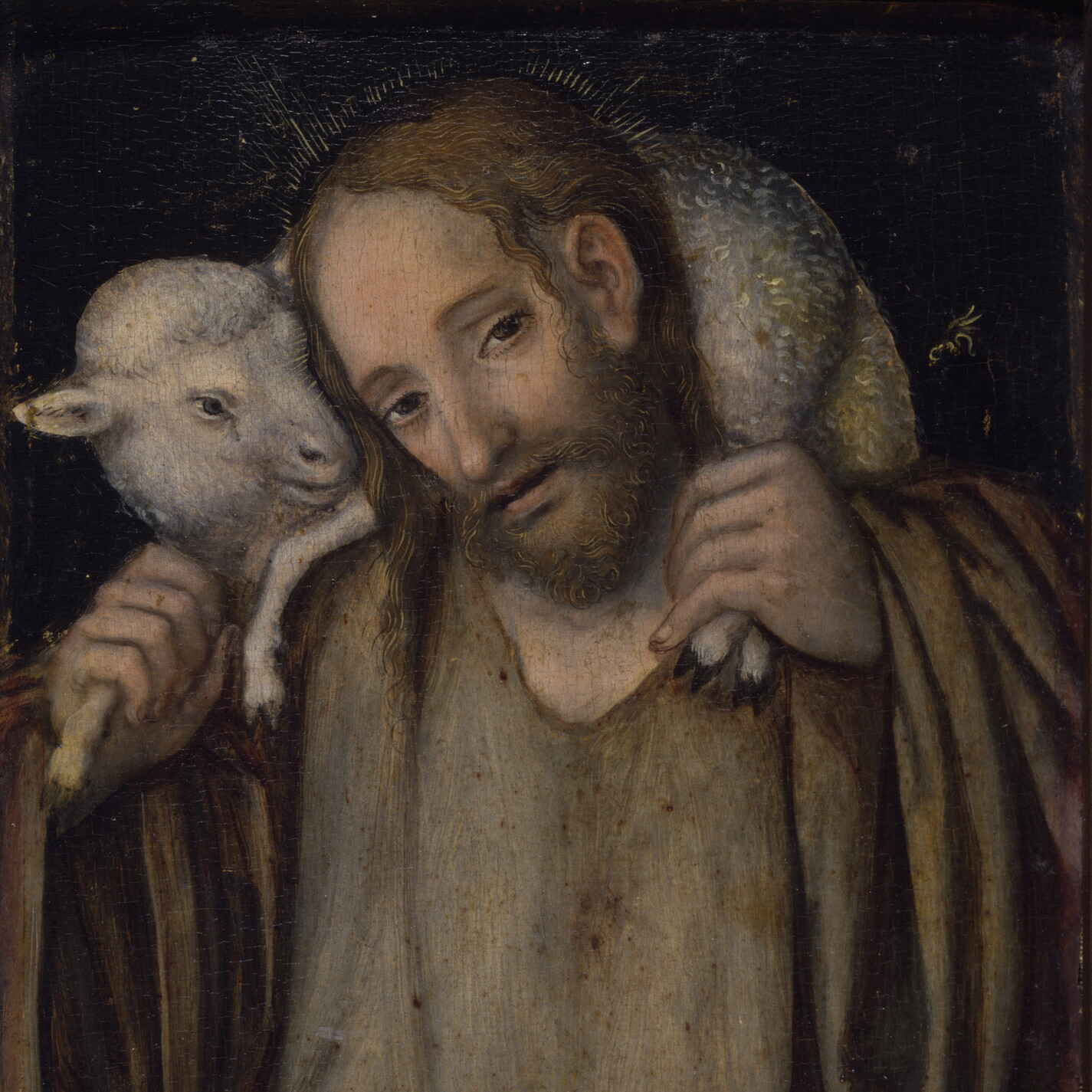
Lucas Cranach the Younger (1515–1586), “The Good Shepherd”, Angermuseum, Erfurt.
11 I am the good shepherd. The good shepherd lays down his life for the sheep. 12 The hired hand is not the shepherd and does not own the sheep. So when he sees the wolf coming, he abandons the sheep and runs away. Then the wolf attacks the flock and scatters it. 13 The man runs away because he is a hired hand and cares nothing for the sheep. 14 I am the good shepherd; I know my sheep and my sheep know me— 15 just as the Father knows me and I know the Father—and I lay down my life for the sheep. 16 I have other sheep that are not of this sheepfold. I must bring them also. They too will listen to my voice, and there shall be one flock and one shepherd.
17 The reason my Father loves me is that I lay down my life—only to take it up again. 18 No one takes it from me, but I lay it down of my own accord. I have authority to lay it down and authority to take it up again. This command I received from my Father.”
John 10, 11–18
It is the third Sunday in what we call Eastertide, and a relevant question is what political significance the death and resurrection of Jesus have.
The historian Nils Rune Langeland is currently publishing the book “Diktatoren”. The theme of the book is what Langeland calls political theology. This theology, according to Langeland, accepts neither democracy nor popular sovereignty, because it claims to possess the truth, and points to Jesus Christ as an example. The cover of the book is adorned with a cross and a swastika.
He tells the newspaper Klassekampen that a genuine democracy cannot be based on “truth”, since it lies in the nature of democracy that politics, and thus truth, can change depending on the perceptions of the majority, but democracy must accept that the majority can also be wrong.
Langeland writes:
The leader (føraren) is bound neither by office, mandate nor ideology. The entire constitution, the legal, moral and social, can be suspended in a single glance and with a single word. The dictator is a personal sovereign and king of truth.
Nils Rune Langeland is not alone in problematising truth in this way; it is this understanding that has underpinned the attacks on the United States and conservative states in Europe.
A few days after Klassekampen had an interview with Nils Rune Langeland, the new leader of Rød Ungdom, Alexandra Fredwall, came forward and said that she does not see why abortion up to the week before birth should not be permitted. At the same time, the party Sentrum received a new leader. The new leader is the trans woman Elisabeth Meling.
What Langeland invites, perhaps without knowing it himself, is a discussion of how we understand the concept of truth, and how it limits our understanding of what makes an action good.
This discussion is not of recent date. In the Middle Ages, an important clarification took place.
Thomas Aquinas (1225–1274) pointed out that God commands what is good because He is good, because an action is in accordance with His nature, whereas the Scottish philosopher Duns Scotus (c. 1266–1308) held that an action from God was good because He willed it; he perceived Aquinas’ doctrine as a limitation of God’s omnipotence.
The question is therefore what makes an action good: whether even God is bound by an absolute truth, or whether, in His omnipotence, He can define the quality of an action. The traditional Christian understanding takes its point of departure in the doctrine of Thomas Aquinas. This doctrine is a logical continuation of the nature of the Trinity, and it was also the one that laid the foundation for Christian law (kristenretten) that shaped Europe. The truth about the good was not something a leader could dispose of at will. The belief in an absolute truth and the death of Jesus, by contrast, laid the foundation for a system of governance built on legislation that protected the rights of citizens and later formed the basis for democracy. God’s nature showed us what was good.
It is, however, interesting that it is the absence of an absolute truth that has made it possible to put forward statements such as those we receive from the leader of Rød Ungdom.
The understanding of truth that Nils Rune Langeland attacks Christianity for is therefore not Christian, but a truth we recognise from Islam. Allah, in His complete omnipotence, has the power to declare any deed good, since He is not limited by an absolute truth.
Christian truth, by contrast, sets normative limits on a country’s leadership, something we see clearly in “Kongespeilet” (“The King’s Mirror”). Here we encounter a king who, in conversation with his son, explains what it entails to be a good ruler, with God as the centre of truth. This understanding can be interpreted as a critique of arbitrary exercise of power, in that the king does not stand above a higher, divine law.
The right to stand above a higher, divine law, however, characterises the ideology of both Alexandra Fredwall and Elisabeth Meling, and both facilitate authoritarian politics.
Alexandra Fredwall represents an ideology that abolishes the law, because it abolishes the normative foundation of our existence. In our desire to create an ever better world for ourselves, she is prepared to sacrifice unborn children right up to birth. Many are shocked to hear the arguments of Alexandra Fredwall, but then they cannot have listened to the debate in the Storting prior to the amendment of the abortion law in December 2025. There we understood what the majority’s representatives perceive as the foundation of morality, namely the Storting itself. This majority believes that a good action is good because they themselves assert that it is so. It is not bound by a higher truth that sets limits on their decisions. It is Rousseau’s general will that we are witnessing, a general will that a few years ago embraced the queer ideology that both Alexandra Fredwall and Elisabeth Meling represent. This ideology abolishes biological truths about sex, and makes it the case that we are now compelled to treat men as women if they say that they are so.
A democracy that believes that it represents both the will of the people and the good bids farewell to the good shepherd and will ultimately not understand what the good is.