

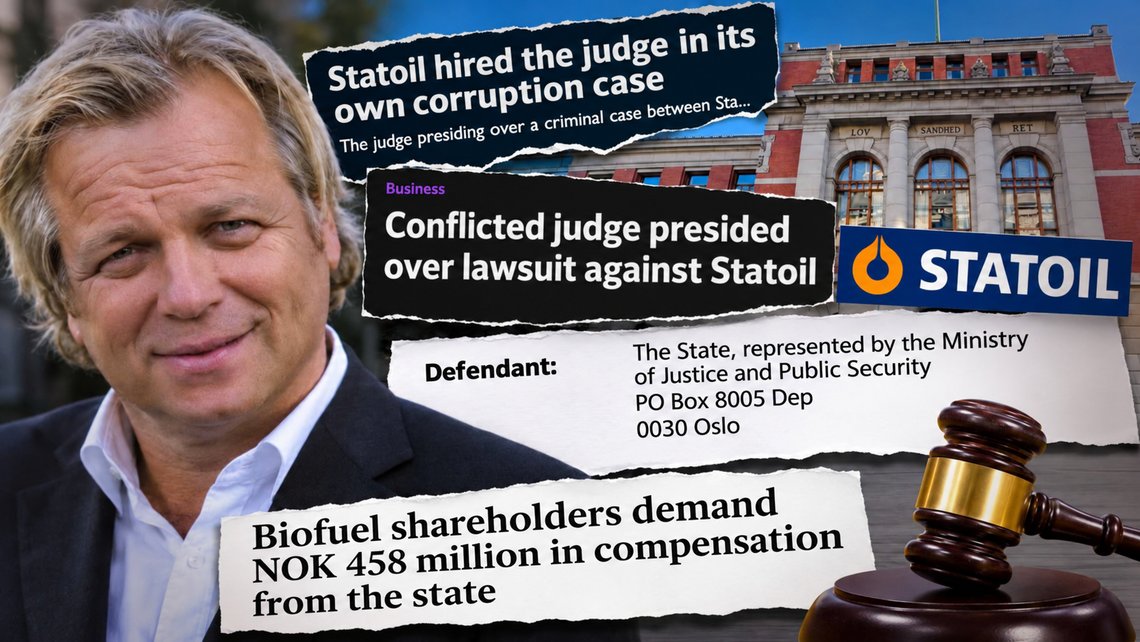


The compensation case against the state, which Steinar Vigdel Kolnes from Sola announced in January, is now underway. In the first instance, he is claiming one million kroner in compensation per year since the dispute between Biofuel AS and Statoil began.
The claim is based on what Kolnes believes to be a breach of EEA law by the Norwegian courts. According to the writ of summons, the payments of one million are to continue until Kolnes and Biofuel AS have been cleared of a false corruption allegation from an anonymous source which Statoil put forward in 2009.
Due to the suspicion of corruption, the company was forced to file for bankruptcy shortly afterwards. 400 people lost their jobs, most of them in Ghana.
In addition to the claim for millions, a separate case seeking financial compensation has been announced. This claim could run into billions, depending on the calculation method used and how many of the company’s former shareholders join the claim.
In an invitation to the state to reach a settlement earlier this year, the compensation amount was set at 45.64 million US dollars.
Biofuel shareholders are demanding 458 million in compensation from the state
Kolnes’s lawsuit against the Ministry of Justice and Public Security is based on the fact that, in 2012, Stavanger District Court concealed from Biofuel that Deputy Judge Lars Ole Sikkeland had been employed by Statoil whilst he was working on Biofuel’s private criminal case against Statoil.
Biofuel lost the case. However, there were several circumstances that suggested possible collusion between Statoil and the courts, which led the founders to continue their fight to clear their names.
- Supreme Court Justice Bergljot C. Webster and the district court judge in Stavanger were both listed as references on Sikkeland’s job application to Statoil.
- Statoil has confirmed that all references were contacted before the employment contract was signed on 4 July 20212.
- Two days later, Webster sat on the Supreme Court’s Appeals Committee, which dismissed Biofuels’ appeal (PDF) regarding access to evidence.
- Webster, who ruled against Biofuels on three occasions, had previously been Sikkeland’s superior at Hjort DA, a law firm that had acted on behalf of Statoil.
- The presiding judge in the original case also had a connection to Statoil and the Supreme Court through his wife, who was employed at Hjort and had previously worked alongside Webster.
- Furthermore, the first decision (PDF) to refuse access was made by Sikkeland in 2011, the same judge who was appointed to Statoil six months later.
– This alone constitutes a breach of the right to be heard, and thus of equality of arms, which is a fundamental principle in both EEA law and at the European Court of Human Rights (ECHR). “We really need no more than this for the state to be liable for damages under EEA law,” says Kolnes.
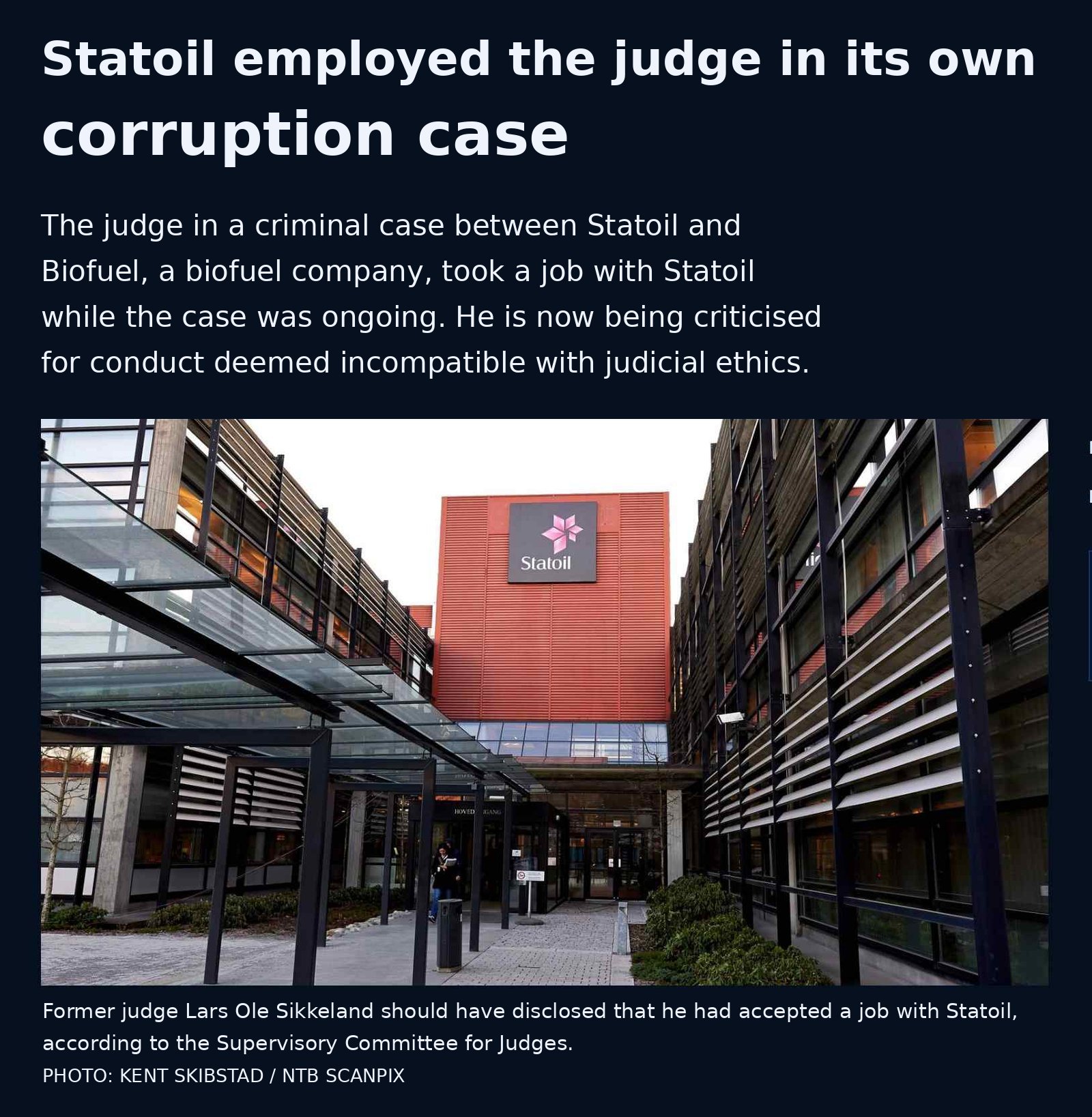
Norwegian News Agency NTB’s report on the disqualified judge in 2014, as published by Norway’s state broadcaster NRK.
Document has contacted Bergljot Webster for comment on the allegations raised in the article.
The judicial system continued, over several rounds, to rule against Biofuels, even after the Supervisory Committee for Judges had reprimanded Sikkeland and he was found to be disqualified by Oslo District Court.
“The judges were on Statoil’s side,” says Kolnes.
The Biofuel owners therefore shifted their focus to the state’s duty to ensure impartial courts.
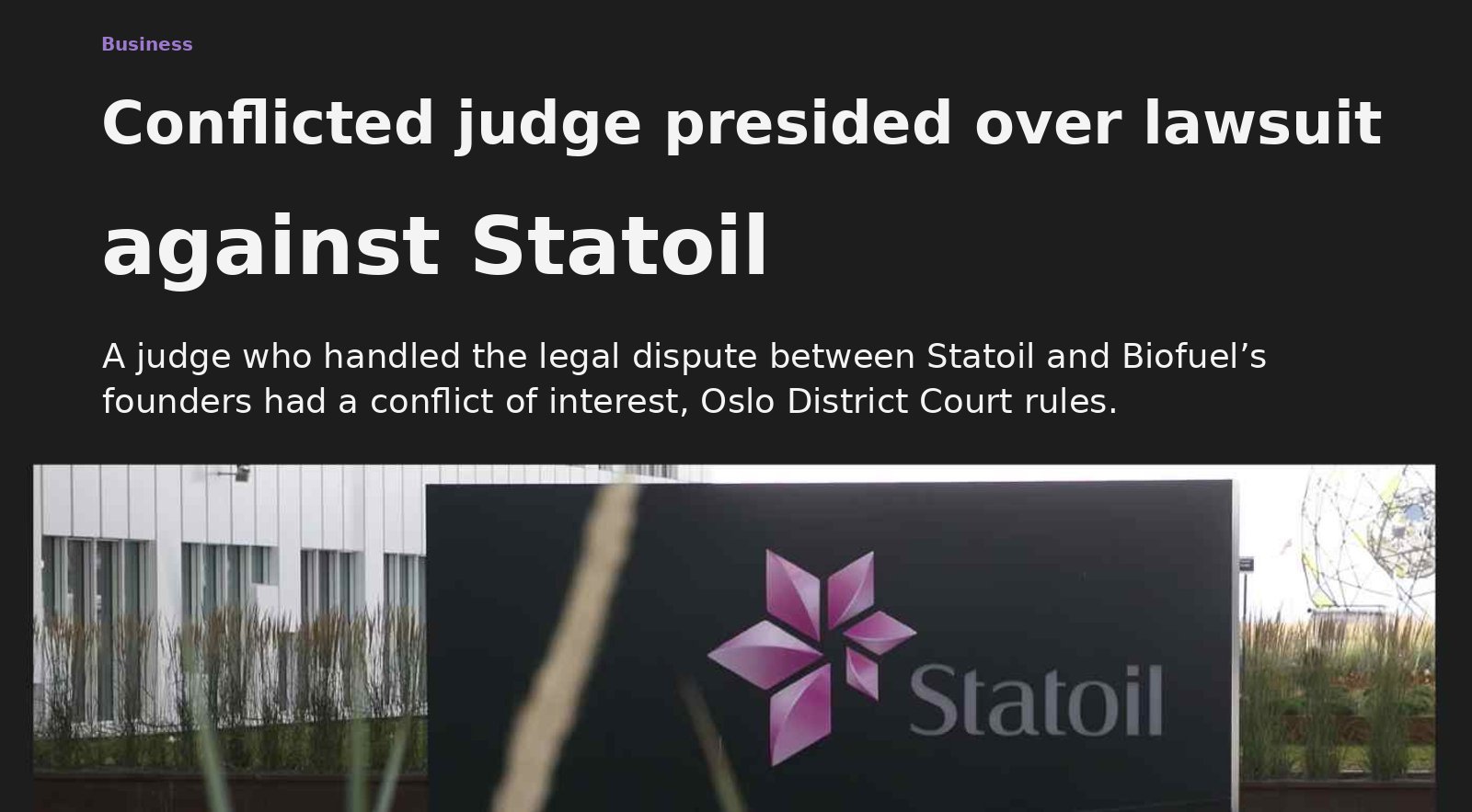
E24’s 2015 report on the ruling that found Sikkeland had a conflict of interest in the Biofuel case three years earlier.
In 2015, the entrepreneurs were successful in Oslo District Court in their claim that their human rights had been violated because Sikkeland was disqualified. Nevertheless, the state was not required to pay compensation or damages.
It was not until 2016 that access was granted to the reports on which the corruption allegations were based. That same year, Borgarting Court of Appeal stated that the suspicion against Biofuel was based on ‘a purely preliminary report’ and that it ‘has, in any event, not been substantiated in retrospect’.
Under scrutiny by the ESA
The case gained renewed attention this year when the EFTA States’ Surveillance Authority (ESA) cited it as an example of ‘serious legal violations’ occurring in Norway. The ESA considers that Norway lacks ‘effective means of redress’ following court rulings that infringe rights under the EEA Agreement.
The Authority has, on its own initiative, launched a supervisory case against Norway to ensure that EEAlegislation is complied with in the dispute between the taxi app Dartride and the Norwegian state.
In the Dartride case, the EFTA Court ruled that EEA states may be held liable for damages if national courts breach EEA law. The historic Grand Chamber judgment of the Supreme Court in the same case also concluded a similar conclusion.
Taxiapp v the State: The Dartride case in the Supreme Court tomorrow
In 2015, the Biofuel owners were successful in Oslo District Court in their claim that their human rights had been violated because the deputy judge in the Statoil case was disqualified. However, they were not awarded compensation or redress.
It was not until 2016 that access was granted to the reports on which Statoil’s allegations of corruption were based. That same year, Borgarting Court of Appeal stated that the suspicions against Biofuel were based on ‘a purely preliminary report’ and that it ‘has, in any event, not been substantiated in retrospect’.
Dispute over whether EEA law applies
Håkon Christian Nyhus, a solicitor with the Government Legal Service, believes that most of Kolnes’s claim must be dismissed, and that all claims relating to Statoil have been finally decided in Statoil’s favour. He believes that ‘re-examinations’ of previous judgements should be dismissed pursuant to Section 200(3) of the Courts Act.

Lawyer Håkon Christian Nyhus represents the State on behalf of the Ministry of Justice and Public Security. (Photo: The Government Attorney)
However, the State accepts that the EEA issues may be considered, but requests an acquittal on the grounds that the breach ‘is not sufficiently obvious’. The lawyer acknowledges that “parts of the activities in the underlying case are governed by EEA law”, but considers this insufficient.
In the State’s view, the claimant is invoking EEA law to ‘get round’ an obstacle in the Courts Act.
Nyhus also argues that the claim is time-barred and involves underlying issues not governed by the EEA Agreement.
Kolnes rejects this, as he believes the breach is ongoing. He also points out that it only became legally possible to bring the claim for damages due to developments in the Dartride case.
According to Kolnes, Biofuel’s connection to the EEA is substantiated by the fact that the company had a British shareholder and raised capital through an investment firm subject to EU and EEA regulations. Finnish and German state investors were also involved when raising capital became impossible due to the corruption allegations against Statoil.
Silence from the Commission for the Review of Criminal Cases
Kolnes has, in parallel, applied for a review of the 2012 case, but, after more than 8 months, has still not received a response as to whether the request is even being considered by the Commission.
– This is in direct contravention of what the BaneheiaCommittee recommended in NOU 2024:24 [‘Tried Again’ on the system for reopening criminal cases, editor’s note]. The committee’s review following the Viggo Kristiansen case focused precisely on predictability, internal deadlines and information provided to the person requesting a retrial, Kolnes writes in a complaint.
The chair of the Commission for the Review of Criminal Cases is Kamilla Silseth. She too was a judge at Stavanger District Court from 2009 to 2013, the same period during which the Biofuel founders believe the court was biased in the Statoil case.
In a letter to the Commission, Kolnes has questioned Silseth’s impartiality. The letter has not yet been answered.
The lengthy processing time has also been the subject of a complaint to the Civil Ombudsman, who last week rejected the complaint without giving reasons:
– ‘We have assessed the information in the case and concluded that we will not be taking it any further,’ the Ombudsman writes in the reply, and continues:
The Ombudsman decides for themselves which cases to investigate further; see Section 10 of the Civil Ombudsman Act.
Read also:
Entrepreneurs are taking legal action against Equinor in the US for bribing a Norwegian judge
The story of Dartride’s compensation claim is set to continue – the state is liable for compensation


