



Oh Lord, oh Lord
The children in the heavens
Jumping for joy
Jumping for love
And opening the sky above
So, put that gun down
For all will be well, say the bells
It’s Sunday morning and I’m holding your hand
Amazed by love
And amazed by pain
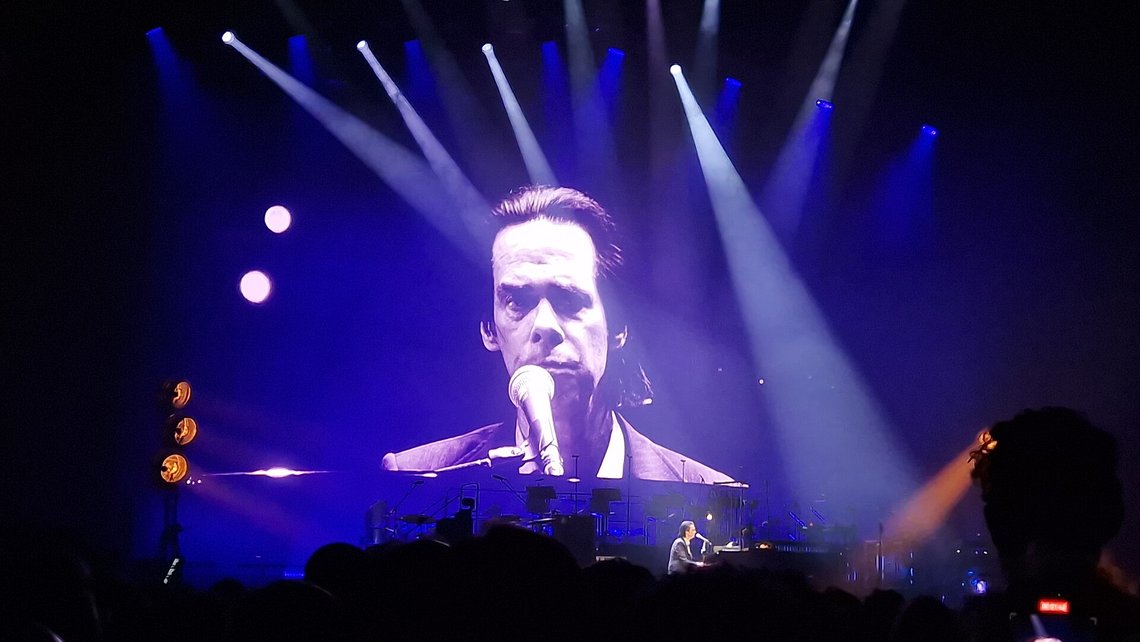
The lines are taken from Nick Cave’s song ‘Frogs’ from his latest gem of an album, ‘Wild God’ (2024). The couple are walking home from church, filled with love, and see the frogs leaping for joy in the gutter in the Sunday rain. It is a small snapshot of everyday grace from a singer who was once the frontman of what was dubbed ‘rock music’s most violent band’, The Birthday Party.
Much water has flowed under the bridge – or down the gutter – since then. Christianity has always been part of Cave’s lyrical universe, but recently his songs have become far more confessional, and Cave himself, the ‘Sinatra of the Swamp’, has found his place in the church.
I was reminded of Cave when I recently read a tribute to Denmark’s supposedly ‘greatest entertainer’, whose trademark is singing about menstruation and the patriarchy, and getting the audience to shout ‘pussy’.
How has one of the most significant songwriters of our time – yes, I mean Cave, not Emma Sehested Høeg – got to this point?
From anger to grace
Cave grew up in Wangaratta, a small town in Australia, where he received an Anglican upbringing and sang in the church choir. This was followed by rebellion with The Birthday Party and concerts descended into pure chaos, brawls with the audience and two decades of substance abuse.
But there was one common thread running through his dramatic, lyrical universe: the Bible. First and foremost the Old Testament, which gave voice to Cave’s theology of wrath, and to the weight and harshness of his lyrics.
Later, a priest advised Cave to take a break from the fire and brimstone of the Old Testament and read the Gospel of Mark instead. Here, in his own words, Cave found an irresistible intensity. Once The Birthday Party had been replaced by the far more cohesive band The Bad Seeds, immortal classics followed, such as ‘The Mercy Seat’, about the condemned man in the electric chair, which bears a striking resemblance to the mercy seat, ‘Red Right Hand’, which takes its title from Milton’s depiction in ‘Paradise Lost’ of God’s punishing hand, and ‘Into My Arms’, which rejects the idea of an intervening God, yet is nonetheless about prayer and mercy.
Grief as the gateway to God
In 2015, Cave’s son Arthur died at the age of just 15 after falling from a cliff near Brighton, and in 2022 his eldest son, Jethro, also died. This shift in mood is reflected in the 2019 album ‘Ghosteen’, notably in the song ‘Sun Forest’, which features Jesus’ promise of the word that will light up the night for the lonely soul gazing up at a sky where the stars are fading one by one.
It is as though Cave has stood in the darkroom of the tapestry, slowly developing images of faith. Much great art, after all, alternates between the two fundamental forms of the hymn and the elegy. The idea that the lament opens the way to hope now underpins Cave’s fundamental outlook: that suffering is the driving force of transformation. God grants us terrible opportunities for transformation.
In a conversation with the intellectual historian Tom Holland, author of the magnum opus *Dominion* on Christianity’s revolutionary breakthrough in world history, Cave explains that the liturgy and the interior of a 12th-century church are as if made for his existential grief. For the church can bear the grief of the individual, as it is older than the mourner. As with art, so too with the church: the form endures when the human being breaks down.
The church provides a lasting framework for faith and doubt, and for Cave, prayer is not so much about speaking to God as it is about listening to his presence.
Mercy and the unhappiest religion
On the website The Red Hand Files, Cave answers questions from readers, which often concern faith and church attendance, including questions about mercy and the culture of cancellation.
Mercy, writes Cave, recognises that we are all imperfect, and this gives us breathing space amidst our shared fallibility. Without mercy, society becomes anxious, vindictive and devoid of humour.
Cave, on the other hand, regards the culture of cancellation as the antithesis of mercy. It is political correctness that is ‘the world’s most miserable religion’. Self-righteous people who refuse to engage with uncomfortable ideas stifle a culture’s creative spirit. It is not the supposedly good intentions of politically correct people, but their lack of humility and their patronising, dogmatic self-assurance that repels Cave. ‘Woke’ is a bad religion that supplants the good religion. It is a consciousness of sin without forgiveness.
The new rebellion
According to Cave, going to church and being conservative these days is the way to provoke people. It’s a statement that fits the punk rocker turned churchgoer very well. And who writes songs not about the patriarchy, dicks or tits, but about walking home from church in the rain.


