

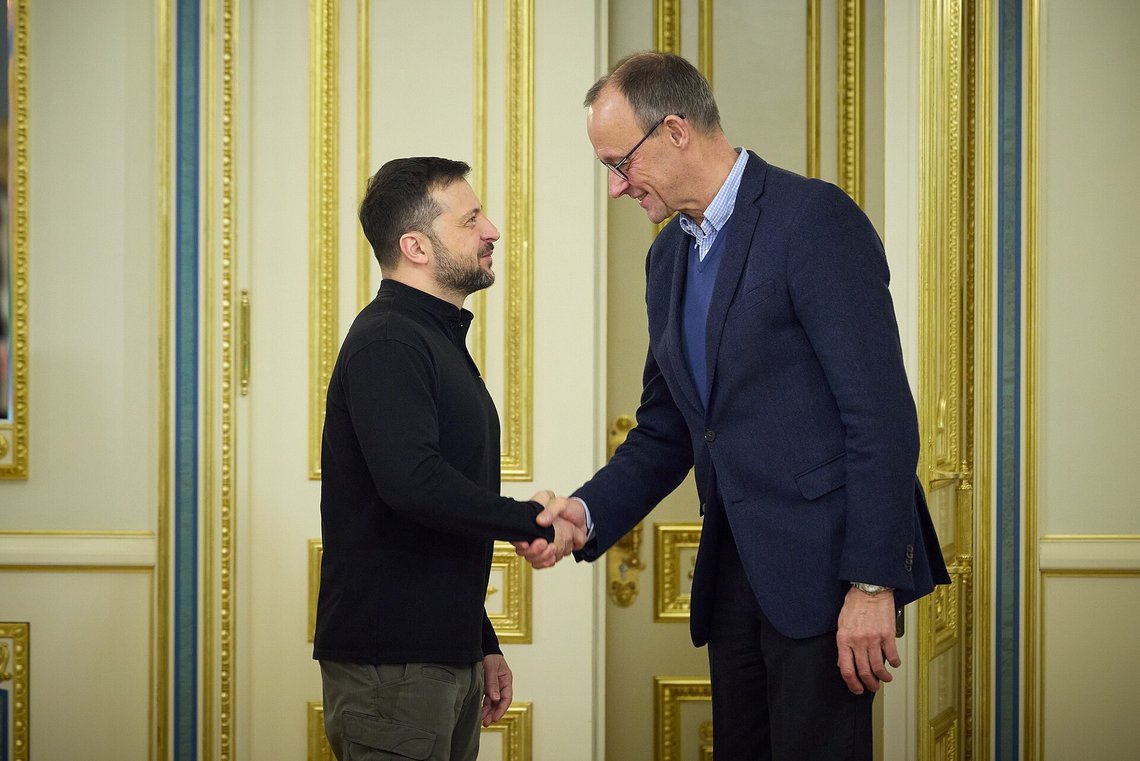


German Chancellor Friedrich Merz is threatening to block the EU’s next long-term budget unless EU member states first agree on a new loan for Ukraine.
The Financial Times reported on Monday that Merz issued the ultimatum in a letter to EU President Antonio Costa.
– “A collective commitment that all of us, without exception, will contribute fairly to closing [Ukraine’s financing] gap is an essential prerequisite”, writes Merz.
The background to this is that, in December last year, the EU approved a loan of 90 billion euros to Kyiv for 2026 and 2027, but Ukraine’s President Volodymyr Zelenskyy warned earlier this year that Ukraine will need a further 70 billion euros in the coming years.
EU Economic Affairs Commissioner Valdis Dombrovskis said on Monday that he is “cautiously optimistic” regarding a new loan for Ukraine, according to the DPA news agency. He believes that member states will agree on a new loan of 45 billion euros for 2027.
– “We are working to cover Ukraine’s funding gap, which has emerged larger than expected”, said Dombrovskis on arrival at a meeting of EU finance ministers.
In other words, this involves doubling the loan amount to Ukraine in 2027, and this is money that EU countries do not have.
The conflict may affect negotiations on the EU’s long-term budget for 2028–2034, which are in full swing. The Union is in a deep economic crisis, which is also hitting Germany hard.
Among the EU member states, it is probably almost only Poland that is experiencing real economic growth based on increased revenue, rather than on expenditure on, for example, mass immigration.
Nevertheless, the European Commission does not appear to be concerned about the Union’s economic state.
Two-thirds
The European Commission is working on a proposal aimed at covering two-thirds of the amount presented by Zelenskyy. One option under consideration is a loan backed by frozen Russian assets held in the EU, similar to the existing €90 billion loan, the Commissioner said.
Merz therefore believes that, before a long-term budget can be adopted, all EU countries must commit to contributing to new loans for Zelenskyy’s government.
However, Hungary, the Czech Republic and Slovakia are not participating in the 90-billion loan, and are unlikely to change their minds regarding new loans to Ukraine. Bulgaria has now signalled that it will not participate in a new loan.
Both Ukraine’s financing and the EU’s long-term budget will be discussed at several forthcoming EU meetings. This week, EU heads of state and government will gather for an informal summit in Dublin.
An extraordinary budget summit has been convened for late November, while the year’s final EU summit will take place in mid-December.
The latter is widely regarded as the final deadline for adopting the EU’s long-term budget.
It therefore appears that negotiations on a new long-term budget for the EU may end in deadlock. Meanwhile, both Russian and Ukrainian soldiers continue to die in the trenches in Ukraine.
On 24 February 2027, the war will have been raging for five years.


