

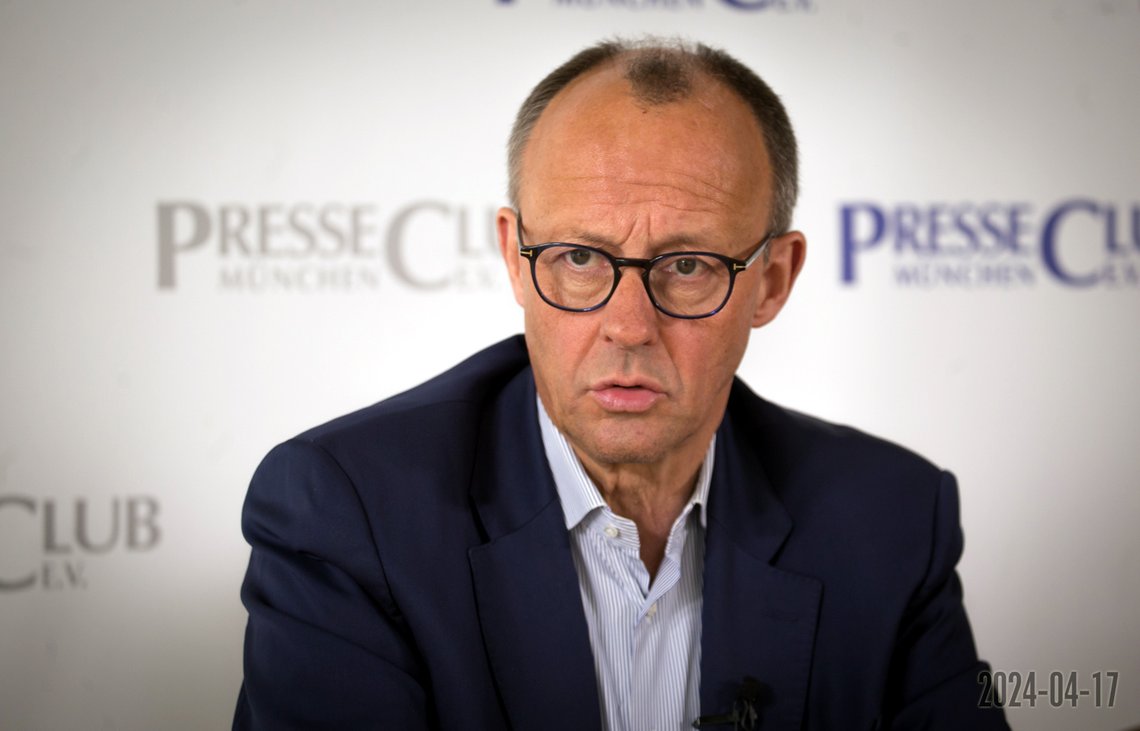


Germany’s Federal Chancellor Friedrich Merz is attacking the existing EU budget system and wants to restructure it fundamentally.
During a ceremony in Sachen on Thursday, Mario Draghi received the Charlemagne Prize for his life’s work: his many years of leadership at the European Central Bank.
Merz used much of his speech in that context to praise Draghi. But he naturally also addressed the Ukraine war and relations with the United States, and additionally made several barbed remarks about the EU’s economic policy, which Hans von der Burchard writes in Die Welt constituted the core of his speech.
The structure of the budget for the years 2028 to 2034, for which the European Commission is proposing almost two trillion euros, has remained virtually unchanged for decades, according to Merz. Roughly the same share of the budget regularly ends up serving the same purposes.
“We are still essentially planning seven years in advance who is to receive how much funding from this budget, and more than two thirds of the European funds still go towards redistribution and subsidies.”
Merz therefore calls for a “fundamental modernisation” and a “radically streamlined structure” capable of enabling the major investments in European competitiveness and defence that Draghi called for in his 2024 report on how the EU economy was to survive by investing in “the green transition”.
The Italian wrote that the EU could achieve “growth through decarbonisation”. It is rather like hearing our Prime Minister Jonas Gahr Støre, who in 2019 claimed that Norway would live from saving the climate.
Merz describes this as a “Draghi-secured” budget that means less money for agriculture and regional programmes, such as road construction financed with EU funds.
“Now, more than ever, we must set priorities.”
Merz says that the EU has introduced something resembling a planned economy. He is reacting to this reform pressure in response to another of Brussels’ demands: that the EU should once again assume common debt in order to withstand the combined challenges posed by Trump’s tariffs, China’s unfair competitive practices, the threat from Putin and Iran’s energy crisis.
This recalls what the EU did during its previous budget negotiations in 2020 — when it decided upon a large debt fund in the midst of the Covid crisis. The EU economy has not recovered since then, and now the debt is to be increased sharply.
Germany has generally been sceptical about burdening the state with large debts, but the climate issue, the Ukraine war and military rearmament after several decades of decline are forcing Berlin to borrow.
Merz attempted to press his “no” to new debt into the arena as a negotiating card:
“Germany cannot go down this road solely for constitutional reasons.”
He did not explicitly mention the strong growth of AfD, which will likely gain further support as a consequence of a new debt debate, but the thought is clearly implied, according to von der Burchard.
Merz appears to feel the economic pressure from China and the United States personally.
“Almost all the principles upon which the Union was built are under pressure,” says Merz.
In a world undergoing reorganisation, there are “new crises every week”.
Draghi likewise points to the EU’s high investment needs in order to keep pace with China in areas such as competitiveness and future technologies like AI and supercomputers. He considers it necessary to invest as much as 800 billion euros every year.
Even though this is supposed to include private investment, an EU budget of 2 trillion euros over seven years appears insufficient in this context.
Draghi refers to a new opinion poll in which three quarters of Europeans want “more resources” for the EU, “so that they can meet the challenges that lie ahead of us”.
This is a thinly veiled message to Merz. And Draghi demands from the EU’s heads of state and government the same thing for which he was honoured in Sachen: “courage” — to “demonstrate that Europe can once again transform crises into unity”.
But the question is whether Europeans also want rising prices, higher interest rates, increasing taxes and more “decarbonisation”, which are certainly possible consequences of such an economic policy.


