

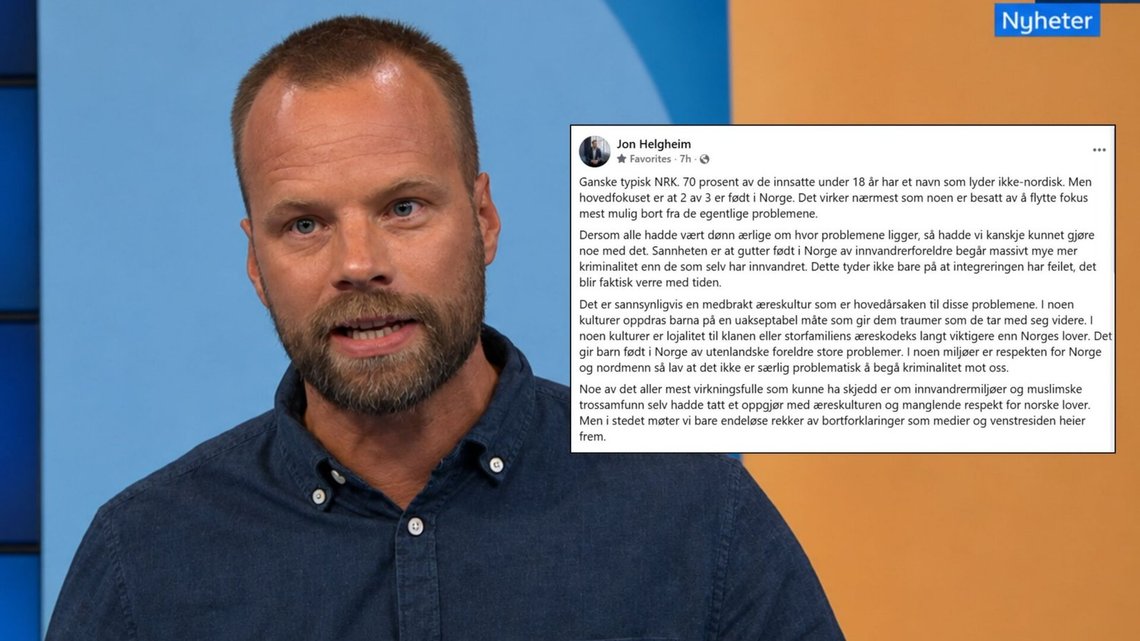


NRK reported that two out of three children in Norwegian youth detention centres were born in Norway. This is despite the fact that their own figures show that 70 per cent have non-Nordic names. Jon Helgheim (FrP), chair of the Justice Committee, has reacted strongly.
On Tuesday morning, NRK published a survey of children in Norwegian prisons. The main finding was in the headline: Two out of three were born in Norway. The rest were born in countries in Europe, Asia and Africa.
That same morning, Jon Helgheim (FrP), chair of the Storting’s Justice Committee, responded on Facebook.
– Quite typical of NRK. 70 per cent of inmates under the age of 18 have a name that sounds non-Nordic. But the main focus is that two out of three were born in Norway. It almost seems as though someone is obsessed with shifting the focus as far away as possible from the real problems, writes Helgheim.
NRK itself acknowledges the gap in the survey. The broadcaster divided the inmates’ names into Nordic and non-Nordic categories, but states that it cannot comment on any immigrant background of the parents. NRK does not have access to such information.
The category ‘born in Norway’ therefore includes both children of Norwegian parents and children of two immigrants.
– If everyone had been completely honest about where the problems lie, we might have been able to do something about it. The truth is that boys born in Norway to immigrant parents commit far more crimes than those who have immigrated themselves. This not only suggests that integration has failed; in fact, the situation is getting worse over time, writes Helgheim.
Figures from Statistics Norway (SSB) point in the same direction.
In the years 2021–2023, an average of 6.4 per cent of Norwegian-born men aged 15–24 with immigrant parents were charged with criminal offences each year. Among young male immigrants, the proportion was 5.9 per cent. Among young men in the rest of the population, it was 3.5 per cent.
If charges are counted, the difference becomes even greater. Over the four-year period 2020–2023, young Norwegian-born men with immigrant parents had around 630 charges per 1,000 inhabitants. Young male immigrants had just over 550. The rest of the population had just over 280.
This results in an over-representation of 124 per cent for those born in Norway and 96 per cent for immigrants.
And the trend is heading in the wrong direction. In the period 2015–2018, the over-representation stood at 59 and 53 per cent. For those born in Norway to immigrant parents, it has thus more than doubled, whilst for immigrants it has almost doubled. Statistics Norway (SSB) itself points out that this is the opposite of the decline seen in the decade up to 2015.
In Oslo, the picture is even bleaker. Young men in the rest of the population had 210 charges per 1,000 during the period. For young immigrants, the figure was 820. For Norwegian-born individuals with immigrant parents, it was 910 – more than four times as high.
Country of origin makes a significant difference. Young Norwegian-born men with parents from Morocco and Somalia had nearly 1,300 charges per 1,000. For those with parents from Vietnam, the figure was 160 – lower than in the general population.
This pattern is not new. Statistics Norway’s 2017 research report found that Norwegian-born individuals with immigrant parents were more over-represented than immigrants themselves, even after the researchers had adjusted for gender and age. In 2015, the over-representation was 76 per cent for those born in Norway and 21 per cent for immigrants.
Statistics Norway emphasises that the comparison applies to young men of the same age, not to immigrants and their own children. The tables for 2020–2023 were compiled on behalf of the Progress Party’s parliamentary group and are publicly available.
NRK also points out that the Ombudsman for Children carried out a similar survey in 2021. Among other things, the Ombudsman reviewed the cases of 20 boys in Greater Oslo who had committed serious or repeated offences. Virtually all of them came from eastern Oslo and neighbouring municipalities. A large majority shared several common characteristics: they had grown up in areas with poor living conditions, had difficult home circumstances, had been subject to child welfare measures, and were of a non-Norwegian ethnic background.
NRK’s own sources point to a support system that is too slow to respond. Psychologist Zemir Popovac tells the broadcaster that measures are implemented too late and are not effective enough for many of these young people. After one year, one in three children has ended up back in prison, according to NRK.
Helgheim points to the culture.
– It is probably a culture of honour brought with them that is the main cause of these problems. In some cultures, children are brought up in an unacceptable way that causes them trauma which they carry with them into adulthood, he writes.
– “In some cultures, loyalty to the clan or the extended family’s code of honour is far more important than Norwegian law. This causes major problems for children born in Norway to foreign parents.”
He believes the solution must come from within these communities themselves.
– One of the most effective things that could have happened would have been for immigrant communities and Muslim religious groups themselves to have taken a stand against the culture of honour and the lack of respect for Norwegian laws. But instead, we are met with nothing but an endless stream of excuses, which the media and the left are cheering on.


