



1 When Jesus saw the crowd, he went up the mountain. There he sat down, and his disciples gathered round him. 2 He began to speak and teach them:
3 ‘Blessed are the poor in spirit,
for theirs is the kingdom of heaven.
4 Blessed are those who mourn,
for they shall be comforted.
5 Blessed are the meek,
for they shall inherit the earth.
6 Blessed are those who hunger and thirst for righteousness,
for they shall be filled.
7 Blessed are the merciful,
for they shall receive mercy.
8 Blessed are the pure in heart,
for they shall see God.
9 Blessed are the peacemakers,
for they shall be called children of God.
10 Blessed are those who are persecuted for righteousness’ sake,
for theirs is the kingdom of heaven.
11 Indeed, blessed are you when they revile and persecute you, [lie about you] and speak all manner of evil against you on my account. 12 Rejoice and be glad, for your reward in heaven is great. In the same way, they persecuted the prophets who came before you.
Matthew 5:1–12
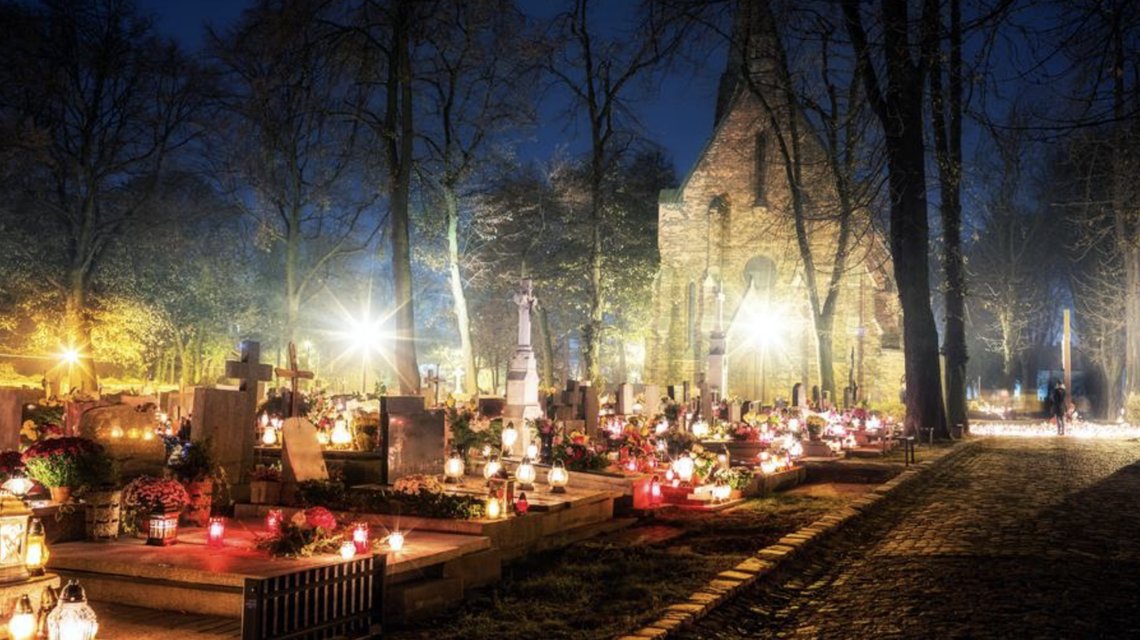
Today, the churches mark what we call All Saints’ Sunday. This means that we remember those who have passed away. We give thanks for what they have meant to us, for how they have passed on the faith to their children and fellow human beings – a chain of people we can trace right back to the Master himself, after he asked his disciples to go out into the world and make disciples of all nations.
As a result of this, we have learnt to trust in a God who is absolutely good and true, something that also shapes our history. We were given a civilisation built on a supreme truth, and that has been an inestimable blessing for us. It has made it possible to recover from various disasters and tragedies.
But we are in the process of losing this blessing.
Some time ago, I discussed religion with a young woman. The topic was whether it was possible, on the basis of faith, to predict certain actions, or whether faith did not predispose one to actions at all.
The woman I was discussing this with was upset by my assertion that it is possible to generalise about groups of people who share a faith or a political conviction. She could not accept the idea that a faith could be absolutely true and lead to predictable actions. I was told that this conflicted with her values and beliefs. At the same time, she made it clear that she herself was not a believer.
I did not press the point that she was not a believer – sometimes it is better not to – but the discussion gave me food for thought.
People in Norway under the age of 40 have been through a school system that claims to be neutral, but which has at the same time been highly critical of the Christian faith. This is due to specific changes in Norwegian curricula. Until 1997, Christianity still held a special position in Norwegian schools. But then we changed direction.
Since then, Norwegian school pupils have been taught to believe that all religions are equal, and that they cannot, in themselves, create oppressive communities of shared belief. The message that was preached, and which is still preached in Norwegian classrooms, is that there is no overarching truth.
And without realising what has happened, Norwegians have been indoctrinated with a new belief, one based on Michel Foucault’s philosophy, his secular philosophy of powerand liberation philosophy, in which belief in an overarching truth is rejected in favour of a belief that what we regard as true, normal and scientific is linked to institutions, historical circumstances and power structures.
It is difficult to know what Michel Foucault actually intended, but there is no getting round the fact that his thinking has given us what we might call a secular orthodoxy: a mindset that was intended to challenge traditional authorities and truths, but which has been elevated to a set of self-evident truths amongst its followers.
In other words, Foucault’s scepticism towards truth has itself become an established truth. Consequently, we have ended up with an academic school and a society in which absolute moral truths are viewed with suspicion, Christianity’s claim to truth is understood as an expression of historical power relations, and criticism of the content of religions is perceived as an expression of intolerance.
However: the secular understanding of humanity and society is not subjected to the same critical scrutiny. Schools no longer preach Christianity, but secularism, and they do so under the guise of neutrality.
It is easy to understand why Christianity is the faith most directly affected by this way of thinking. Christianity asserts that absolute truth is to be found in Jesus Christ and that the struggle between good and evil, truth and falsehood, is not merely something that exists in our imagination, literature or films, but is a living reality that affects us. Through His death and resurrection, He won a final victory. Today we think with gratitude of those who, for nearly two thousand years, have passed on this message.
There is a reason why we face opposition. But remember: He Himself has promised to be with us all the days until the end of the world.


