

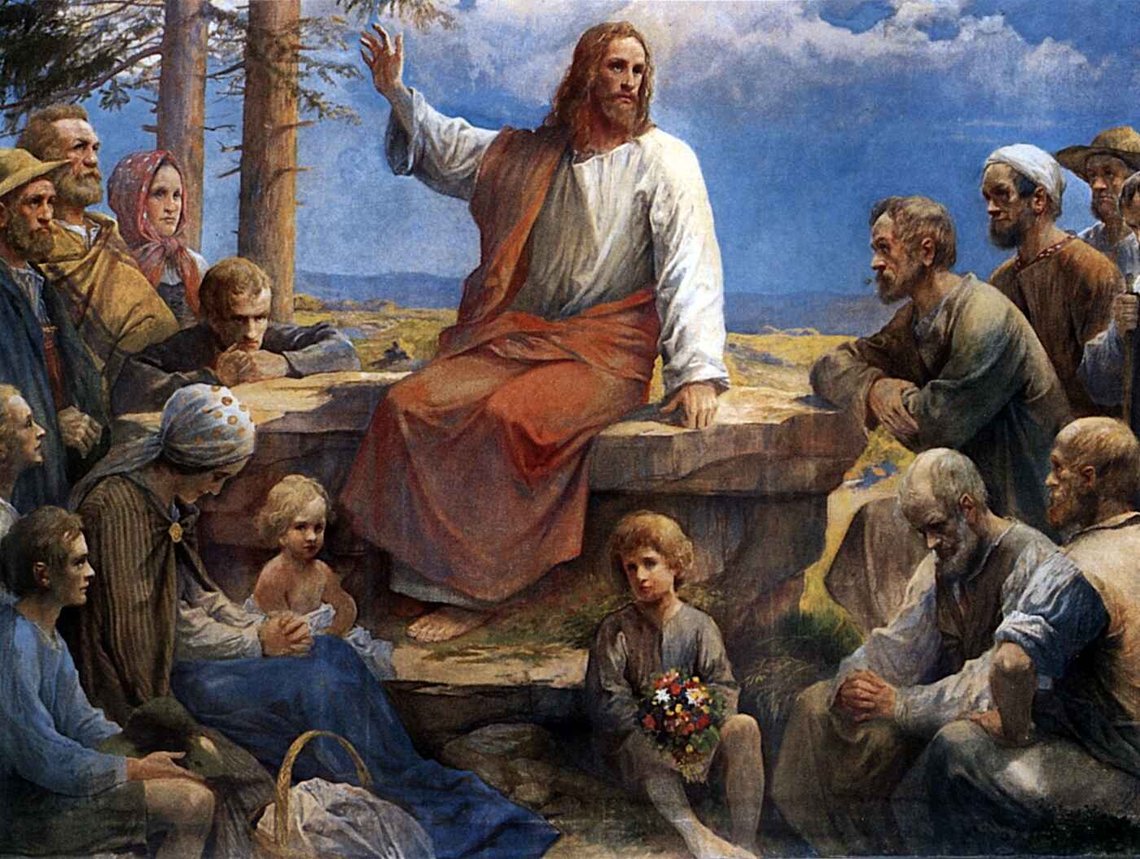
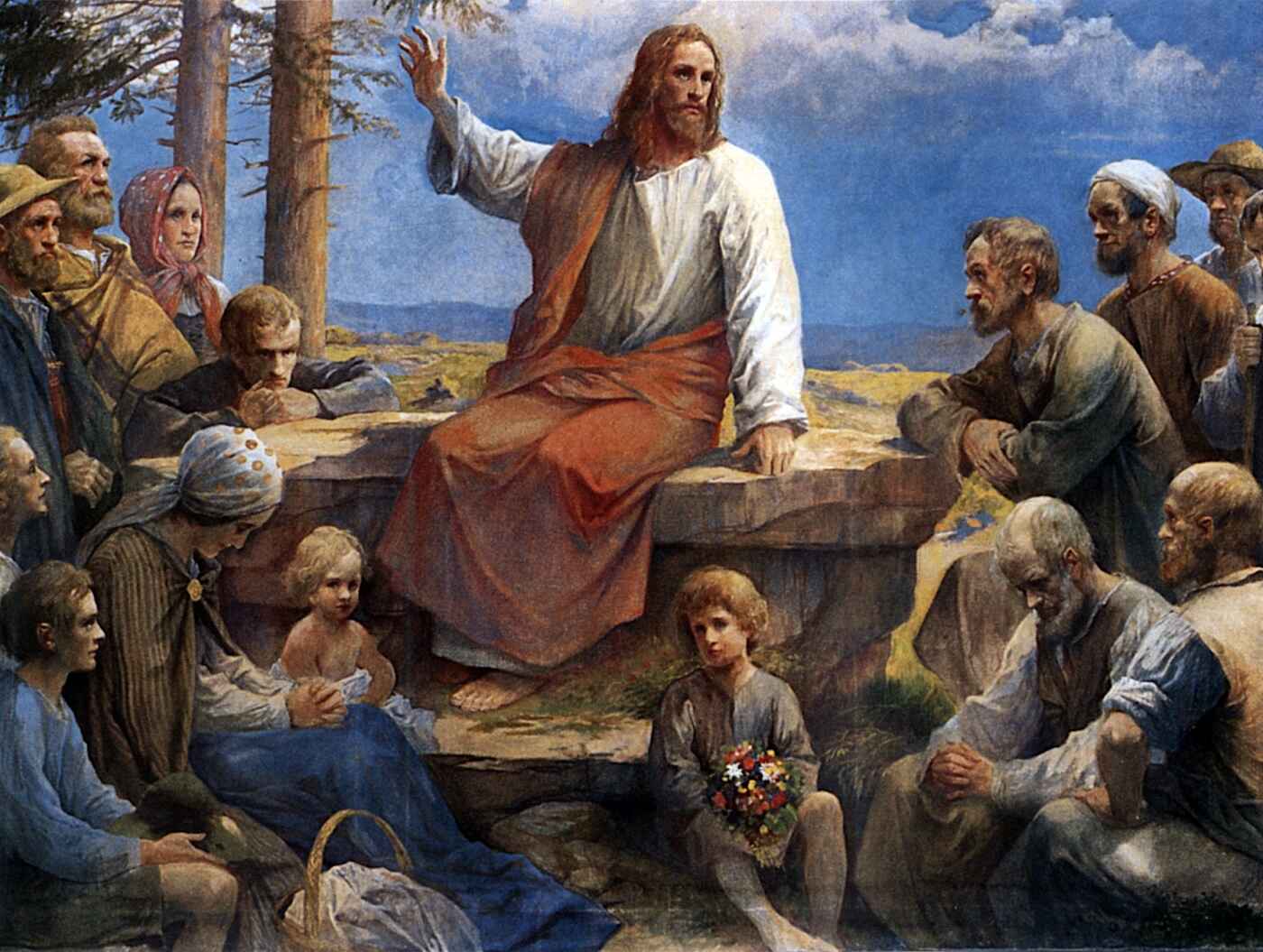
 Rudolf Yelin (1864–1940), “The Sermon on the Mount”, the Protestant church in Reinerzau bei Alpirsbach in the Black Forest, Germany.
15 Beware of false prophets! They come to you in sheep’s clothing, but inwardly they are ravenous wolves. 16 By their fruits you shall know them. Do people pick grapes from thornbushes, or figs from thistles? 17 A good tree bears good fruit, and a bad tree bears bad fruit. 18 A good tree cannot bear bad fruit, nor can a bad tree bear good fruit. 19 Every tree that does not bear good fruit is cut down and thrown into the fire. 20 Therefore by their fruits you shall know them.
Matthew 7:15–20
Is there a connection between political systems and the faith of the people? Few assertions attract as much criticism as the claim that this is the case. We do not like to speak of false prophets, or of the fact that there are religions that bear bad fruit, or that there are some that are not compatible with democracy and the fundamental rights of citizens.
Democracy, or the belief that man has the capacity to establish legislation that has the good of the people in view, requires a certain understanding of reality. But in public life it is repeated ad nauseam: all religions have love in common, and all desire the same thing, namely peace and security for all. Not long ago, an interfaith service was held at Sola in Rogaland, where representatives of various religions prayed for peace. The journalist who interviewed the dialogue priest responsible did not dare ask the clarifying question: Do they all represent the truth about God?
For we never hear anyone explain how anyone other than a triune God can give us a real ethical foundation for a free society, a society in which human dignity is respected and in which man, endowed with free will, can recognise reason and be held responsible for his actions. Or, to be quite specific: we never hear anyone explain how Islam’s Allah can possess the same attributes as the God of the Trinity. For it is Islam that we as a society are facing, and that demands influence.
Anyone who takes the time to read or listen to teaching about Islam, while also having a grasp of the Christian faith, will notice that Islam and Christianity part company on all the important matters that determine the political consequence of faith. They do not merely part company. Muslims also regard the teachings of Christianity as blasphemous.
The only similarity we find between Christianity and Islam is the belief that God or Allah created the world. But there the similarity also ends. Allah is everything the God of the Trinity is not, and Islam therefore gives man an entirely different status from that given by Christianity. For Muslims, the idea of God as Father, the Incarnation and atonement are alien elements. For there is no Fall in Islam, since everything that takes place has its origin in Allah.
The God of Christianity is a triune communion into which man is invited. Islam’s Allah is a sole ruler with no one besides himself. And while the believer in Islam is invited to submission, the Christian is invited to become a child of God, where we may call God our Father. From a political standpoint, it is autocracy versus a harmonious communion.
Since the God of the Trinity is a holy relation, God also loves man, and he must also give him the freedom to choose. This lies in the nature of love. God wants man to love him, but this presupposes that man knows what God considers right and good, in both time and space. The God of the Trinity is therefore bound by his love and truth. He cannot say that something is good one day, only to say something different the next. What is good consists of actions that accord with his nature. Under such conditions, reason also became an instrument for serving God. For God is a God of reason and wants man to worship him with all his heart, with all his soul, with all his reason and with all his strength.
This understanding stands in sharp contrast to a faith that understands the concept of omnipotence in an entirely different way from that found in Christianity. Allah’s omnipotence cannot be limited, and any action is good so long as Allah says that this is the case.
We should therefore not be surprised that such a faith led, in medieval Europe, to leaders who sought to implement this understanding in the laws of their states. Here in Norway, both the Christian law of 1024 and the National Law of 1274 were deeply inspired by Christianity’s image of God. To put it in the words of today’s text: it was a faith that bore very good fruit.
The political differences we find in Muslim and Christian states are therefore natural consequences of whom the inhabitants worship. A non-relational god who commands man to submit to him becomes the model for a very different political culture from that of the God of the Trinity, who invites us into a communion built on holy love.
The one leads to good fruit, the other to bad.


