



Energy management in Norway is at odds with the intention of the licence conditions for the international cables.
When the construction of the two major international cables was out for consultation, everyone had the opportunity to read Statnett’s analysis report, “Cables to Germany and the UK – analysis of the socio-economic benefits of spot trading – Basis for the 2013 licence application».

Statnett’s analysis report (AI-translated from Norwegian), which formed the basis of the licence application submitted in May 2013. Source: The Norwegian Government
The first point on page 1 of the Summary contains the following text.
«Thermal power generation in Germany and the UK helps the Norwegian-Swedish power system to cope with hydrological fluctuations by generating more during dry periods and less during wet periods.»
Since then, large parts of thermal power generation in Germany and the UK have been phased out – German nuclear power and British coal-fired power. These have largely been replaced by unpredictable and unstable generation – wind power.
Consequently, the first point in the documentation that underpinned the need to link our power system to the German and British power systems no longer applies. The most important argument – security of supply – no longer applies.
However, it was known that this would happen, as it was clear in 2013 that Germany had decided to phase out its nuclear power, which at that time produced as much electricity as Norwegian hydropower does today – 140 TWh per year. And it was known that the British had decided to phase out coal-fired power when the Ormen Lange field began gas production and exports to the UK in 2007.
Consequently, those who drafted the material circulated for consultation – Statnett – knew that the key selling point was not valid, even though it was used as the main argument.
– Just a few pennies
By the time the licence had been granted and Statnett, funded through the state budget, had spent nearly 20 billion kroner on building cables and we saw the first signs that electricity prices would rise, we were told in many different ways that they would only rise by a few øre (cents) per kWh.
Politicians and Fornybar Norge (Norwea + Norsk Energi) stood their ground and insisted that prices would only rise by a few øre.
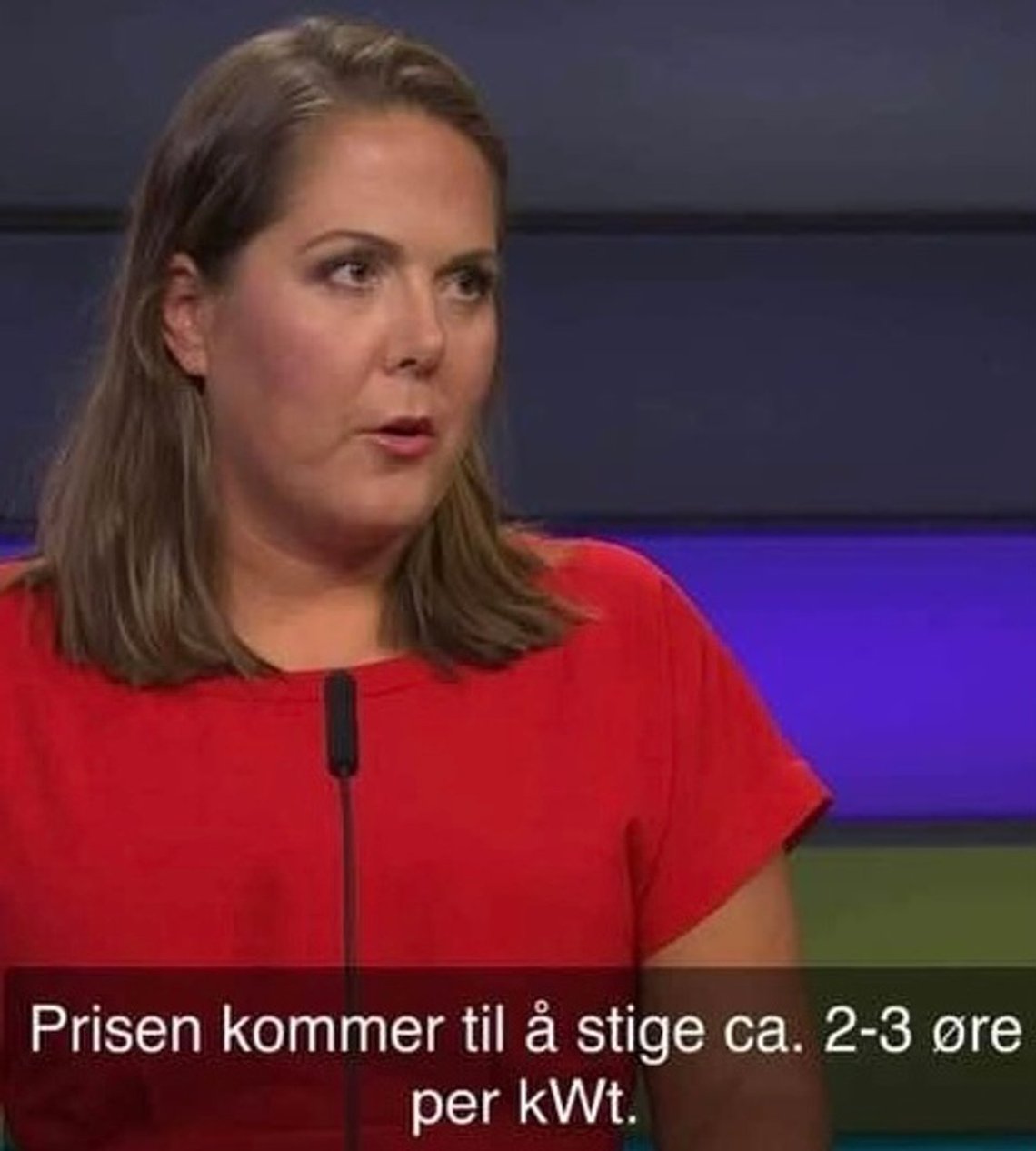
Lene Westgaard-Halle of Norway’s Conservative Party on NRK’s Debatten programme. Screenshot: NRK.
They presented various versions of what Statnett had written in the aforementioned analysis report. Whether they had read it themselves, heard it from someone else, or had it presented on a PowerPoint slide is not known. However, the text as written in the supporting documentation for the licence application reads as follows:
“The cables to Germany and the UK affect prices in Norway and the Nordic region in several ways. We will see more stable prices over the course of the year, but at the same time greater short-term price volatility. As we expect a larger Nordic power surplus and more unregulated generation, the cables will, in isolation, also result in a slightly higher price level in Norway (annual average). Based on the specific assumptions we have used in our baseline estimate, our simulations show that the average price in Norway will increase by just under 5€/MWh2 (4 øre/kWh) in 2020 and by 4 €/MWh (just over 3 øre/kWh) in 2030, taken together for both cables.»
In hindsight, this is the second-biggest misrepresentation in the documentation from the authorities that was circulated for consultation. The biggest was the claim that thermal power – which they knew was due to be phased out – would ensure security of supply when there had been no rainfall.
Statnett wanted higher margins
Firstly, the wholly state-owned company Statnett owns the cables. An important source of income for Statnett is the so-called ‘bottleneck revenue’ from the cables, which is generated by the flow multiplied by the price differential across the cables.
The report raises the concern that lower electricity prices, should the cables not be built, would lead to increased domestic industrial consumption.
Statnett implied that there would be more business activity, more jobs and greater value creation in Norway if the cables were not to be built. Furthermore, they state that such activity would increase demand for electricity, which in turn would drive up prices, thereby having the same price effect as the cables. What they did not state, but which is a logical consequence of that reasoning, is that Statnett would miss out on the healthy margins if the cables were not built.
The supporting documentation for the licence application states:
“At the same time, it is uncertain how significant this effect will actually be and how long it will last. If we end up with a lower Nordic surplus than we are assuming, and greater transmission capacity to other systems, the price increase will be smaller. If, on the other hand, developments go in the opposite direction, the increase will be greater. In addition to this, the market may adapt to the relatively low price level if the cables are not built, for example through increased industrial consumption. If this happens, we will see higher prices even without the cables, and thus the cables’ actual impact on price levels will be reduced.»
This can only be understood as follows: one might as well build the cables, since the effect on prices will be the same whether they are built or not. Because if the cables are not built, prices will remain low, and this will stimulate more industrial activity, which will in any case push prices up.
The text thus gives the impression that Statnett regarded innovation in Norway, resulting from access to more power, as a competitor that would not exist if the cables were built, from which Statnett could earn good margins on congestion revenues.
After the cables
After the cables came into operation – NordLink to Germany in December 2020 and NorthSeaLink to the UK in October 2021 – the authorities, Fornybar Norge and a number of consultancy firms, led by DNV, McKinsey and BCG at the forefront – denied that the cables have had any effect whatsoever on prices.
Reluctantly, however, they have made some partial concessions, though nothing that seems convincing enough to suggest they have truly taken the reality on board.
These two cables more than doubled Norway’s transmission capacity to the Continent. At the same time, they increased the exposure between the Swedish-Norwegian system and the Continent by 50 per cent.
What happened before and after these cables came into operation is illustrated by the changes in electricity prices in Kristiansand and Tromsø following their commissioning.
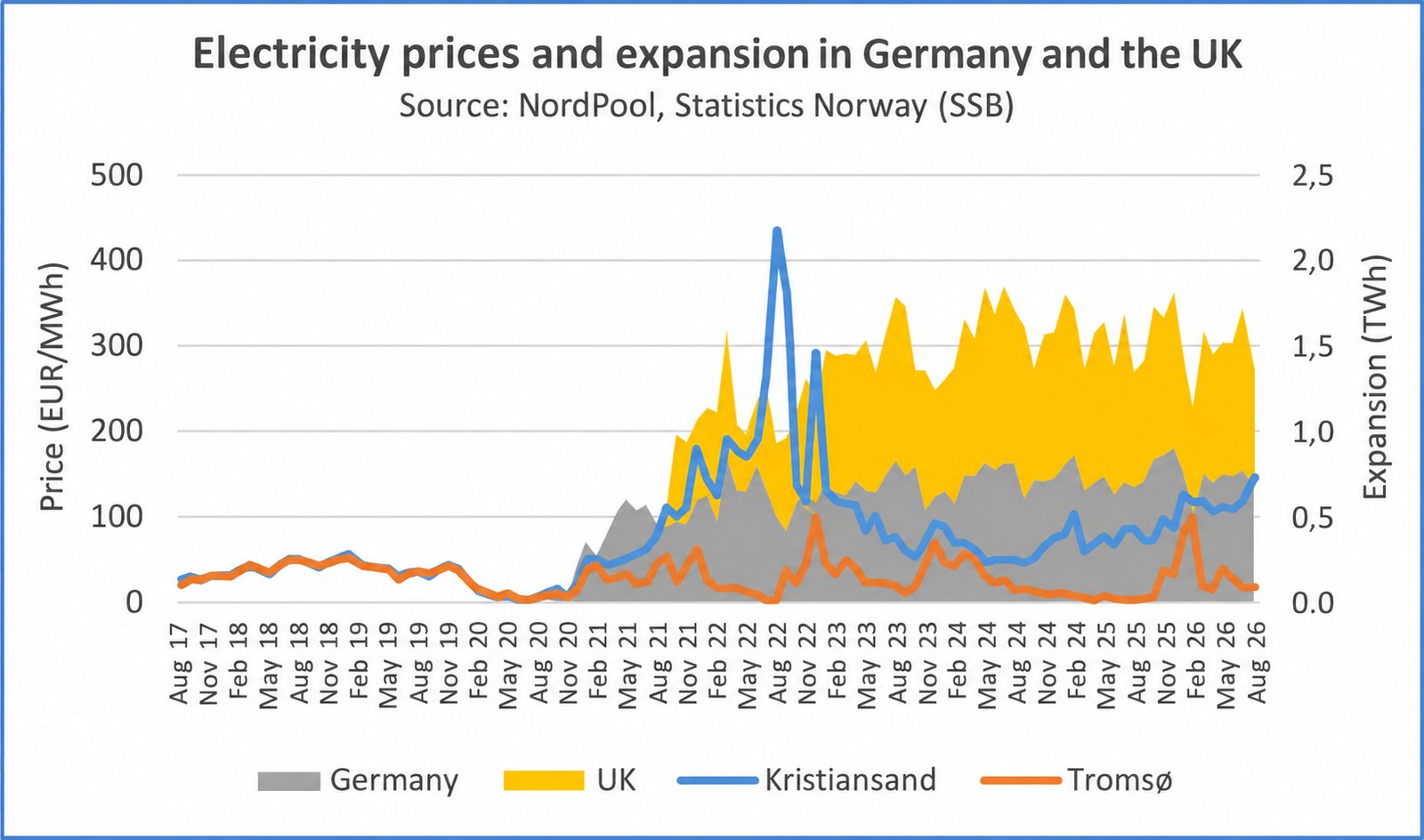
The attached figure shows that monthly prices in Kristiansand and Tromsø were virtually identical before NordLink came into operation. Following the launch of NordLink, the prices diverged and have never converged since. When NorthSeaLink came into operation in 2021, the gap widened even further.
The result is that in Northern Norway, electricity prices are normal, whilst in Southern Norway we have seen the EU’s dysfunctional energy policy find its way into our sockets.
Another piece of mathematical evidence which, incredibly, the authorities and the establishment refuse to address – or are reluctant to acknowledge, even partially, with various reservations and quibbles – can be observed in the form of the price difference between Oslo and Stockholm.
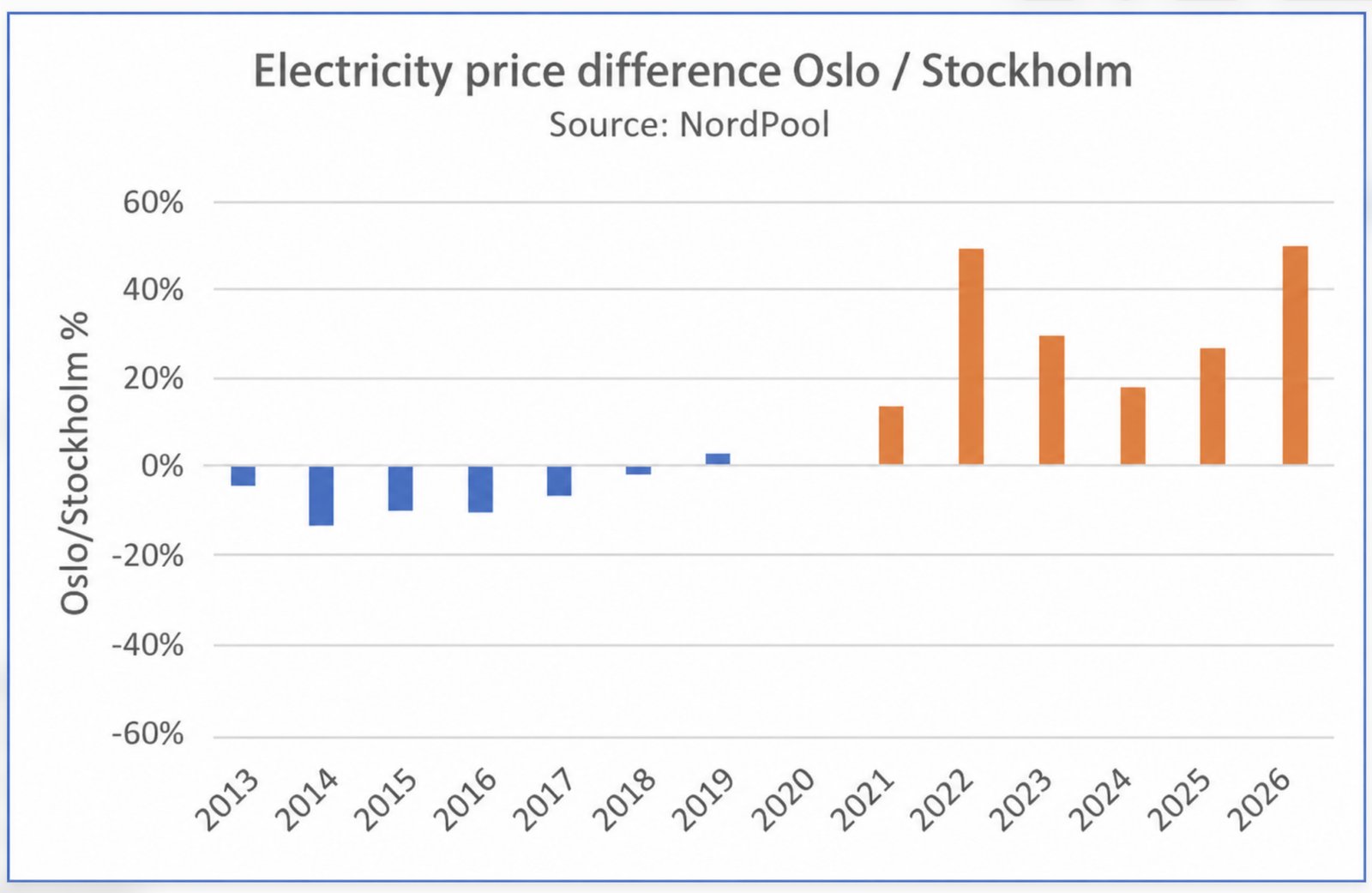
The figure above shows the price difference between Oslo (NO1) and Stockholm (SE3) as a percentage. The year 2020 has been omitted as the price in Oslo was significantly lower than in Stockholm due to the pandemic lockdown.
In the years before the cables came into operation, the price in Oslo was significantly lower than that in Stockholm – on average, 6.5 øre per kWh. Since the cables came into operation, the price in Oslo has been significantly higher than in Stockholm – 31 per cent on average.
The debate over the cables has died down, following various reports from the Ministry of Energy that have long since been shelved to gather dust due to their irrelevant content. The same applies to similar reports from Statnett and Fornybar Norge. But the mistake persists.
Only one solution
There is only one solution to the problem. It is not to cut the cables, as many representatives of the Labour Party, the Conservative Party and Fornybar Norge claim their opponents advocate.
Rather, it is to use the cables to Norway’s advantage. The premise for the cables’ existence is Norway’s electricity surplus. Security of supply was merely a gimmick – a ploy by Statnett, Norwea and Norsk Energi to boost their own profitability at the expense of the Norwegian people.
For the cables to be used to Norway’s advantage, the following principle must be introduced. Electricity shall only be exported when the reservoir fill level is above the median fill level. When the reservoir fill level falls below the median fill level, a temporary export ban shall be introduced until the fill level again permits exports. In this way, Norway’s security of supply would be safeguarded, prices would remain low and the ‘Norway price’ would be unnecessary. And all that is needed is a standing instruction to Statnett, which has a monopoly on the export and import of electricity.
The following figure shows the status of the power balance in Southern Norway.
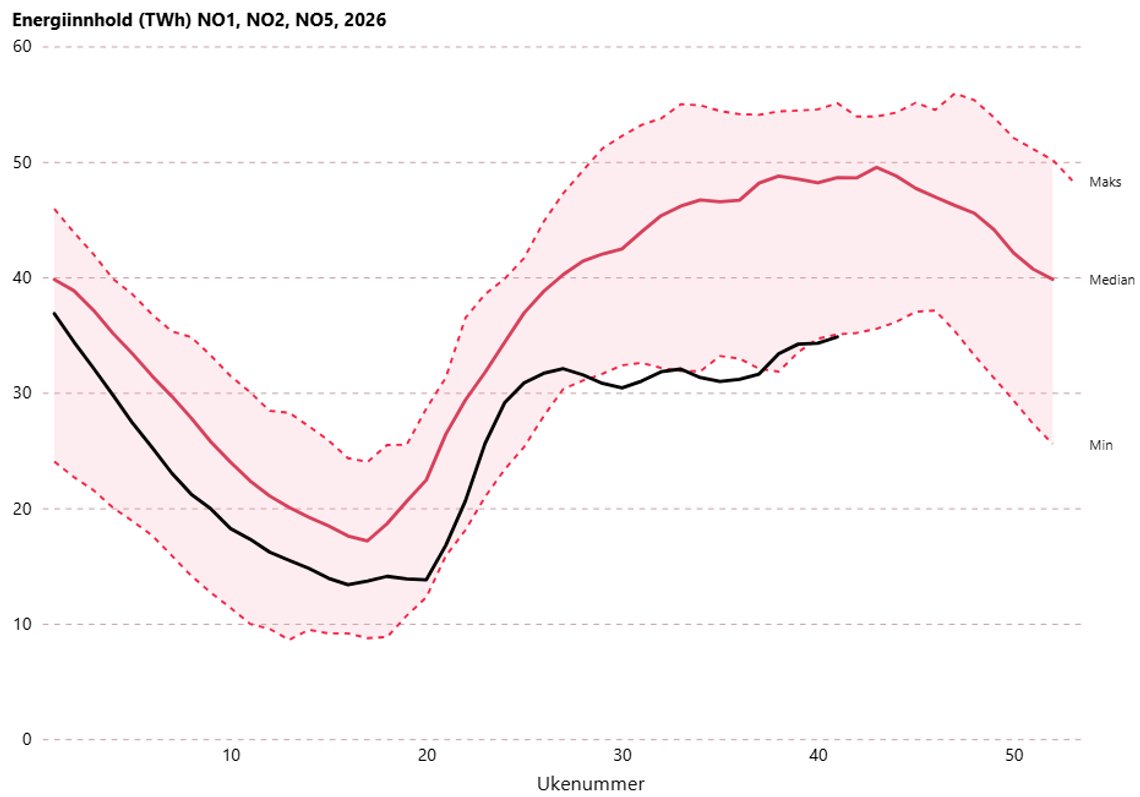
Reservoir levels in southern Norway as at week 41. The red line indicates the median level. The solid black line shows the fill level for the year. Source: NVE
In the current situation, with reservoir levels as at week 41 which is 14 TWh below the median, an export ban would have been introduced long ago. The shortfall in the reservoirs in the south is equivalent to half a year’s consumption by households in Southern Norway. This amount was exported last year at a bargain price, even though there was ample storage capacity in the reservoirs.
Electricity prices in Southern Norway are heading towards a new record. In Kristiansand, the price has exceeded 1.80 kroner per kWh. This is due to record-low levels in the reservoirs.


