



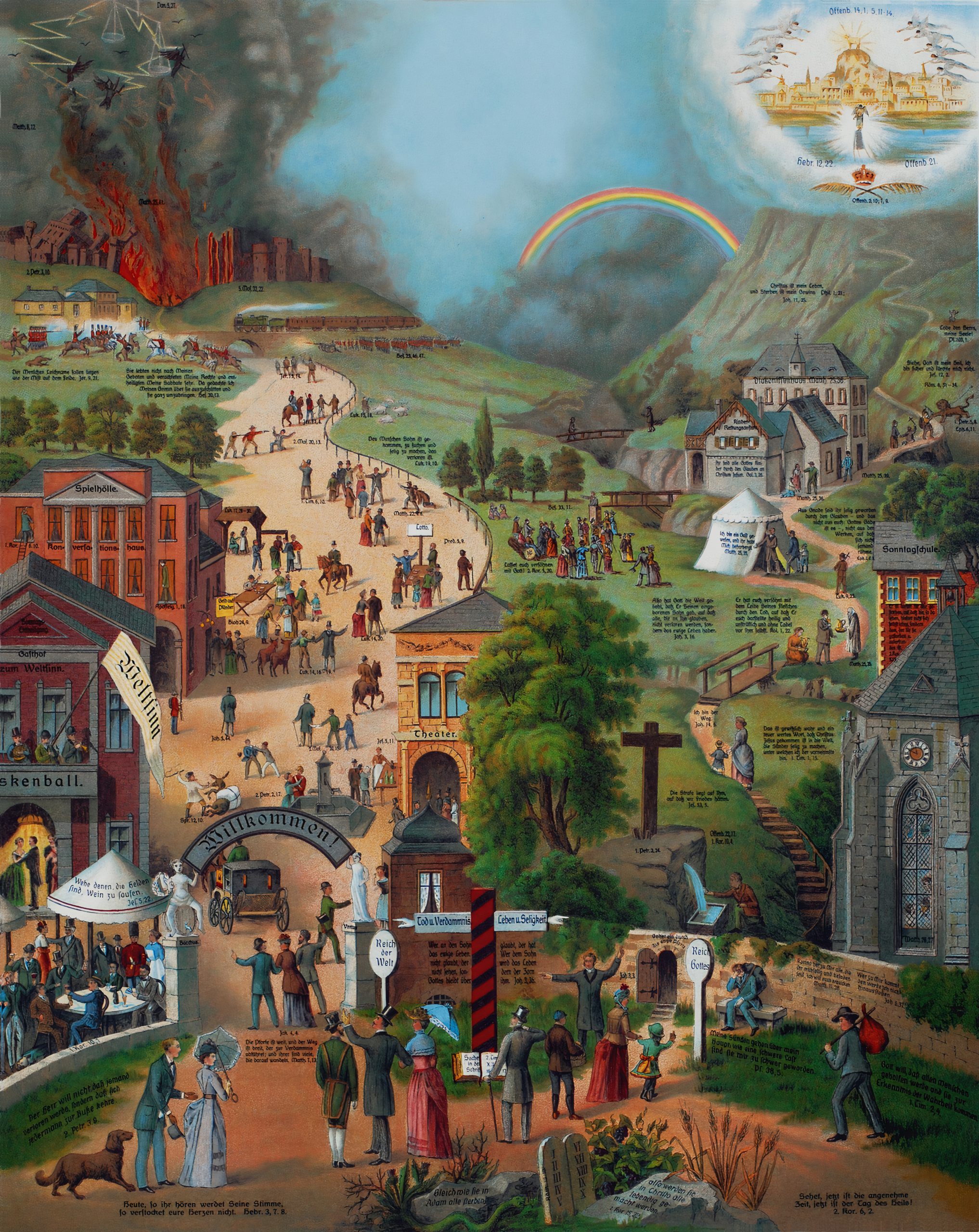
A modern poster version of ‘The Broad Way and the Narrow Path’ by Charlotte Reihlen and Paul Beckmann. Based on Mark 7:13–14, where Jesus illustrates the same point as in today’s text.
22 On his journey to Jerusalem, Jesus went from town to town and from village to village, teaching.
23 Then someone asked, ‘Lord, will only a few people be saved?’ He said to them: 24 ‘Strive to enter through the narrow gate! For I tell you, many will try to enter, but will not succeed. 25 Once the master of the house has got up and shut the door, and you are standing outside knocking and saying, ‘Lord, open the door for us’, he will reply, ‘I do not know where you come from.’ 26 Then you will say, ‘But we ate and drank with you, and you taught in our streets.’ 27 But he will reply, ‘I do not know where you come from. Depart from me, all you who practise injustice!’ 28 There you will weep and gnash your teeth when you see Abraham, Isaac and Jacob, and all the prophets, in the kingdom of God, whilst you yourselves are thrown out. 29 People will come from the east and the west, and from the north and the south, and will take their places at the feast in the Kingdom of God. 30 Then some who are last will be first, and some who are first will be last.’
Luke 13:22–30
Today’s Sunday service has a theme we do not necessarily like to talk about: our need to acknowledge responsibility for our actions and our need for forgiveness.
But I would like us also to see the positive side of this requirement. For it reveals one of the treasures of Christianity: our free will and our understanding of right and wrong. Both at an individual and a societal level. Our free will is a prerequisite for love, moral action and the possibility of repentance. It is precisely because human beings are not merely cogs in a larger system that repentance and forgiveness make sense.
The Day of Repentance and Prayer is therefore a Sunday with a dual message: humankind must acknowledge its responsibility for the society it has created, whilst at the same time recognising that it is not itself master of all things. We need both repentance and prayer because we are both guilty and dependent on a power and wisdom that lie beyond ourselves.
On a day like this, given what we are witnessing in Europe, I believe it is appropriate to focus on what we are doing with our society, and the responsibility we bear. And particularly with regard to our leadership.
Repentance is more than simply regretting individual actions. It is acknowledging that we may have strayed from the right path, both as individuals and as a society. We may have done wrong, neglected our duties or put ourselves first at the expense of others.
Christianity provides us with a standard that transcends our own desires and judgements, even for the leaders of nations. Yet there is much to suggest that they have forgotten this. All too often, they seem to treat their own judgements as sufficient justification for their actions, without asking whether their decisions are in accordance with a moral standard that stands above themselves.
This is not merely a theological question, but also a fundamental question for democracy. Tocqueville warns against democracy making the will of the majority the supreme authority. He argues that freedom is threatened if political power is not subject to limits that can restrain it. In *Democracy in America*, he writes that only God can be omnipotent without danger, because his wisdom and justice are commensurate with his power. No human authority can lay claim to such perfection.
Tocqueville highlights a crucial question that is extremely relevant to our own time: What is to check power if power itself is allowed to define what is right? Tocqueville emphasises that no human authority should have unlimited power, and links this to the realisation that God’s wisdom and justice cannot be compared with man’s limited judgement.
European politics illustrates his point. When political leaders regard their own judgements as the ultimate yardstick for what is right, it becomes more difficult to acknowledge that they themselves may be fundamentally mistaken. This also erodes some of the foundation for repentance: the realisation that there is a truth and a justice that transcend ourselves.
Repentance is therefore not primarily self-contempt, but the recognition of truth. We must dare to see ourselves and society as we actually are, not just as we wish to present ourselves.
But this Sunday is not just about acknowledging our own faults; it is also about prayer. And asking God for help when we are in difficulty expresses a fundamental realisation that we cannot manage everything on our own.
Questions about the meaning of life, the ultimate value of human beings, or what makes a good society, presuppose a spiritual revelation. We should therefore be concerned about what leaders who reject this revelation might lead us to do.
Winston Churchill was not known for his Christian faith, but he initiated a national day of prayer in Britain in May 1940, shortly after becoming Prime Minister. The country had a long tradition of such days, and Winston Churchill understood their significance. On Sunday 26 May 1940, in the midst of the dramatic military crisis that led to the evacuation of British and French soldiers from Dunkirk, a national day of prayer was therefore organised.
On Sunday 26 May 1940, people gathered in churches across the UK to pray for the soldiers and the country’s future. A service was also held at Westminster Abbey.
Churchill thus understood the importance that prayer and religious gatherings could have in maintaining the population’s courage and unity. He understood the need for humility in the face of the immense challenges Britain was facing, and the moral strength that faith gave the people.
It is therefore important that the Day of Repentance and Prayer is not reduced to a purely private, religious act.
The Bible also addresses people and nations. The prophets of the Old Testament criticise societies that practise injustice, oppress the weak or believe that religious ceremonies can replace justice.
This gives the Day of Repentance and Prayer a social dimension. We must ask whether our institutions promote justice. This does not mean that the major problems facing Europe are an expression of God’s punishment; quite the contrary. Europe’s problems are a direct result of a political leadership that sees itself as the source of morality and believes it can create heaven on earth. The problem is that this leadership, in its spiritual blindness, fails to understand that evil is also a spiritual reality.
Europe cannot be saved until our leaders acknowledge their responsibility for the situation in which the continent finds itself; but to do so, they must recognise that they too are subject to the justice that God shows us. They must quite simply abdicate as the source of morality, step down from the throne and ask God for forgiveness.
There is little reason to believe that this will happen, but we are allowed to hope, and we are allowed to pray.


