

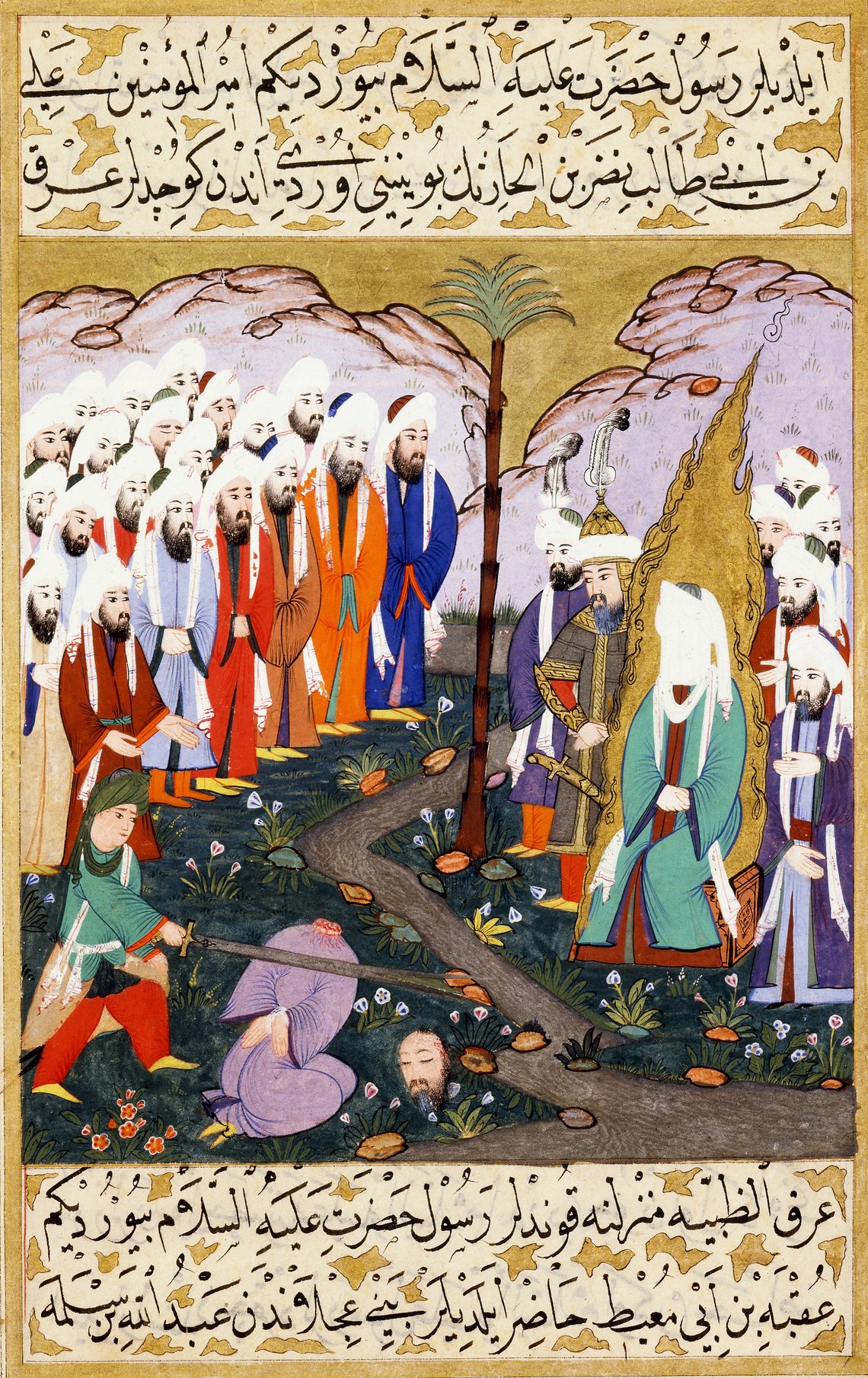


Muhammed was a white man who owned black slaves
Muhammed was an Arab man who is described as white. Muhammad is also described as an excellent example and as having great moral character, while Muslims are instructed to accept what Muhammad gives them and refrain from what he prohibits (Surahs 33:21, 68:4, 33:36, and 59:7).
Muhammad had around 11 wives, had sex slaves, married a six-year-old girl despite being 54 years old himself, and owned Black slaves. These facts are relatively well known. What is less well known is that, according to Islamic sources, Muhammad is described as a white man who owned Black slaves.
Was Muhammed a White Man?
Hadith al-Bukhari, Vol. 1, Book 3, No. 63
While we were sitting with the Prophet in the mosque, a man came riding on a camel. He made his camel kneel . . . then said: “Who amongst you is Muhammad?” At that time the Prophet was sitting amongst us (his companions) leaning on his arm. We replied, “This white man reclining on his arm.”
Hadith al-Bukhari, Vol. 4, Book 56, No. 744
“I saw the Prophet, and Al-Hasan bin Ali resembled him.” I said to Abu-Juhaifa, “Describe him for me.” He said, “He was white and his beard was black with some white hair.”
Hadith al-Bukhari, Vol. 2, Book 17, No. 141
“The Prophet never raised his hands for any invocation except for that of Istisqa’ and he used to raise them so much that the whiteness of his armpits became visible.”
Hadith al-Bukhari, Vol. 1, Book 8, No. 367
“When Allah’s Apostle invaded Khaibar, we offered the Fajr prayer there yearly in the morning when it was still dark. The Prophet rode and Abu Talha rode too and I was riding behind Abu Talha. The Prophet passed through the lane of Khaibar quickly and my knee was touching the thigh of the Prophet. He uncovered his thigh and I saw the whiteness of the thigh of the Prophet.”
Hadith al-Bukhari, Vol. 2, Book 17, No. 122
“I heard Ibn ‘Umar reciting the poetic verses of Abu Talib: And a white (person) (i.e. the Prophet) who is requested to pray for rain.”
Will Durant wrote in The Age of Faith (1950)
“Mohammed lived with Khadija . . . She bore him some daughters, of whom the most famous was Fatima, and two sons who died in infancy. He consoled his grief by adopting Ali, the orphan son of Abu Talib . . . Ali, who married Fatima, fondly describes his adoptive father at forty-five as of middle stature, neither tall nor short. His complexion was rosy white; his eyes black; his hair, thick, brilliant, and beautiful, fell to his shoulders.”
Did Muhammed have black slaves?
Hadith al-Bukhari, Vol. 9, Book 91, No. 368
“I came and behold, Allah’s Apostle was staying on a Mashroba (attic room) and a black slave of Allah’s Apostle was at the top of its stairs. I said to him, “(Tell the Prophet) that here is ‘Umar bin Al-Khattab (asking for permission to enter).” Then he admitted me.
Syrian Islamic jurist, Ibn Qayyim al Jawiyya (1292-1293), wrote in Zad al-Ma’ad (part 1, page 114, 116, 160), of Mohammed’s Black slaves, Bilal, Abu Hurairah, Usamah Ebn Zaayed, Rabbah, and stated
“Muhammad had many male and female slaves. He used to buy and sell them, but he purchased more than he sold, especially after God empowered him by his message, as well as after his immigration from Mecca. He once sold one black slave for two. His name was Jacob al-Mudbir.”
Hadith al-Bukhari, Vol. 9, Book 89, No. 256
Allah’s Apostle said, “You should listen to and obey, your ruler even if he was an Ethiopian (black) slave whose head looks like a raisin.”
Hadith al-Bukhari, Vol. 4, Book 52, No. 137
The Prophet said, “Let the black slave of Dinar perish. And if he is pierced with a thorn, let him not find anyone to take it out for him . . . If he [the black slave] asks for anything it shall not be granted, and if he needs intercession [to get into paradise], his intercession will be denied.”
As a comparison, Jesus Christ was most likely a brown-skinned Middle Eastern Jewish man. He had no wife, no children, no sex slaves, and no slaves. Instead, his message emphasized serving others, sexual purity, faithfulness in marriage, and caring for the vulnerable.
Islamic History and Slavery
It might not be a surprise that Islamic and Arab countries built upon Muhammeds teachings, in particular, were so late to abolish slavery, often under significant pressure from the West. England abolished the slave trade in 1807 and slavery throughout England and its colonies in 1833 which controlled much of the world. The birthplace of Muhammad, along with many other Islamic countries, was late in abolishing slavery:
Saudi Arabia abolished slavery in 1962.
Oman abolished slavery 1970.
Mauritania abolished slavery in 1981.
In addition to this, according to Peter Hammond in his book Terrorism, Slavery and Islam, the Middle East was responsible for approximately 28 million slaves. This is probably a high estimate, and other historians would place the figure closer to 18 million. In comparison, transatlantic slave trade slave trade world was responsible for approximately 12.5 million slaves through the transatlantic slave trade. The Islamic slave trade lasted longer.
Another difference is that Islamic slave traders often castrated Black male slaves, which may help explain why there are fewer descendants of enslaved Black men in the Middle East. It was also more common in Islamic societies for female slaves to be the majority of slaves, and be used for sexual exploitation and in harems, whereas the Atlantic slave trade generally transported more men because of the demand for labor. The United States, specifically, was responsible for only a relatively small share of the transatlantic slave trade (4%).
Luke 4:18-19,
Jesus said, “The Spirit of the Lord is upon me, because he has anointed me to proclaim good news to the poor. He has sent me to proclaim liberty to the captives and recovering of sight to the blind, to set at liberty those who are oppressed, to proclaim the year of the Lord’s favor.”
Regardless of people’s personal beliefs, the founder of a religion matters. People follow his teachings, and history, civilizations, and our lives are deeply influenced by them even today. Ultimately, it is a question of freedom or slavery.
Sources
– Federer, William. What Every American Needs to Know about the Qur’an – A History of Islam & the United States (pp. 66-67). (Function). Kindle Edition.
– Hadith
– Peter Hammond, Islam, Terrorism and Slavery


